RoutinesAges 7–17
Skincare by Age: What Kids Need at 7, 8, 9… up to 17
A year-by-year guide from 7 to 17: what's changing in your child's skin, the routine that fits, and what can wait.

Quick answer
Skincare can start at 7: sunscreen before outdoor time and a gentle wash after sweaty days. Around 9 to 11, as oil and sweat rise, most children need a gentle face wash, light moisturiser and daily sunscreen. From 12 to 17 those three steps continue, with acne products only on a dermatologist's advice. Retinol, acids and vitamin C can wait.
Skincare by age is simpler than social media makes it look. From 7 to 17, children need the same three basics: a gentle face wash, a light moisturiser and sunscreen. What changes with age is how often they use them and what they're dealing with, from sweaty playground days at 7 to pimples and shaving at 16.
This guide is for Indian parents who want a clear, year-by-year answer. Start with the summary table, then jump to your child's age. Each section ends with a link to our most detailed guide for that age.
What age should kids start skincare?
Sun protection comes first and starts early; a simple daily routine usually begins somewhere between 8 and 11. The trigger is what your child's skin is doing, not their birthday.
- Sunscreen: from early childhood. The Indian Sunscreen Forum's 2025 consensus recommends a broad-spectrum sunscreen of at least SPF 15 for children over six months. It prefers mineral (inorganic) filters such as zinc oxide and titanium dioxide for children. The American Academy of Dermatology (AAD) suggests SPF 30 or higher for tweens.
- Face wash: when the face gets sweaty, grimy or oily, or once daily sunscreen needs washing off at night. Our guide to face wash for kids covers when and how.
- Moisturiser: when skin feels dry or tight, and as a daily step once your child washes their face regularly.
Puberty is the big shift. KidsHealth (Nemours) says most girls start puberty between 8 and 13 and most boys between 9 and 14. The American Academy of Pediatrics (AAP) adds that skin oil can rise up to two years before other signs of puberty. That's why many families move from "sunscreen, and a wash when needed" to a daily routine at around 9 to 11. For the full picture on sun protection, see our parent's guide to sunscreen for kids in India.
What does skincare look like at each age from 7 to 17?
The three basics stay the same; what changes is how often, and what to watch for. Here's the whole picture at a glance.
| Age | What's changing | Routine | Skip for now |
|---|---|---|---|
| 7 | Skin still childlike, with little oil; lots of outdoor play | Sunscreen before outdoor time; gentle wash after sweaty days; moisturiser if dry | Adult face washes, scrubs, "glow" products |
| 8 | Puberty can begin in some girls; swimming and sport | Same, with your child learning to apply sunscreen | Retinol, acids, de-tan packs |
| 9 | Oil can rise before other puberty signs; bumps around the nose | Evening face wash, light moisturiser, sunscreen on school days | Toners, scrubs, serums |
| 10 | Oilier skin, the odd pimple, interest in skincare videos | Three steps daily: cleanse, moisturise, protect | Retinol, AHAs and BHAs, vitamin C, anti-ageing creams |
| 11 | Sweat, an oilier T-zone, first spots, prickly heat | Wash twice a day plus after sport; sunscreen in the school bag | Scrubs, borrowed adult acne products |
| 12 | Social-media skincare requests; first pimples | Same three steps; one new product at a time | Multi-step routines, active serums |
| 13 | More oil, blackheads and pimples | Twice-daily wash, light non-comedogenic textures, sunscreen | Stacking acne products, steroid creams |
| 14 | Sports gear and sweat; first makeup for some | Same three steps; wash after training | Pore-clogging makeup, sharing brushes |
| 15 | Exam stress; acne may persist | Same routine; dermatologist for stubborn acne | Steroid or "mixed" creams from the chemist |
| 16 | Shaving; acne can affect mood | Same routine plus careful shaving | Dry shaving, picking |
| 17 | Near-adult skin; more independence | Same three steps, fully self-run | Anti-ageing products, 10-step routines |
Skincare for a 7-year-old
A 7-year-old needs sunscreen before outdoor time, a gentle face wash after sweaty or dusty days, and moisturiser only if their skin feels dry. There's no need for a daily routine or special products yet.
At 7, skin is still childlike, with little of the extra oil that comes with puberty. The job is protecting it during morning assembly, PT and play. The Indian Sunscreen Forum prefers mineral sunscreens for children and advises reapplying every two hours outdoors, or sooner after sweating or swimming.
This is the age to start habits, not a regimen. Show your child how to dot sunscreen on the forehead, cheeks, nose and chin and blend it outwards, then let them try while you check the ears and neck. Skip adult products, scrubs and makeup.
If you notice signs of puberty at 7, such as body odour, body hair or breast development, talk to your paediatrician: the NHS says signs before 8 could mean early puberty. More in our hub on skincare for kids aged 7–9 and our guide to sunscreen for 7 to 9-year-olds.
The day-by-day plan, for girls and boys alike, is in our skincare routine for a 7 or 8-year-old.
Skincare for an 8-year-old
An 8-year-old needs the same light-touch care as a 7-year-old: sunscreen for outdoor time, a gentle wash after sweaty days, and moisturiser when skin is dry. The difference at 8 is that some children, especially girls, begin to show the first signs of puberty.
KidsHealth says most girls start puberty between 8 and 13, and body odour usually starts between 8 and 13 in girls and 9 and 14 in boys. A daily bath, especially after sweaty days or in hot weather, plus clean clothes, underwear and socks each day, usually handles it. Our guide to body odour and a first deodorant explains when a deodorant makes sense.
Eight is often the age of swimming classes and longer sports practice. The AAD suggests showering with fresh, clean water straight after the pool, then moisturising. Put sunscreen on before swimming and again after towel drying. Keep skipping adult actives, face scrubs and de-tan packs.
See our hub on skincare for kids aged 7–9 and sunscreen for a 9-year-old (and 7 to 8-year-olds).
For the full plan, including eczema and sun at school, see our skincare routine for a 7 or 8-year-old.
Skincare for a 9-year-old
A 9-year-old usually needs a gentle face wash in the evening, a light moisturiser, and sunscreen on school days. For many children, 9 is when "only when needed" starts to become a daily habit.
The reason is oil. The AAP says oil production can rise up to two years before other signs of puberty, and that boys and girls as young as 9 may have small bumps and bigger-looking pores around the nose and the middle of the face. Most boys start puberty between 9 and 14, so body odour may start in boys too.
Keep it simple: wash with fingertips and lukewarm water, pat dry, moisturise, and put sunscreen on before school. Don't squeeze the first bumps. This is also when many children notice skincare videos. A 2025 study in Pediatrics describes girls as young as 7 demonstrating multi-step routines online. Skip toners, scrubs and "glow" serums.
More in our hub on skincare for kids aged 7–9 and our guide to sunscreen for a 9-year-old.
The full plan, from a first face wash to sweat and sport, is in our skincare routine for a 9-year-old.
Skincare for a 10-year-old
A 10-year-old needs three steps every day: a gentle cleanser, a light moisturiser and a broad-spectrum sunscreen with SPF 30 or higher. That's the routine the AAD recommends for tweens in its October 2025 guide.
At 10, skin often starts to feel oilier and the odd pimple appears. The AAD notes that washing once, in the evening, may be enough if skin is dry or sensitive; otherwise twice a day suits most children. The AAP (2025) lists what to avoid in a cleanser: sulfates, alcohols, fragrances and physical scrubs.
Ten is a good age to hand the routine over. Pair skincare with brushing teeth and agree that only one new product is added at a time, as the AAD suggests. Skip retinol, exfoliating acids (AHAs and BHAs), vitamin C serums and anti-ageing creams. The AAD says these target "wrinkles, sun damage, and uneven skin tone, issues that children don't have".
Our full plan is in skincare routine for a 10-year-old, and our hub on skincare for tweens (10–12) covers the wider age band.
Skincare for an 11-year-old
An 11-year-old needs the same three steps, usually with a face wash twice a day plus after sport. Early puberty brings more sweat, an oilier T-zone (forehead, nose and chin) and the first spots.
The AAD advises washing no more than twice a day, plus after sweating, with fingertips and lukewarm water. Indian summers and monsoons add prickly heat (heat rash). The NHS says it's usually caused by sweating a lot and generally settles on its own after a few days; loose cotton clothes and keeping cool help. Blot sweat with a clean handkerchief rather than wiping it, because the AAD says wiping can irritate skin and lead to breakouts.
Sunscreen becomes a school-bag habit: on at home in the morning, topped up before games and after sweating. Keep hair oil off the forehead, keep hands off spots, and skip scrubs, acids and borrowed adult acne products.
Read our skincare routine for an 11-year-old for a full school-day plan.
For girls, our guide to skincare for an 11 or 12-year-old girl covers period pimples, makeup and kajal.
Skincare for a 12-year-old
A 12-year-old needs a gentle face wash morning and night, a light moisturiser and daily sunscreen, and no serums, retinol or acids. Many 12-year-olds are also asking for the products and routines they see online.
The July 2025 Pediatrics study looked at 100 TikTok routines by creators aged 7 to 18. They averaged six products and about US$168 per routine, only 26.2% included sunscreen, and the 25 most-viewed videos contained an average of 11 potentially irritating active ingredients. A February 2026 viewpoint in the Indian Journal of Dermatology, Venereology and Leprology calls it the "digital dermatosis" and lists rashes from irritation and allergy among the risks.
The kindest approach is a swap, not a flat no. Let your 12-year-old choose their own face wash, moisturiser and sunscreen from a shortlist, and explain, as KidsHealth suggests, that some creators are paid to show products. First pimples are common now: wash gently, don't pick, and give changes a few weeks.
Our skincare routine for a 12-year-old covers the trends to skip and how to say no kindly.
For a daughter starting her periods, see skincare for an 11 or 12-year-old girl; for choosing a cleanser, see face wash for a 10 to 12-year-old.
Skincare for a 13-year-old
A 13-year-old needs the same three basics, with textures chosen for oilier skin: a gentle cleanser twice a day, a light non-comedogenic moisturiser, and sunscreen every morning. What changes at 13 is oil, blackheads and pimples.
The AAP says around 85% of people have acne as teens, and that acne comes from oil and bacteria inside the skin, not dirt. What helps: gentle twice-daily washing, washing after sweating, hands off, and keeping hair oil off the forehead. The AAD says acne from hair products can take 4 to 6 weeks to clear once the product is stopped.
If pimples keep coming, the AAD's 2025 guide says teens may benefit from an acne ingredient such as salicylic acid or benzoyl peroxide, while keeping skin moisturised and protected from the sun. Both can dry and irritate the skin, so it's worth asking a dermatologist which product suits your teen. The AAD says a treatment that works should show some improvement in 4 to 6 weeks.
Our skincare routine for a 13-year-old and pimples at 13 go further.
For a son, our guide to skincare for teenage boys covers sweat, helmets and the first shave.
Skincare for a 14-year-old
A 14-year-old needs the three basics plus a quick face wash after sport or training. At 14, many teens are playing more competitive sport, and some are starting to wear makeup.
Cricket helmets, chin straps and tight kit trap heat and sweat against the skin. The AAD calls the resulting rough bumps acne mechanica, and suggests clean, soft padding between gear and skin, moisture-wicking clothes, and loose-fitting clothes instead of tight ones. Wash caps, headbands and sweaty kit before wearing them again, and reapply sunscreen after training.
If your teen wears makeup, the AAD suggests products labelled oil-free, won't clog pores or non-comedogenic; removing all makeup, including eye makeup, before bed; and cleaning brushes every week without sharing them.
See our skincare routine for a 14 or 15-year-old and our guide to sunscreen for teenagers in India.
Skincare for a 15-year-old
A 15-year-old needs the same simple routine, a dermatologist if acne is stubborn, and a firm rule against steroid creams on the face. For many Indian teens, this is also board-exam season.
Stress shows on skin. The AAP says stress doesn't cause acne, but that studies show teenagers tend to have worse acne when school is stressful; regular exercise, sleep and supportive relationships help.
A common wrong turn in India is a cream from the chemist. In a study across 12 Indian dermatology centres, published in IJDVL in 2011, 433 of 2,926 patients with facial skin problems were using steroid creams on the face. For 59.3%, a non-doctor had suggested it (a friend, relative, pharmacist or beautician), acne was among the most common reasons, and 90.5% had side effects, most often acne. No cream goes on the face unless a doctor prescribed it for that purpose.
Read steroid creams on your child's face and our skincare routine for a 14 or 15-year-old.
Skincare for a 16-year-old
A 16-year-old needs the same three steps, with a few grown-up additions: shaving care for some, and attention to how acne affects their mood. Most 16-year-olds can manage their skin almost entirely on their own.
For teens who shave, the AAD suggests wetting the skin and hair first, using a shaving cream or gel, shaving in the direction the hair grows, rinsing the blade after each swipe, and changing the blade, or throwing away a disposable razor, after 5 to 7 shaves.
Acne can weigh on teenagers. The AAD notes that many studies have linked acne with depression, anxiety or both, and suggests watching for sadness that lasts two weeks or longer. It also describes teens who felt daily reminders were nagging and used their acne treatment less often, so focus on appointments rather than daily comments, and give your teen some time alone with the dermatologist.
See our skincare routine for a 16 or 17-year-old and our guide to face wash for teenagers in India.
Skincare for a 17-year-old
A 17-year-old's skin is close to adult skin, but the best routine is still the simple one: a gentle cleanser, a light moisturiser and daily sunscreen. There's no need to jump to anti-ageing products or 10-step routines.
Seventeen is about independence. Your teen may be commuting to coaching classes, preparing for college or travelling alone, so a routine that fits in a bag matters more than a long one. Sunscreen stays essential: brown skin still tans, and the Indian Sunscreen Forum notes that pigmentation triggered by visible light lasts longer in darker skin tones. The same consensus says most people apply far less sunscreen than the amount used in testing, which greatly reduces protection, so apply generously.
If acne continues, a dermatologist is still the right person to decide on stronger treatment. As the AAD's 2025 guide puts it, skincare "doesn't have to be complicated to be effective". See our skincare routine for a 16 or 17-year-old and our hub on skincare for teens (13–17).
When should you see a doctor?
At any age, see a paediatrician or dermatologist if a skin problem is painful, spreading, scarring or not settling. Specific signs to watch for:
See a doctor if:
- signs of puberty appear before 7 in a girl or 9 in a boy (KidsHealth), or before 8 in any child (NHS)
- body odour starts before 7 or 8 in a girl, or before 9 in a boy (KidsHealth)
- a heat rash doesn't improve after a few days (NHS)
- a product causes redness, burning, peeling or a rash that doesn't settle once you stop it, or skin keeps reacting to over-the-counter products (AAD)
- pimples are deep, painful or cyst-like, are leaving dark marks or scars, or haven't cleared with non-prescription care (AAD)
- anyone has been applying a steroid or "mixed" cream to your child's face
- acne is affecting your teen's mood, with sadness that lasts two weeks or more (AAD)
There's good news too: the AAD says that, thanks to advances in treatment, virtually every case of acne can be successfully treated.
Read next: best skincare for kids in India: ado and 9 other brands · every ado ingredient, explained
How ado fits in
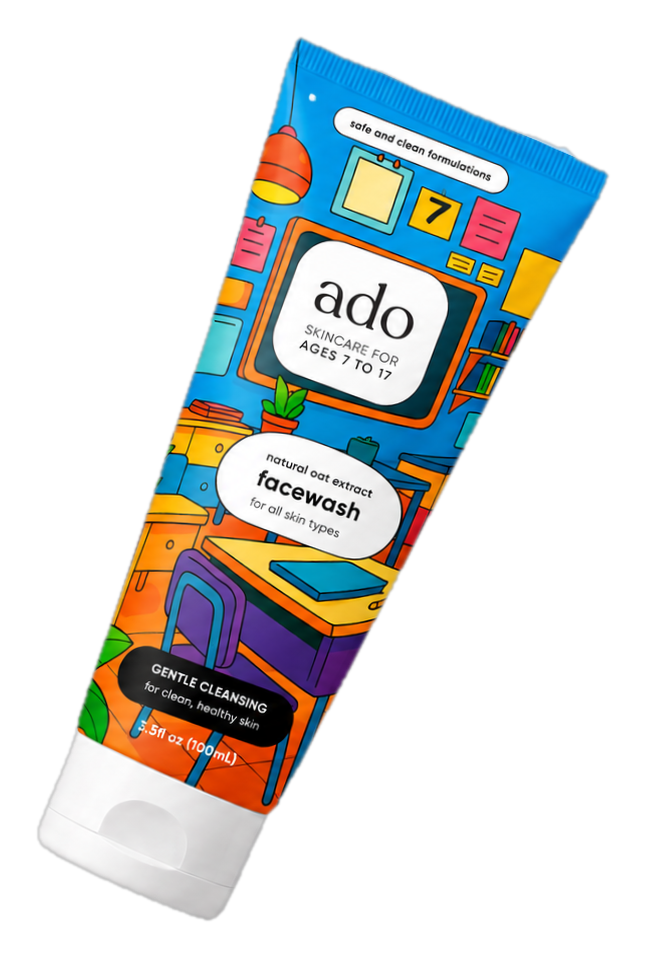
ado is an Indian skincare brand made for kids, tweens and teens aged 7–17: a gentle oat face wash, a moisturiser and a zinc oxide SPF 50+ sunscreen. It's one routine for the whole age range, so the steps your 8-year-old learns are the ones they'll still use at 16.
The face wash is sulfate-free, dye-free and non-comedogenic, and the lightweight moisturiser is pH-balanced. ado's mineral SPF 50+ sunscreen is broad-spectrum (UVA/UVB) and non-comedogenic, with zinc oxide as its only UV filter. There's oat in every step, each tube is 100 mL, full ingredient lists are on every product page, and there are no retinoids, exfoliating acids or vitamin C serums. All three come together in ado's Tween's Kit.
ado's products contain fragrance (it's the last ingredient on each label); if your child's skin is sensitive, patch-test first or choose a fragrance-free option. It's gentle daily care, not an acne treatment, so for pimples that aren't settling, see a dermatologist.
Made for growing skin

The complete routine
Tween's Kit
The complete ado routine in one box: cleanse, moisturise, protect.
- Cleanse Facewash
- Hydrate Moisturiser
- Protect Sunscreen
Price
₹2,699Regular price
₹3,297
Save ₹598

ado mineral sunscreen (SPF 50+)
Price ₹1,499
Sources
- Practical Recommendations for Indians on Sunscreen Use: A Modified Delphi Consensus by Indian Sunscreen Forum (PRISM-ISF), J Cosmet Dermatol 2025 · Journal of Cosmetic Dermatology (PMC)
- A dermatologist's guide to skincare from growing up to glowing up (28 Oct 2025) · American Academy of Dermatology
- Understanding Puberty (reviewed May 2022) · KidsHealth (Nemours)
- Food and Adolescent Acne · American Academy of Pediatrics / HealthyChildren.org
- Early or delayed puberty · NHS
- Deodorant Use for Kids and Teens (reviewed June 2022) · KidsHealth (Nemours)
- 12 summer skin problems you can prevent · American Academy of Dermatology
- Pediatric Skin Care Regimens on TikTok (Hales et al., Pediatrics, July 2025; PubMed record) · Pediatrics / American Academy of Pediatrics
- Trendy Skin Care for Tweens & Teens: Is It Safe? (updated 7 Aug 2025) · American Academy of Pediatrics / HealthyChildren.org
- Face washing 101 · American Academy of Dermatology
- Heat rash (prickly heat) (reviewed 9 May 2024) · NHS
- The digital dermatosis: social media's unintended impact on pre-adolescent skincare (viewpoint, 23 Feb 2026) · Indian Journal of Dermatology, Venereology and Leprology
- Is It OK for My Child to Use Skin Care Products? (reviewed April 2024) · KidsHealth (Nemours)
- Teen Acne: How to Treat & Prevent This Common Skin Condition (updated 3 Apr 2025) · American Academy of Pediatrics / HealthyChildren.org
- Are your hair care products causing breakouts? · American Academy of Dermatology
- 9 things to try when acne won't clear · American Academy of Dermatology
- Is sports equipment causing your acne? · American Academy of Dermatology
- I have acne! Is it okay to wear makeup? · American Academy of Dermatology
- Topical corticosteroid abuse on the face: a prospective, multicenter study of dermatology outpatients (Saraswat et al., 2011) · Indian Journal of Dermatology, Venereology and Leprology
- Hair removal: How to shave · American Academy of Dermatology
- 5 ways to help your teenager survive acne · American Academy of Dermatology
This guide is general information for parents, not medical advice. If you're worried about your child's skin, please see a dermatologist or paediatrician. How we write these guides.