RoutinesAges 10–12
Skincare Routine for a 12-Year-Old: What They Need, What to Buy, What to Skip
Serums, acids and 10-step videos: what a 12-year-old's skin really needs, what doctors say to skip, and how to say no kindly.

Quick answer
A 12-year-old needs three steps: a gentle face wash morning and night, a light moisturiser, and a broad-spectrum sunscreen (SPF 30 or higher) every morning. Skip retinol, exfoliating acids, vitamin C serums and multi-step routines from social media; dermatologists say they target adult skin concerns and can irritate younger skin. See a doctor for painful or scarring pimples.
A 12-year-old needs a short, simple skincare routine: a gentle face wash morning and night, a light moisturiser, and a broad-spectrum sunscreen (SPF 30 or higher) every morning. They don't need retinol, exfoliating acids, vitamin C serums or the multi-step routines trending on social media.
This guide is for Indian parents of 11 to 13-year-olds, especially if your child has started asking for serums they've seen online. It covers the daily routine, what to skip and why doctors say so, how to say no without a fight, and what to do about first pimples, sweat and sport.
What skincare does a 12-year-old actually need?
Three steps: cleanse, moisturise, protect. That's what the American Academy of Dermatology (AAD) recommends for tweens in its October 2025 guide, and the American Academy of Pediatrics (AAP) sets out the same three steps in its August 2025 advice on trendy skincare.
- Cleanse: a gentle face wash (or "facewash") without scrubbing beads, alcohol or harsh sulfates such as sodium lauryl sulfate (SLS). The AAP lists sulfates, alcohols, fragrances and physical scrubs as things to avoid in a cleanser.
- Moisturise: a light moisturiser (or moisturizer). The AAP suggests one labelled non-comedogenic, which means it's made not to clog pores. Oily skin still needs it; a gel texture suits humid days.
- Protect: a broad-spectrum sunscreen with SPF 30 or higher every morning, as the AAD advises. SPF (sun protection factor) measures protection from UVB, the rays that burn. Broad-spectrum means UVA, which tans skin, is covered too.
KidsHealth (Nemours) puts it simply: most kids and teens need just three skin care products. Or, as the AAD's dermatologist says, skincare "doesn't have to be complicated to be effective".
Girls and boys need the same basics. If your child's skin is dry or sensitive, the AAD notes that washing once, in the evening, may be enough.
What does a 12-year-old's routine look like, morning and night?
About two minutes in the morning and one at night. Here's the whole plan.
| When | Step | What to use | Time |
|---|---|---|---|
| Morning | 1. Cleanse | Gentle face wash, lukewarm water, fingertips | 30 seconds |
| Morning | 2. Moisturise | A thin layer of light moisturiser | 20 seconds |
| Morning | 3. Protect | Broad-spectrum sunscreen, SPF 30 or higher, applied generously as the last step | 1 minute |
| After sport | Rinse or wash | Same face wash; reapply sunscreen if heading back outdoors | 1 minute |
| Night | 1. Cleanse | Same face wash, to remove sunscreen, sweat and dust | 30 seconds |
| Night | 2. Moisturise | Same moisturiser | 20 seconds |
A few habits make it work:
- Wash with fingertips and lukewarm water, then pat dry. The AAD says scrubbing irritates skin, and advises washing no more than twice a day, plus after sweating.
- Put sunscreen on at home, before the school bus. Dot it on the forehead, cheeks, nose and chin, then blend outwards. Include the ears and the back of the neck.
- Use enough. The Indian Sunscreen Forum's 2025 consensus notes that most people apply far less sunscreen than the amount used in testing, which "greatly reduces effectiveness".
- Reapply about every two hours outdoors, and after swimming, heavy sweating or wiping the face, as the same consensus advises.
For help choosing a sunscreen at this age, see our sunscreen checklist for 10 to 12-year-olds and the full parent's guide to sunscreen for kids in India.
Can a 12-year-old use serums, retinol or acids?
Mostly no. The AAD advises tweens to avoid retinol, vitamin C and exfoliating acids, because they target "wrinkles, sun damage, and uneven skin tone, issues that children don't have". The AAP adds serums with active ingredients to the list, unless a doctor has prescribed them.
What to skip for now:
- Retinol and other retinoids, often sold as anti-ageing serums or night creams.
- Exfoliating acids: AHAs such as glycolic and lactic acid, and BHAs such as salicylic acid, in toners, peels and serums.
- Vitamin C serums, and anything sold to fade spots or reverse ageing.
- Multi-step routines: toners, essences, several serums, mists and masks layered morning and night.
- Face scrubs: the AAP lists physical scrubs among things to avoid.
What about a "gentle" serum? Most 12-year-olds simply don't need one, because a plain moisturiser does the job with fewer ingredients. Niacinamide is a milder ingredient, and the AAP even lists it among good moisturiser ingredients for tweens and teens. Our guide on whether a 12-year-old can use niacinamide explains when it's fine, and skincare ingredients tweens should avoid has the full list.
One exception: acne. If pimples are persistent, a dermatologist may suggest an acne ingredient. That's a medical decision for a doctor, not a trend to copy.
Why do doctors say no to these skincare trends?
Because young skin reacts more easily, gains nothing from adult actives, and the routines trending online are long, costly and short on sunscreen. Four sources set this out clearly.
- Young skin is more easily irritated. The AAD's 2025 guide says children's skin is "thinner, more sensitive, and more prone to irritation than adult skin", and that these actives "can cause redness, burning, or peeling". The AAP adds a weakened skin barrier and long-term sensitisation or allergies to the risks.
- The routines online are heavy. A study in Pediatrics (July 2025) analysed 100 TikTok skincare videos by creators aged 7 to 18, which averaged 1.1 million views each. Routines used an average of 6 products costing about US$168, and only 26.2% of videos included sunscreen. The 25 most-viewed videos contained an average of 11, and up to 21, potentially irritating active ingredients.
- Allergens are common. Summarising that research, the AAP notes that nearly 76% of the 25 most-viewed videos promoted products with known allergens, such as artificial fragrance.
- An Indian journal has flagged it too. A February 2026 viewpoint in the Indian Journal of Dermatology, Venereology and Leprology (IJDVL) calls it the "digital dermatosis". It lists irritant and allergic contact dermatitis (rashes from products touching the skin), a damaged skin barrier and greater sun sensitivity among the risks, and describes "glass skin" as an unattainable goal that keeps people buying.
The Pediatrics authors concluded that these routines offer little to no benefit for the children they target. Your 12-year-old isn't missing out.
How do you say no to a skincare trend kindly?
Say yes to the interest and no to the product. Wanting a routine is a healthy instinct; your job is to steer it towards what young skin needs.
- Start with curiosity. Ask what they've seen and what they hope it will do. Often the real answer is "everyone has one", not a skin problem.
- Explain who's selling. KidsHealth suggests teaching children that some creators are paid, so a routine video is really a kind of advert.
- Offer a swap, not just a ban. Let your child choose their own face wash, moisturiser and sunscreen from a shortlist you're happy with, and give them a shelf for it.
- Agree on two house rules. The AAD suggests adding only one new product at a time. The AAP's rule is easy to remember: a product that stings or burns is a red flag, not a sign it's working.
- Talk about filters. Faces in videos are often filtered or edited. The AAP encourages parents to help children feel confident in their skin "without the filters, fads or 10-step routines".
- Talk about money. KidsHealth suggests chatting about what else that money could go towards.
| If your 12-year-old asks for… | Try saying yes to… |
|---|---|
| A retinol or vitamin C serum | A sunscreen they choose themselves and keep in their school bag |
| An exfoliating toner or peel | A gentle face wash they pick, used with fingertips |
| A 10-step routine | Their own 3-step routine, on their own shelf |
| A "glass skin" or glow product | A light moisturiser, and a chat about filters and editing |
For your 12-year-old: Your skin doesn't need fixing. Wash it, keep it comfortable and protect it from the sun. That's what dermatologists suggest at your age, and it's the routine plenty of adults wish they'd started earlier.
What about first pimples, sweat and sport?
Keep the same routine and add a few habits. Pimples are a normal part of growing up: the AAP says around 85% of people have acne as teens, and oil production can rise up to two years before other signs of puberty.
First pimples
- Wash gently up to twice a day and after sweating, as the AAD advises. The AAP explains that acne comes from extra oil and bacteria inside the skin, not dirt on top, so scrubbing harder doesn't help.
- Hands off. The AAD says touching the face can make acne flare, and that picking, popping or squeezing raises the risk of scars. On brown skin, the AAD notes that dark spots after acne can last much longer than the acne itself.
- Watch the hair oil. Oil from the hair can cause pimples along the forehead and hairline, so keep oiled hair off the face and wash it out regularly.
- Be patient. The AAD says it can take several weeks to a few months to see a difference.
Sweat and sport
- Blot sweat with a clean towel or handkerchief rather than wiping it. The AAD says wiping can irritate skin and lead to breakouts.
- Rinse or wash the face after cricket, football or a sweaty PE period, then reapply sunscreen if heading back out.
- Helmets and chin straps trap heat and sweat. The AAD calls the resulting bumps acne mechanica, and suggests clean, soft padding between gear and skin, plus moisture-wicking clothes.
- Wash caps, headbands and sweaty kit before wearing them again.
For more, read pimples at 13: what helps and what to avoid, and our guide to body odour and a first deodorant if sweat has started to smell.
When should a 12-year-old see a doctor?
Most 12-year-olds never need more than the basics. Book a visit with your paediatrician or a dermatologist if you notice any of these:
See a doctor if:
- pimples are deep, painful or lumpy (cysts or nodules), which the AAD says can leave scars
- pimples are leaving dark marks or scars, or haven't improved after a few months of gentle care
- a product causes redness, burning, peeling or a rash that doesn't settle once you stop it
- your child's skin is sensitive or keeps reacting to over-the-counter products; the AAD's 2025 guide says that's the time to see a board-certified dermatologist
- someone has suggested a steroid or "mixed" cream from the chemist for the face (read why steroid creams don't belong on a child's face)
- skin worries are affecting their mood; the AAD notes that acne can lead to depression or anxiety, so watch for sadness that lasts two weeks or more
What should you buy for a 12-year-old's skin?
Three basics, plus a quick way to check anything your child asks for after watching a video. Look for the words in the middle column, and leave anything in the last column on the shelf.
| Product | Look for on the label | Leave on the shelf |
|---|---|---|
| Face wash | "Gentle", "sulfate-free", "non-comedogenic" | Scrubs, "peel", glycolic or salicylic acid (unless a doctor suggests it) |
| Moisturiser | Light gel or lotion, "non-comedogenic"; fragrance-free for sensitive skin | "Anti-ageing", retinol, heavy oils |
| Sunscreen | "Broad spectrum", SPF 30 or higher, zinc oxide or titanium dioxide | Sprays, which the AAP says give uneven coverage |
The Indian Sunscreen Forum prefers mineral filters (zinc oxide or titanium dioxide) for children, and the AAP suggests a mineral sunscreen for tweens and teens too. Also skip vitamin C serums, "glow" and skin-lightening or de-tan products, and multi-step kits built around toners, essences and serums.
Budget: three basics are enough. The AAD's dermatologist says that just because a product is expensive "doesn't mean it is good or better for your skin".
Read next: skincare routine for an 11-year-old · skincare by age, from 7 to 17 · skincare for an 11 or 12-year-old girl
How ado fits in
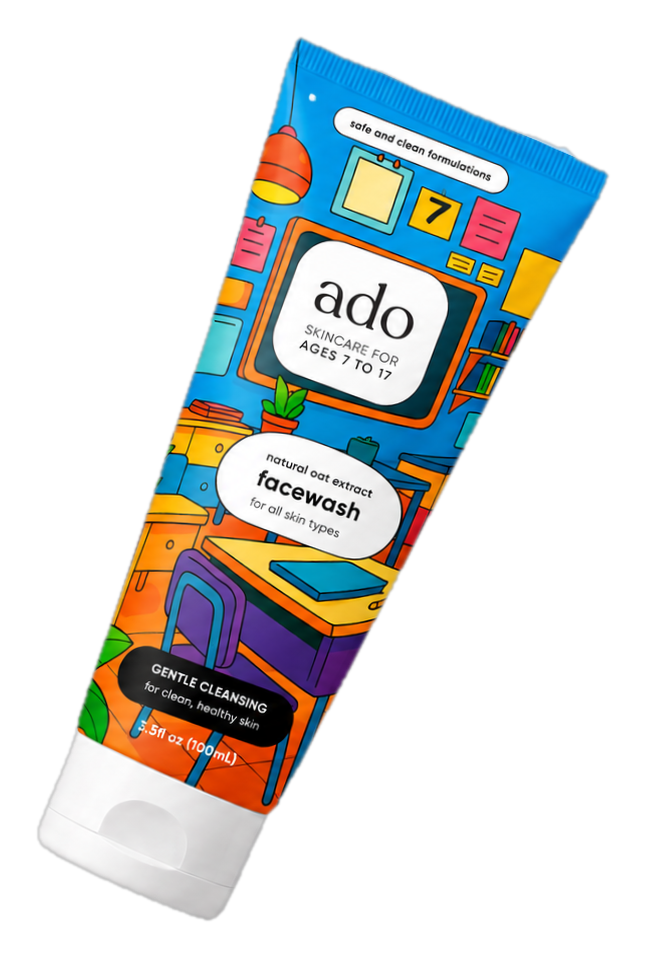
ado is an Indian skincare brand made for kids, tweens and teens aged 7–17, and its routine is exactly these three steps. ado's Tween's Kit has a gentle, sulfate-free oat face wash, a lightweight, pH-balanced daily moisturiser and ado's mineral SPF 50+ sunscreen, which is broad-spectrum (UVA/UVB) with zinc oxide as its only UV filter. There's oat in every step, and there are no adult actives: no retinoids, no exfoliating acids and no vitamin C serums.
ado's products contain fragrance (it's the last ingredient on each label); if your child's skin is sensitive, patch-test first or choose a fragrance-free option. It's gentle daily care, not an acne treatment, so for pimples that aren't settling, see a dermatologist. For more on this age group, visit our hub on skincare for tweens (10–12), or compare our skincare routine for a 10-year-old and skincare routine for a 13-year-old.
Made for growing skin

The complete routine
Tween's Kit
The complete ado routine in one box: cleanse, moisturise, protect.
- Cleanse Facewash
- Hydrate Moisturiser
- Protect Sunscreen
Price
₹2,699Regular price
₹3,297
Save ₹598

ado mineral sunscreen (SPF 50+)
Price ₹1,499
Sources
- A dermatologist's guide to skincare from growing up to glowing up (28 Oct 2025) · American Academy of Dermatology
- Trendy Skin Care for Tweens & Teens: Is It Safe? (updated 7 Aug 2025) · American Academy of Pediatrics / HealthyChildren.org
- Pediatric Skin Care Regimens on TikTok (Hales et al., Pediatrics, July 2025; PubMed record) · Pediatrics / American Academy of Pediatrics
- The digital dermatosis: social media's unintended impact on pre-adolescent skincare (viewpoint, 23 Feb 2026) · Indian Journal of Dermatology, Venereology and Leprology
- Practical Recommendations for Indians on Sunscreen Use: A Modified Delphi Consensus by Indian Sunscreen Forum (PRISM-ISF), J Cosmet Dermatol 2025 · Journal of Cosmetic Dermatology (PMC)
- Is It OK for My Child to Use Skin Care Products? (reviewed April 2024) · KidsHealth (Nemours)
- Face washing 101 · American Academy of Dermatology
- Acne: Tips for managing · American Academy of Dermatology
- 10 tips for clearing acne in darker skin tones · American Academy of Dermatology
- 12 summer skin problems you can prevent · American Academy of Dermatology
- Is sports equipment causing your acne? · American Academy of Dermatology
- Teen Acne: How to Treat & Prevent This Common Skin Condition (updated 3 Apr 2025) · American Academy of Pediatrics / HealthyChildren.org
- Food and Adolescent Acne · American Academy of Pediatrics / HealthyChildren.org
- 9 things to try when acne won't clear · American Academy of Dermatology
- 5 ways to help your teenager survive acne · American Academy of Dermatology
- I have acne! Is it okay to wear makeup? · American Academy of Dermatology
This guide is general information for parents, not medical advice. If you're worried about your child's skin, please see a dermatologist or paediatrician. How we write these guides.