Face washAges 10–9
Face Wash for Kids: When to Start and What to Use (Ages 7–12)
No fixed age: watch for oil, sweat and sunscreen. Then choose the gentlest wash that does the job.
Quick answer
There is no fixed age. Start a gentle face wash when your child's face gets oily or sweaty, or once they wear sunscreen daily, often between about 8 and 11. Choose a soft, SLS-free cleanser without scrubs, and go fragrance-free if their skin is sensitive. Wash once a day for younger or dry skin, twice a day plus after sweaty sport for older children.
There is no fixed age to start using a face wash. Many 7- and 8-year-olds are fine with a splash of lukewarm water, and a mild, gentle face wash makes sense once your child's face starts getting oily or sweaty, or once they wear sunscreen every day. For many children that happens somewhere between about 8 and 11.
Choose a soft, non-stripping cleanser without SLS or scrubs (fragrance-free if your child's skin is sensitive), and use it once or twice a day. This guide is for parents of children aged 7 to 12. For older children, see our face wash guide for teenagers.
At what age should a child start using face wash?
Start when the skin asks for it, not at a set birthday: oiliness, sweat or daily sunscreen are the usual signals, often between about 8 and 11. What is happening on your child's skin matters more than their age. Between about 6 and 8, children go through adrenarche, when the adrenal glands start making more of a hormone called DHEA. According to Cleveland Clinic, it can bring oilier skin and hair, the first pimples and body odour, and it comes roughly two years before puberty itself. Puberty usually starts between 8 and 13 in girls and between 9 and 14 in boys (KidsHealth).
Signs your child is ready for a face wash:
- their face looks shiny or feels greasy by the time they are home from school
- they come back sweaty from cricket, football, skating or PE
- tiny blackheads have appeared on the nose or chin
- a few pimples have popped up on the forehead, often under a fringe or a cap
- they now wear sunscreen every day, and a gentle cleanser in the evening helps lift it off
- they are asking for one because their friends have one, which is a fine reason too; a gentle wash is a sensible first product
Is plain water enough?
For a younger child with no oiliness, often yes. Water rinses off sweat and dust. The American Academy of Dermatology notes that for children with dry or sensitive skin, washing once a day in the evening may be enough. Once oil, sweat or sunscreen come into the picture, a gentle facewash does a better job than water alone, as long as it is mild.
What should a face wash for an 8- or 10-year-old have, and what should it skip?
A face wash for an 8- or 10-year-old should be gentle, non-abrasive and alcohol-free, and skip scrubs, harsh sulfates such as SLS and adult actives. You are looking for the gentlest thing that gets the job done. The American Academy of Dermatology's face-washing advice is to use a gentle, non-abrasive cleanser that does not contain alcohol.
| Look for | Skip |
|---|---|
| A gentle gel or cream cleanser with a soft lather | Scrubs, beads and grainy "exfoliating" washes. AAP's HealthyChildren.org lists physical exfoliants among cleanser ingredients tweens and teens should skip. |
| Mild cleansing agents; SLS-free | Sulfates such as sodium lauryl sulphate (SLS), also on HealthyChildren.org's skip list |
| Skin-friendly ingredients such as glycerin or coco-glucoside, both on HealthyChildren.org's look-for list, or soothing colloidal oatmeal | Alcohol-heavy or strongly "cooling" washes |
| Little or no fragrance; fragrance-free if your child has eczema, very sensitive skin or reacts to fragrance | Strong perfume. The AAD notes that added scents can trigger irritation or allergic reactions. |
| Made for children or for sensitive skin | Adult acne washes with salicylic acid or benzoyl peroxide, unless a doctor suggests one |
| Nothing that promises to change skin colour | Anti-ageing, skin-lightening or de-tan washes. The AAD says retinol, vitamin C and exfoliating acids can cause redness, burning or peeling and offer no benefit to young skin. |
Our guide to skincare ingredients tweens should avoid goes through the adult actives in more detail.
What is SLS, and why look for SLS-free?
SLS stands for sodium lauryl sulphate (sulfate in American spelling), a strong foaming cleanser used in many soaps and detergents. It cleans well, but it can also disrupt the skin barrier. It irritates skin so reliably that dermatology researchers use it in lab tests to trigger irritation on purpose, according to a 2022 review of irritant contact dermatitis.
Hard water can make this worse. In a UK lab study of 80 people, skin washed with SLS in hard water held on to more SLS residue, which increased water loss from the skin and caused irritation, particularly in some people with eczema. If your tap water leaves white, chalky marks on taps and buckets, it is probably hard, and an SLS-free cleanser is a sensible choice.
A face wash does not need mountains of foam to work. A soft lather is enough for a child's face.
Soap bar or face wash?
A bath soap is fine for the body, but many are a poor match for the face. An Indian study in the Indian Journal of Dermatology measured common bath soaps with a pH meter and found most had a pH of 9 to 10, while healthy skin sits at about 5.4 to 5.9. The authors explain that high-pH soap raises skin pH, which can leave skin drier and more easily irritated. Gentler synthetic cleansers with a neutral or slightly acidic pH are less irritating, according to the same 2022 review.
How often should a child wash their face?
Once or twice a day is plenty. More is not better: the American Academy of Dermatology warns that washing several times a day can further irritate the skin and lead to more breakouts.
| Your child | How often |
|---|---|
| 7–8, no oiliness, mostly indoors | Lukewarm water, with a gentle cleanser once a day in the evening if they want one |
| 8–10, some shine, sweaty after play, daily sunscreen | A gentle cleanser in the evening; water or cleanser in the morning |
| 10–12, oily forehead or nose, regular sport | Twice a day, morning and night, plus a quick wash after heavy sweating |
The twice-a-day routine, plus after sweating, follows advice from both the AAD and HealthyChildren.org. For children with dry or sensitive skin, stick to once a day for longer.
How do you teach a child to wash their face?
Children pick this up most easily by doing it with you a few times. Here is the routine, based on the AAD's face-washing steps:
- Tie hair back or use a headband.
- Wet the face with lukewarm water, not hot.
- Put a pea-sized amount of cleanser on the fingertips.
- Massage gently in small circles for about 30 to 60 seconds: forehead, nose, chin, cheeks, and along the jaw and hairline. Fingertips only, no cloth, sponge or loofah, and no scrubbing.
- Rinse well with lukewarm water, including the hairline and under the jaw, where cleanser likes to hide.
- Pat dry with their own clean, soft towel.
- If skin feels tight, add a light moisturizer. In the morning, finish with sunscreen.
Tip: keep the face wash next to the toothbrush so the two habits join up. For the first week, do it side by side. A sticky note on the mirror saying "wet, wash, rinse, pat" helps younger children remember the order.
When your child is ready to add the next steps, our skincare routine for a 10-year-old shows how moisturiser and sunscreen fit in, and our parent's guide to sunscreen for kids in India covers the sun side. For age-by-age basics, see our pages on skincare for kids aged 7–9 and skincare for tweens aged 10–12.
When should you see a doctor?
See a doctor if washing leaves skin red, stinging or itchy even with a gentle product, or if pimples are painful or leave marks.
See a paediatrician or dermatologist if:
- the skin turns red, stings, flakes or itches after washing, even with a gentle product
- dry, itchy patches keep coming back
- pimples are painful or deep, or leave dark marks or scars; the AAD suggests seeing a dermatologist when breakouts leave marks
- pimples come with body odour or underarm or pubic hair before age 8 in girls or 9 in boys; Cleveland Clinic describes these as signs of early adrenarche, which is worth a paediatrician check
- someone has suggested a cream from the chemist for pimples or marks; check with a doctor first, and never use a steroid cream on the face unless a doctor has prescribed it for that purpose
Our guides to steroid creams on a child's face, pimples at 13 and body odour and a first deodorant cover the other changes that often arrive at the same time.
Still using baby products? Our ado vs baby skincare page explains when a baby product is still fine and when to switch.
Read next: skincare routine for an 11-year-old · best skincare for kids in India: ado and 9 other brands · face wash for a 10 to 12-year-old
How ado fits in
ado Gentle Oat Face Wash is a soft-lather gel made for ages 7–17, with coconut-derived cleansers, glycerin and oat kernel extract. It is sulfate-free (so SLS-free), dye-free, paraben- and phthalate-free and non-comedogenic, and it is non-stripping, so it can clear away sweat, sunscreen and the school day once or twice a day without leaving skin tight. ado's products contain fragrance (it's the last ingredient on each label); if your child's skin is sensitive, patch-test first or choose a fragrance-free option. The full ingredient list is on the product page, and for many younger children this is the one step they need for now.
Made for growing skin
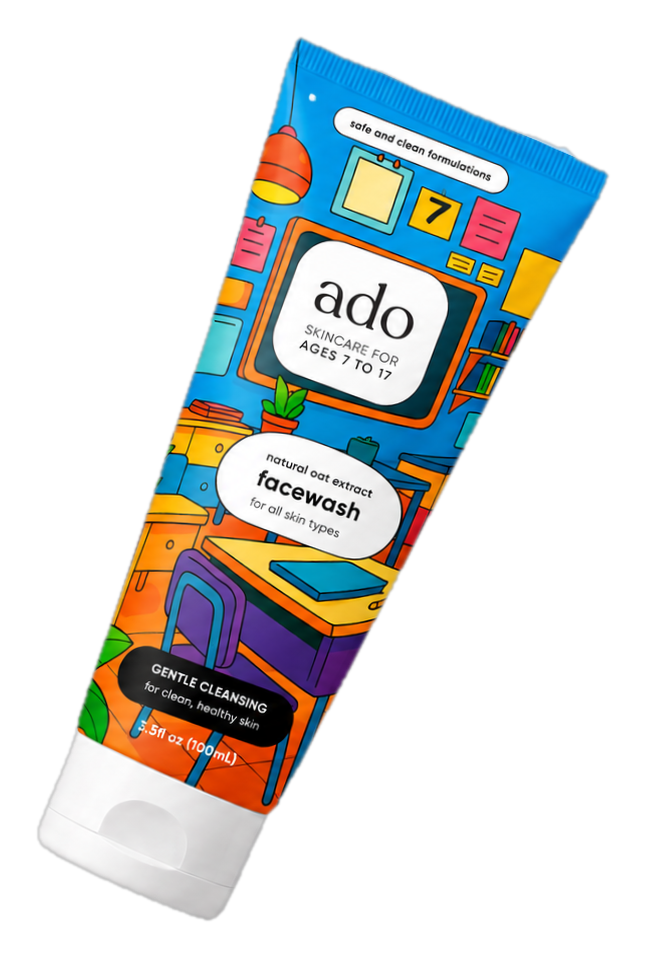
ado gentle oat face wash
Price ₹849
Sources
- Adrenarche / Premature Adrenarche · Cleveland Clinic
- Deodorant Use for Kids and Teens · Nemours KidsHealth
- A dermatologist's guide to skincare from growing up to glowing up · American Academy of Dermatology
- Face washing 101 · American Academy of Dermatology
- 10 skin care habits that can worsen acne · American Academy of Dermatology
- Trendy Skin Care for Tweens & Teens: Is It Safe? · HealthyChildren.org (American Academy of Pediatrics)
- Irritant Contact Dermatitis: a Review · Current Dermatology Reports (2022), via PMC
- The Effect of Water Hardness on Surfactant Deposition after Washing and Subsequent Skin Irritation in Atopic Dermatitis Patients and Healthy Control Subjects · Journal of Investigative Dermatology (2018), via PubMed
- Evaluation of pH of Bathing Soaps and Shampoos for Skin and Hair Care · Indian Journal of Dermatology (2014), via PubMed
- The digital dermatosis: social media's unintended impact on pre-adolescent skincare · Indian Journal of Dermatology, Venereology and Leprology
This guide is general information for parents, not medical advice. If you're worried about your child's skin, please see a dermatologist or paediatrician. How we write these guides.