Ingredients
What's in ado: Every Ingredient, Explained
All three ingredient lists, exactly as printed on our tubes, with what each ingredient does and why it's there.
Quick answer
ado's three products are built from mild cleansers (in the face wash), humectants, emollients and oat, with zinc oxide as the sunscreen's only UV filter. None contains parabens, phthalates, retinoids or exfoliating acids. Each lists fragrance, last on the label. The face wash and sunscreen use preservatives on the EU's permitted list.
ado's three products are made from mild cleansers, humectants, emollients and oat, and the sunscreen uses zinc oxide as its only UV filter. None contains parabens, phthalates, retinoids or exfoliating acids, and each lists fragrance, last on the label. Here is every ingredient, exactly as printed on our tubes, with what it does and why it's there.
ado is an Indian skincare brand made for kids, tweens and teens aged 7–17: a gentle oat face wash, a moisturiser and a zinc oxide SPF 50+ sunscreen. We make these products, so we're not neutral, and this page sticks to the label and public reference sources.
How to read the tables. "What it is" gives each ingredient's main functions as listed in CosIng, the European Commission's cosmetic ingredient database. "Why it's there" is our plain-English reason. Under India's Cosmetics Rules, 2020 (Rule 34), ingredients above 1% are listed in descending order and those at 1% or less in any order, so position is only a rough guide to amount.
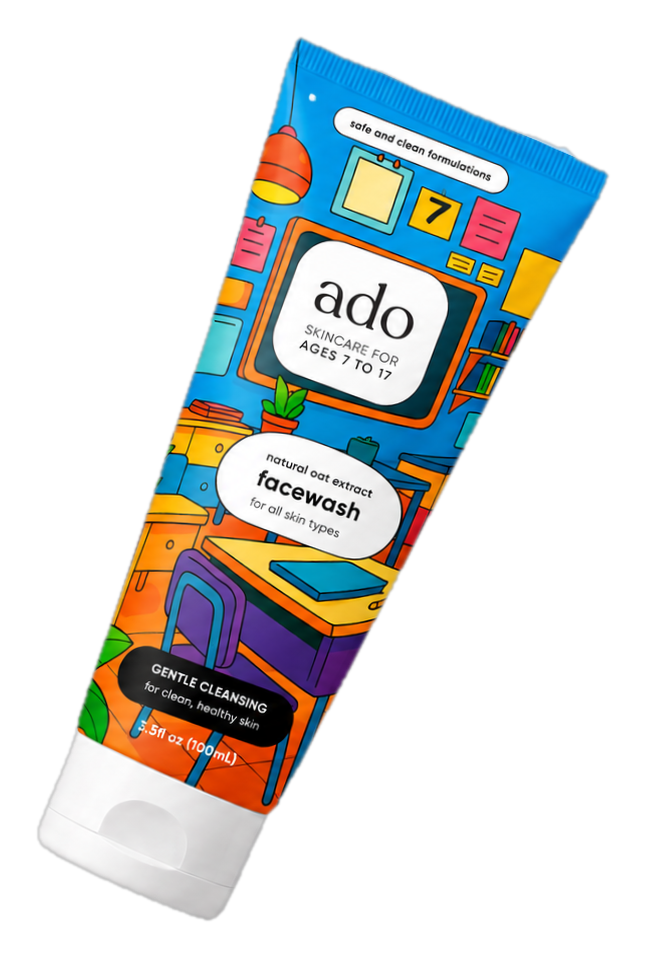
What's in ado Gentle Oat Face Wash?
A sulfate-free gel cleanser with three mild, coconut-derived cleansers and oat kernel extract. The label says it's formulated without dyes, parabens, sulfates and phthalates, and that it's non-comedogenic (made not to clog pores).
| Ingredient (as printed on the label) | What it is (CosIng function) | Why it's there |
|---|---|---|
| Aqua | Solvent (water) | The base that carries and dissolves everything else. |
| Cocamidopropyl Betaine | Surfactant: cleansing, foam boosting | A mild, coconut-derived cleanser that lifts sweat, dust and sunscreen and makes a soft lather. |
| Sodium Lauroamphoacetate | Surfactant: cleansing, foaming | A second mild, coconut-derived cleanser. Used together, the cleansers keep the lather gentle and non-stripping. |
| Glycerin | Humectant | Helps skin hold on to moisture, so it doesn't feel tight after washing. |
| Coco-Glucoside | Surfactant: cleansing | A mild cleanser made from coconut alcohol and glucose. The AAP lists coco-glucoside among cleanser ingredients to look for. |
| Sodium Chloride | Viscosity controlling; bulking (salt) | Thickens the gel. |
| Citric Acid | Buffering (pH adjuster); chelating | Adjusts the pH of the gel. It isn't there to exfoliate, and the wash is rinsed off. |
| Acrylates/C10-30 Alkyl Acrylate Crosspolymer | Viscosity controlling; emulsion stabilising; film forming | Gives the gel its texture and keeps it stable. |
| Sodium Benzoate | Preservative | Helps keep the face wash free of microbes once it's opened. More on this below. |
| Glyceryl Oleate | Emollient; emulsifying | Softens skin so washing doesn't leave it dry. |
| Polyquaternium-10 | Film forming; antistatic | A conditioning polymer that leaves skin feeling smooth after rinsing. |
| Guar Hydroxypropyltrimonium Chloride | Skin conditioning; film forming; viscosity controlling (made from guar gum) | Helps skin feel soft after rinsing. |
| Sodium Hydroxide | Buffering (pH adjuster) | Adjusts the pH of the finished gel. |
| Avena sativa (Oat) Kernel Extract | Skin conditioning; emollient; antioxidant | The oat in this step. It's an oat extract, not colloidal oatmeal. |
| Fragrance | Fragrance (parfum) | Gives the face wash its scent. See the fragrance section below. |
What's in ado Daily Moisturiser?
A lightweight gel-cream built on glycerin, squalane and oat kernel flour (colloidal oatmeal). The label says it's pH balanced and free from parabens and phthalates.
| Ingredient (as printed on the label) | What it is (CosIng function) | Why it's there |
|---|---|---|
| Aqua | Solvent (water) | The base of the gel-cream. |
| Glycerin | Humectant | Helps skin hold on to moisture. |
| Squalane | Emollient; refatting | A light oil that softens skin without a greasy feel. The AAP lists squalane among moisturiser ingredients to look for. |
| Dimethicone | Emollient; skin protecting | A silicone that gives a smooth, non-greasy feel and helps protect the skin's surface. |
| Avena sativa (Oat) Kernel Flour | Finely ground oat (colloidal oatmeal): absorbent, bulking, viscosity controlling | Helps soothe dry skin and gives the cream body. |
| Cetearyl Olivate | Emulsifying; emollient (made from olive oil fatty acids) | Holds the water and oils together and softens skin. |
| Sorbitan Olivate | Emulsifying | Works with cetearyl olivate to keep the cream stable. |
| Carbomer | Gel forming; viscosity controlling | Gives the light gel-cream texture. |
| Acrylates/C10-30 Alkyl Acrylate Crosspolymer | Viscosity controlling; emulsion stabilising | Keeps the texture smooth and stable. |
| 1,2-Hexanediol | Solvent; skin conditioning | Helps dissolve and blend the other ingredients. |
| Caprylyl Glycol | Emollient; skin conditioning | Conditions and softens skin. |
| Sodium Hydroxide | Buffering (pH adjuster) | Adjusts the pH. The moisturiser is labelled pH balanced. |
| Tropolone | Skin conditioning | A skin-conditioning ingredient, as CosIng classes it. |
| Fragrance | Fragrance (parfum) | Gives the moisturiser its scent. |
What's in ado Mineral Sunscreen SPF 50+?
One active ingredient, zinc oxide, which is the only UV filter. The label says broad spectrum (UVA/UVB); no PA rating is stated. India's sunscreen consensus, PRISM-ISF (2025), says a sunscreen with inorganic filters like zinc oxide "is preferred over any other sunscreen" for children. The other ingredients make up the lightweight, non-greasy cream and preserve it.
| Ingredient (as printed on the label) | What it is (CosIng function) | Why it's there |
|---|---|---|
| Zinc Oxide (active) | UV filter; skin protecting | The only UV filter. It protects against UVB and UVA rays, and the tube is labelled broad spectrum SPF 50+. EU rules list zinc oxide as a permitted UV filter (Annex VI). |
| Aqua | Solvent (water) | Part of the cream base. |
| C12-15 Alkyl Benzoate | Emollient | A light emollient that helps the cream spread smoothly. |
| Styrene/Acrylates Copolymer | Film forming; opacifying | Helps the sunscreen form an even film on skin. |
| Octyldodecyl Citrate Crosspolymer | Humectant | Helps skin hold on to moisture. |
| Phenyl Trimethicone | Skin conditioning (occlusive); silicone | Gives a silky, light feel. |
| Cetyl PEG/PPG-10/1 Dimethicone | Emulsifying | Holds the water and silicone parts of the cream together. |
| Dimethicone | Emollient; skin protecting | A smooth, non-greasy feel. |
| Polyhydroxystearic Acid | Emulsifying | Helps keep the cream evenly mixed. It's an emulsifier, not an exfoliating acid. |
| Glycerin | Humectant | Helps skin hold on to moisture. |
| Ethyl Methicone | Emollient (silicone) | A light, smooth feel. |
| Silica | Absorbent; opacifying; viscosity controlling | Absorbs excess oil and helps the non-greasy finish. |
| Cetyl Dimethicone | Emollient (silicone) | Softens skin and helps the cream glide on. |
| Triethoxycaprylylsilane | Binding | Helps bind the powder ingredients into the cream. |
| Glyceryl Behenate | Emollient; emulsifying | Adds body and helps keep the cream stable. |
| Sodium Chloride | Viscosity controlling (salt) | Helps keep the texture stable. |
| Acrylates/Dimethicone Copolymer | Film forming; binding | Helps the sunscreen form an even film. |
| Phenoxyethanol | Preservative | Helps keep the sunscreen free of microbes once it's opened. More on this below. |
| Chlorphenesin | Preservative | Works alongside phenoxyethanol to preserve the product. |
| Phenethyl Alcohol | Fragrance | CosIng classes it as a fragrance ingredient. See the fragrance section below. |
| Avena sativa (Oat) Kernel Flour | Finely ground oat (colloidal oatmeal): absorbent, bulking | Helps soothe skin. |
| Caprylyl Glycol | Emollient; skin conditioning | Conditions and softens skin. |
| Cetyldimethicone/Bis-Vinyldimethicone Crosspolymer | Emollient; skin conditioning (silicone) | Gives a soft, smooth finish. |
| Chrysanthemum parthenium (Feverfew) Flower/Leaf/Stem Juice | Skin conditioning; antioxidant | A plant juice included for skin conditioning. |
| Fragrance | Fragrance (parfum) | Gives the sunscreen its scent. |
What's not in ado?
No parabens or phthalates in any product, no sulfates or dyes in the face wash, no adult actives, and no chemical UV filters in the sunscreen.
- Parabens and phthalates: all three labels say the products are free from them.
- Sulfates (including SLS) and dyes: the face wash is formulated without them. The American Academy of Pediatrics (AAP) advises avoiding harsh sulfates such as sodium lauryl sulfate in cleansers.
- Adult actives: no retinoids, no exfoliating AHAs or BHAs (such as glycolic or salicylic acid) and no vitamin C serums. The American Academy of Dermatology (AAD) says these target "issues that children don't have". Citric acid is in the face wash to adjust pH, and polyhydroxystearic acid is an emulsifier in the sunscreen.
- Chemical UV filters: none, because zinc oxide is the only UV filter. The AAP suggests avoiding chemical sunscreens with avobenzone or oxybenzone, which can irritate young skin.
More in our guides to skincare ingredients tweens should avoid and mineral vs chemical sunscreen for kids.
Does ado contain fragrance?
Yes. All three products list fragrance, last on each label, as the single word "Fragrance", so its individual components aren't named. The sunscreen also lists phenethyl alcohol, which CosIng classes as a fragrance ingredient.
Fragrance gives each product its scent, and there is a trade-off. The AAD says fragrance-free products are gentler for sensitive skin, because added scents can trigger irritation or allergic reactions. A 2026 viewpoint in the Indian Journal of Dermatology, Venereology and Leprology lists fragrances among the common allergens in skincare promoted to children.
If your child's skin is sensitive: ado's products contain fragrance (it's the last ingredient on each label). If your child has eczema, very sensitive skin or reacts to fragrance, patch-test first or choose a fragrance-free option.
To patch-test, the AAD suggests trying a small amount on the skin before using a product on the whole face, and adding one new product at a time.
Are the preservatives in ado OK for children?
The preservatives in ado's face wash and sunscreen are on the EU's list of permitted cosmetic preservatives, each with a maximum concentration, and the most discussed one, phenoxyethanol, has been reviewed with children in mind. A preservative stops bacteria and mould growing once a product is opened. Any ingredient can still irritate an individual child.
- Face wash: sodium benzoate, the sodium salt of benzoic acid. CosIng lists it in Annex V (entry 1) of the EU Cosmetics Regulation, at up to 2.5% (as the acid) in rinse-off products. We found no opinion on it from the EU's Scientific Committee on Consumer Safety (SCCS).
- Sunscreen: phenoxyethanol, permitted at up to 1.0% (Annex V, entry 29). After France's medicines agency asked for a lower limit in products for children under three, the SCCS reviewed it. Its 2016 opinion "considers 2-phenoxyethanol safe for use as a preservative with a maximum concentration of 1.0%" and says the safety margin for children "also covers this specific age group".
- Sunscreen: chlorphenesin, permitted at up to 0.3% (Annex V, entry 50). CosIng lists no SCCS opinion on it.
- Moisturiser: CosIng classes none of its ingredients as a preservative. Its 1,2-hexanediol, caprylyl glycol and tropolone are listed as solvent and skin-conditioning ingredients.
When should you see a doctor?
If your child's skin reacts, stop the product and see your paediatrician or a dermatologist. The AAP calls a product that stings or burns a red flag, not a sign it's working.
See a doctor if:
- a rash, redness, itching, swelling or burning appears after using a product, or doesn't settle once you stop
- your child has eczema or a known allergy and you're unsure about an ingredient on these lists
- you're thinking of using the sunscreen on a baby under 6 months: the label says to ask a doctor
- your child's skin keeps reacting to different products
Where can you check these lists?
Each list is printed on the 100 mL tube and in the Ingredients section of the ado Gentle Oat Face Wash, ado Daily Moisturiser and ado Mineral Sunscreen SPF 50+ pages. The Tween's Kit has all three, or see all ado products. Our editorial standards explain how we check facts. Spot a mistake? Email hi@adoskin.com.
Sources
- CosIng: the European Commission database of cosmetic ingredients (functions and Annex entries) · European Commission
- Opinion on Phenoxyethanol, SCCS/1575/16 (16 March 2016, final version 6 October 2016) · Scientific Committee on Consumer Safety (SCCS), European Commission
- The Cosmetics Rules, 2020 (Rule 34: manner of labelling) · Central Drugs Standard Control Organisation (CDSCO), Government of India
- A dermatologist's guide to skincare from growing up to glowing up (28 Oct 2025) · American Academy of Dermatology
- Trendy Skin Care for Tweens & Teens: Is It Safe? (2025) · American Academy of Pediatrics / HealthyChildren.org
- The digital dermatosis: social media's unintended impact on pre-adolescent skincare (2026) · Indian Journal of Dermatology, Venereology and Leprology
- Practical Recommendations for Indians on Sunscreen Use: A Modified Delphi Consensus by Indian Sunscreen Forum (PRISM-ISF), J Cosmet Dermatol 2025 · Journal of Cosmetic Dermatology (PMC)