ComparedAges 10–9
ado vs Baby Skincare: When Your Child Has Outgrown Baby Products
When it's time to move on from baby products, and what ado's gentle routine for ages 7–17 gives a growing child.
Facts checked on 29 September 2026. We make ado, so we're not neutral: every fact about another brand comes from its own website on that date. Spotted something out of date? Email hi@adoskin.com
Quick answer
ado is made for the years after baby care: one gentle routine for ages 7–17, with a broad-spectrum SPF 50+ sunscreen whose only UV filter is zinc oxide. Chicco's sunscreen is labelled from birth, and Mamaearth's kids' face wash and Mineral Based Sunscreen up to age 10. Baby products that still suit your child's skin are fine to keep.
A 10-year-old can keep using a baby product that still suits their skin, but most children outgrow baby care somewhere between 8 and 14, when oilier skin, sweat, first pimples and long school days in the sun arrive. ado is made for that next stage: one gentle routine for ages 7–17, with a mineral SPF 50+ sunscreen whose only UV filter is zinc oxide.
ado is an Indian skincare brand made for kids, tweens and teens aged 7–17: a gentle oat face wash, a daily moisturiser and a zinc oxide SPF 50+ sunscreen, sold on their own or together as the Tween's Kit. This guide covers when to switch, why parents move a growing child to ado, how to make the change, and the baby and young-kids' lines families move on from.
We make ado, so we're not neutral. Facts about other brands come from their own websites (for Sebamed, its brand-store listing on Amazon.in), checked on 29 September 2026; ado's come from our labels. Spotted something out of date? Email hi@adoskin.com and we'll fix it. Prices are MRP on the day. Our editorial standards explain how we check facts.
When is it time to switch from baby products?
Switch when your child's skin and days change, not on a birthday. For most children that happens with puberty, which KidsHealth (Nemours) says usually starts between 8 and 13 in girls and between 9 and 14 in boys; its hormones bring body odour and acne.
- The face gets shiny, with blackheads or first pimples. The American Academy of Dermatology's 2025 guide (AAD) notes that hormonal changes often increase oil production, and KidsHealth suggests washing the face once or twice a day with a mild soap or gentle cleanser. A rich baby cream may start to feel heavy. See face wash for kids.
- Days in the sun get longer. Assemblies, PE, cricket and football mean hours outdoors, so sunscreen moves from a holiday product to a daily one. The AAD recommends SPF 30 or higher.
- More sweat. Sport and humid monsoon afternoons add sweat; the AAD notes that heat and sweat trapped under helmets, straps and tight clothing can trigger a type of acne. For underarm sweat and smell, see body odour at 9 or 10.
- The stated age no longer fits. Many baby and young-kids' products are labelled from birth, or only up to age 10.
- They want their own routine. Steer that wish towards gentle basics made for their age, not adult serums. See a skincare routine for a 10-year-old.
Why do parents move a growing child to ado?
Because ado is made for the years that baby care doesn't cover: ages 7 to 17, with an SPF 50+ mineral sunscreen and no adult actives. Here is what that means on the label.
- Made for 7 to 17, the years after baby care. Of the lines on this page, Chicco's sunscreen is labelled from birth, Mother Sparsh's from age 3 and Sebamed's for babies, while Mamaearth's kids' face wash and Mineral Based Sunscreen stop at age 10. ado's three products are made for ages 7 to 17, so one routine lasts from primary school to Class 12, and siblings of different ages can share it.
- SPF 50+, with zinc oxide as the only UV filter. ado's sunscreen is labelled broad spectrum SPF 50+ (UVA/UVB); the baby and young-kids' sunscreens on this page state SPF 20 to 50. For children, India's sunscreen consensus, PRISM-ISF (2025), says "a sunscreen containing inorganic filters, like zinc oxide and titanium dioxide, is preferred over any other sunscreen."
- More margin when kids apply too little. The same consensus notes that most people apply 0.5–1.5 mg/cm² instead of the tested 2 mg/cm², "which greatly reduces effectiveness". A higher SPF leaves more room for error on a rushed school morning; SPF 30 applied well and reapplied is still fine. More in SPF 30 vs SPF 50 for kids.
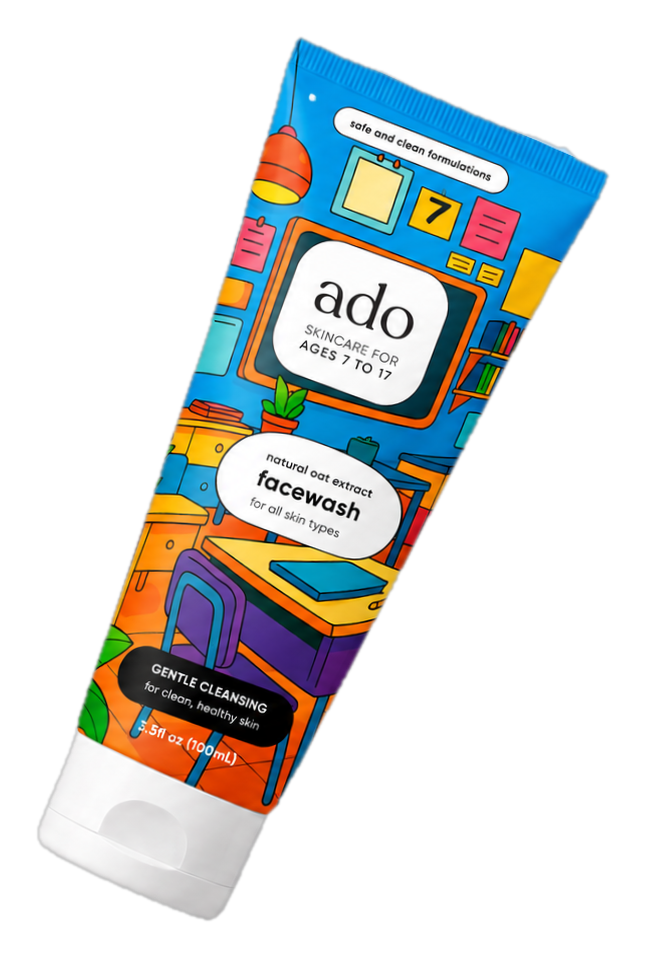
- A face wash made for oilier, growing skin. ado's face wash is a gentle gel cleanser with coconut-derived cleansers and oat kernel extract. It is sulfate-free, dye-free and non-comedogenic (made not to clog pores), with a soft lather that doesn't strip the skin.
- A step up from baby care, without adult actives. The AAD's guide advises tweens and teens to avoid retinol, vitamin C and exfoliating acids, and the American Academy of Pediatrics says such anti-ageing ingredients can cause redness, peeling and a weaker skin barrier. ado's range has no retinoids, no exfoliating acids and no vitamin C serums.
- Every ingredient on the page. ado publishes the full ingredient list on every product page, and our ingredients page explains each one. Oat is in every step. The face wash has oat kernel extract. The moisturiser and sunscreen have oat kernel flour (colloidal oatmeal), and all three are free from parabens and phthalates.
ado's products contain fragrance (it's the last ingredient on each label); if your child's skin is sensitive, patch-test first or choose a fragrance-free option.
What's in the ado routine?
Three steps, each in a 100 mL tube: cleanse, hydrate, protect. Mornings are face wash, moisturiser and sunscreen; evenings are face wash and moisturiser.
- ado Gentle Oat Face Wash, ₹849. A gentle gel cleanser with coconut-derived cleansers, glycerin and oat kernel extract. It's sulfate-free, dye-free, non-comedogenic and free from parabens and phthalates.
- ado Daily Moisturiser, ₹949. A lightweight, non-greasy gel-cream with glycerin, squalane and oat kernel flour (colloidal oatmeal). It's pH balanced, free from parabens and phthalates, and helps skin hold on to moisture.
- ado Mineral Sunscreen SPF 50+, ₹1,499. Zinc oxide is its only UV filter, and it's labelled broad spectrum SPF 50+ (UVA/UVB); no PA rating is stated. It's lightweight and non-greasy, with oat kernel flour (colloidal oatmeal). The label makes no water-resistance claim, so reapply at least every 2 hours outdoors and straight after towel drying, swimming or sweating.
- Tween's Kit, ₹2,699. All three tubes together, ₹598 less than buying them separately (₹3,297).
On a school morning: wash, moisturise, then dot sunscreen on the forehead, cheeks and nose and blend outwards, 15 minutes before the bus or assembly. Pack the tube for sports day, swimming class or cricket practice. At night, face wash and moisturiser are enough. All three are made in India in a GMP- and ISO-certified facility, and they're cruelty-free.
How do you move a child from baby products to ado?
Gradually, one product at a time, starting with the step your child needs most.
- Start with the biggest need. For a child outdoors most school days, that's often a daily sunscreen; for a shiny or spotty face, a gentle face wash.
- Patch-test first. Try each new product on a small patch of skin before the whole face, especially if your child's skin is sensitive, as ado's products contain fragrance.
- Add one product at a time, so you can tell what suits your child's skin.
- Keep what a doctor prescribed. If a paediatrician or dermatologist suggested a product for eczema or another skin condition, ask them before you change it.
- Make sunscreen daily, not just for holidays, and let your child take over the routine as they grow. Age guides: skincare for kids aged 7–9 and skincare for tweens (10–12).
See a paediatrician or dermatologist if: a rash doesn't settle after you stop a new product, your child has dry, itchy patches that keep coming back, pimples are painful, deep or leaving marks, or products sting or burn every time.
What baby and kids' brands do parents in India move on from?
Mostly lines made for babies and young children. Here they are in alphabetical order, as listed on 29 September 2026.
- Chicco: Chicco is a baby-care brand; its Mineral Sun Cream SPF 50 is labelled "0M+", from birth. It states PA++++, and Chicco calls it a zinc oxide mineral sunscreen (we couldn't read the full ingredient list). It costs ₹999 for 75 g.
- Himalaya: Himalaya's Gentle Baby Sunscreen Lotion gives no numeric age. It states SPF 50 and PA++++ but doesn't name its UV filters. It costs ₹400 for 50 ml.
- Mamaearth: Mamaearth's kids' Foaming Face Wash and Mineral Based Sunscreen are labelled for children up to age 10; that sunscreen lists zinc oxide as its only UV filter, states SPF 20 with no PA, and costs ₹299 for 100 ml. Its Baby Rich (SPF 50, PA++++, ₹549 for 50 g) and Milky Soft (SPF 30, PA+++, ₹329 for 80 g) sunscreens say they suit "newborns as well as older kids" and list zinc oxide and titanium dioxide (Baby Rich also lists Suncat DE, function not stated).
- Mother Sparsh: Mother Sparsh's Kids Daily Active Sunscreen Lotion is labelled for ages 3 and up. Its ingredient list shows seven organic (chemical) UV filters and no zinc oxide or titanium dioxide, and it states SPF 50 and PA++++. It costs ₹599 for 50 g.
- Sebamed: Sebamed's Baby Sun Lotion is listed for babies on its Amazon.in brand store. It states SPF 50 with no PA rating, and the listing doesn't name its UV filters; it costs ₹1,390 for 200 ml.
How ado fits in
When your child is ready for their own routine, the Tween's Kit brings together the face wash, moisturiser and sunscreen for ₹2,699, ₹598 less than buying the three separately (₹3,297). If it's just the sunscreen that needs an upgrade, ado's mineral SPF 50+ sunscreen is ₹1,499 for 100 mL. For older children, see our guide to teen skincare brands; for more sunscreens, see kids' sunscreens in India compared.
The ado routine

The complete routine
Tween's Kit
The complete ado routine in one box: cleanse, moisturise, protect.
- Cleanse Facewash
- Hydrate Moisturiser
- Protect Sunscreen
Price
₹2,699Regular price
₹3,297
Save ₹598

ado mineral sunscreen (SPF 50+)
Price ₹1,499
ado gentle oat face wash
Price ₹849
Sources
- Understanding Puberty · Nemours KidsHealth
- A dermatologist's guide to skincare from growing up to glowing up (28 Oct 2025) · American Academy of Dermatology
- Is sports equipment causing your acne? · American Academy of Dermatology
- How to decode a sunscreen label · American Academy of Dermatology
- Practical Recommendations for Indians on Sunscreen Use: A Modified Delphi Consensus by Indian Sunscreen Forum (PRISM-ISF), J Cosmet Dermatol 2025 · Journal of Cosmetic Dermatology (via PubMed Central)
- Trendy Skin Care for Tweens & Teens: Is It Safe? (2025) · American Academy of Pediatrics / HealthyChildren.org
Brand names belong to their owners. We compare publicly listed facts only (age range, SPF and PA, filters, pack size, price and key ingredients) as shown on each brand's website on the date above. Prices change often; check the brand's site before you buy. How we write comparisons.