RoutinesAges 10–12
Skincare Routine for an 11-Year-Old: A Simple Plan and What to Buy in India
Sweat, a shinier T-zone and the first spots: how to adjust a simple routine for an 11-year-old's school and sport day in Indian heat.
Quick answer
An 11-year-old needs a gentle face wash, a light moisturiser and a broad-spectrum sunscreen (SPF 30 or higher). As puberty brings sweat, an oilier T-zone and first spots, move to washing twice a day plus after sport, and make sunscreen a daily school-bag habit. Skip scrubs, acids, retinol and vitamin C serums.
An 11-year-old needs a gentle face wash, a light moisturiser and a broad-spectrum sunscreen (SPF 30 or higher). What changes at 11 is sweat, an oilier T-zone and the first spots, so most children this age do best washing their face twice a day, plus after sport, and wearing sunscreen every school day.
This guide is for Indian parents of 10 to 12-year-olds whose skin is starting to change. It covers what early puberty does to skin, when to move to twice-daily washing, a routine built around a hot Indian school day, sweat and prickly heat, sunscreen habits, and what to avoid.
What changes in an 11-year-old's skin?
For many children, puberty is starting. KidsHealth (Nemours) says most girls start puberty between 8 and 13 and most boys between 9 and 14, and the NHS says it's normal for puberty to start any time between 8 and 14. So at 11, some children are well into it and others haven't begun. Both are normal.
KidsHealth explains that hormones from the adrenal glands bring underarm hair, body odour and acne. Skin oil (sebum) often rises first: the American Academy of Pediatrics (AAP) says this can happen up to two years before other signs of puberty, and children as young as 9 may notice bumps and bigger-looking pores around the nose and the middle of the face.
In practice, you may notice:
- a shiny T-zone (forehead, nose and chin) by the afternoon
- tiny bumps, blackheads or the first red spots, often on the forehead and nose
- more sweat after games, and a smell by the end of the school day
- a new interest in skincare, often sparked by videos or friends
None of this means your child needs stronger products. It means the basics need to happen a little more often.
When should an 11-year-old start washing their face twice a day?
When the face feels oily by afternoon, spots appear, or your child sweats a lot most days. For many children that happens somewhere between 10 and 12. Until then, one wash in the evening is often enough.
The American Academy of Dermatology (AAD) advises washing no more than twice a day, plus after sweating, with lukewarm water and fingertips, then patting dry. Its October 2025 guide for tweens adds that washing once, in the evening, may be enough for dry or sensitive skin.
Signs it's time to add a morning wash:
- the forehead and nose look shiny before lunch
- blackheads or small spots are appearing on the T-zone
- your child wakes up with an oily face
- there's games, PE or sports practice most days
Signs to stay at once a day: the skin feels tight, dry or stings after washing. Washing more often won't stop spots, because the AAP explains that acne comes from extra oil and bacteria inside the skin, not dirt on top. Our guide to face wash for kids explains what to look for in a mild cleanser (or "facewash").
What does an 11-year-old's routine look like on a school day in India?
Three steps before school, a rinse after sport and two steps at bedtime. Here's how it fits around a typical Indian school day:
| When | What to do | Why |
|---|---|---|
| Before the school bus | Face wash, light moisturiser, then sunscreen as the last step | Covers the bus stop, assembly and outdoor PE |
| Before games or PE | Reapply sunscreen to the face, ears and neck | The Indian Sunscreen Forum advises reapplying about every two hours outdoors |
| After sport or a sweaty day | Rinse or wash the face; blot, don't wipe | Sweat mixed with oil and bacteria can clog pores |
| Outdoor tuition, practice or play | Reapply sunscreen if it's still sunny | Sweating and wiping the face remove it |
| Bedtime | Face wash, then moisturiser | Washes off sunscreen, sweat and dust |
How to make it stick:
- Keep it under three minutes. As the AAD's dermatologist puts it, skincare "doesn't have to be complicated to be effective".
- Match textures to the season: a light gel moisturiser (or moisturizer) in humid summer and monsoon months, and a little more in a dry North Indian winter.
- Pack a small sunscreen and a clean handkerchief in the school bag, so topping up and blotting sweat don't depend on you.
- Add one new product at a time, and try it on a small patch of skin first, as the AAD suggests.
How do you handle sweat, prickly heat and first spots?
Keep skin cool, blot sweat and keep hands off spots. These three habits handle most of what an Indian summer and early puberty throw at an 11-year-old.
Sweat and prickly heat
Prickly heat (heat rash) is common in hot, humid weather. The NHS says it's usually caused by sweating a lot: sweat glands get blocked, and the trapped sweat leads to small, raised, itchy or prickly spots. On brown skin the spots may be harder to see, or look grey or white. It usually gets better on its own after a few days.
- Keep your child cool: loose cotton clothes, cool baths or showers, and plenty to drink, as the NHS suggests.
- While a heat rash settles, the NHS advises against perfumed shower gels or creams. Pat the rash rather than scratching it.
- Blot sweat with a clean towel or handkerchief. The AAD says wiping sweat off can irritate skin and lead to breakouts, and that sweat mixed with oil and bacteria can clog pores.
- Wash sweaty uniforms, caps and headbands before wearing them again.
- For body odour, KidsHealth says a daily bath, especially after lots of sweating or in hot weather, plus clean clothes, underwear and socks each day, helps. Our guide to body odour and a first deodorant covers the next step.
First spots
- Hands off. The AAD says touching the face through the day can make acne flare.
- Keep hair oil off the forehead. The AAD explains that oil from hair products can clog pores along the hairline, and that it can take 4 to 6 weeks for this kind of acne to clear once the product is stopped. Oil the scalp before a hair wash, rather than leaving it in for days.
- Choose a sunscreen labelled non-comedogenic, meaning it's made not to clog pores.
- Give any change a few weeks. The AAD says it can take several weeks to a few months to see a difference.
If spots are becoming the main worry, our guide to pimples at 13 goes further.
How do you make sunscreen a daily habit at 11?
Put it on at home every school morning, and keep a tube in the school bag for games. It's also the step most often left out online: in a 2025 study in Pediatrics of 100 TikTok skincare videos by creators aged 7 to 18, only 26.2% included sunscreen.
What to use: the AAD suggests a broad-spectrum sunscreen with SPF 30 or higher every day for tweens. The Indian Sunscreen Forum's 2025 consensus prefers sunscreens with inorganic (mineral) filters, such as zinc oxide and titanium dioxide, for children. For oily or acne-prone skin, it suggests non-comedogenic, oil-free textures such as gels and light lotions.
- Same place, same time. Keep sunscreen by the school shoes or water bottle, and apply it as the last step before leaving home.
- Use enough. The consensus notes that most people apply far less than the amount used in testing, which greatly reduces protection. Dot it on the forehead, both cheeks, nose and chin, then blend outwards.
- Don't miss the edges. Ears and the back of the neck catch a lot of sun during assembly and at the bus stop.
- Reapply after sweat and water. About every two hours outdoors, and after swimming, heavy sweating or wiping the face.
- Every skin tone needs it. Brown skin tans too, and the consensus notes that pigmentation triggered by visible light lasts longer in darker skin tones.
For a full checklist, see sunscreen for a 10 to 12-year-old or our parent's guide to sunscreen for kids in India.
What should an 11-year-old avoid?
Anything made for adult skin problems, and anything that scrubs or stings. The AAD's 2025 guide says tweens should skip retinol, vitamin C and exfoliating acids because they target "wrinkles, sun damage, and uneven skin tone, issues that children don't have".
- Adult actives: retinol, AHAs such as glycolic acid, BHAs such as salicylic acid, and vitamin C serums.
- Harsh cleansers: the AAP lists sulfates, alcohols, fragrances and physical scrubs as things to avoid in a cleanser.
- Heavy oils on an oily T-zone: the AAP lists heavy oils among moisturiser ingredients to skip.
- Borrowed acne products from an older sibling or parent, unless a doctor has suggested them.
- Bleach, de-tan packs and lightening creams. A tan fades on its own; our guide to tan after the summer holidays explains gentle care.
- Any cream from the chemist on the face without a doctor's advice, especially steroid creams (read steroid creams on your child's face).
If your child is asking for serums they've seen online, our skincare routine for a 12-year-old covers the trends to skip and how to say no kindly, and skincare ingredients tweens should avoid has the full list.
When should you see a doctor?
Most 11-year-olds only need the basics. Book a visit with your paediatrician or a dermatologist if you notice any of these:
See a doctor if:
- a heat rash doesn't improve after a few days, as the NHS advises
- spots are deep, painful or lumpy, or are leaving dark marks or scars; the AAD says deep blemishes can leave scars
- spots haven't improved after a few months of gentle care
- a product causes redness, burning, peeling or a rash that doesn't settle once you stop it
- your child's skin keeps reacting to over-the-counter products; the AAD's 2025 guide says that's the time to see a board-certified dermatologist
- someone has applied a steroid or "mixed" cream to your child's face
- you have questions about puberty timing, or your child is anxious about how their body is changing
What should you buy for an 11-year-old's skin?
The same three basics, chosen for a sweatier, shinier face: a gentle face wash, a light gel moisturiser and a broad-spectrum sunscreen with SPF 30 or higher. If you can, pick a sunscreen size that fits the school bag for top-ups before games.
- Face wash: "gentle", "sulfate-free" and, now that the T-zone is getting oily, "non-comedogenic" (made not to clog pores). Skip gritty "deep-cleansing" scrubs; the AAP lists physical scrubs among things to avoid.
- Moisturiser: a gel or an oil-free lotion. The AAP suggests gel textures for oily or acne-prone skin and lists heavy oils as something to skip, which matters most in humid months.
- Sunscreen: "broad spectrum", SPF 30 or higher and "non-comedogenic", with zinc oxide or titanium dioxide as the filters. The Indian Sunscreen Forum prefers these mineral filters for children, and suggests oil-free gels or light lotions for oily skin.
Skip at 11: acne kits and borrowed acne creams, alcohol-based toners, retinol, exfoliating acids, vitamin C serums, and skin-lightening or de-tan packs.
Budget: three basics are enough. The AAP notes that some influencer routines include 10 or more products and "can cost hundreds of dollars"; an 11-year-old needs none of that.
How ado fits in
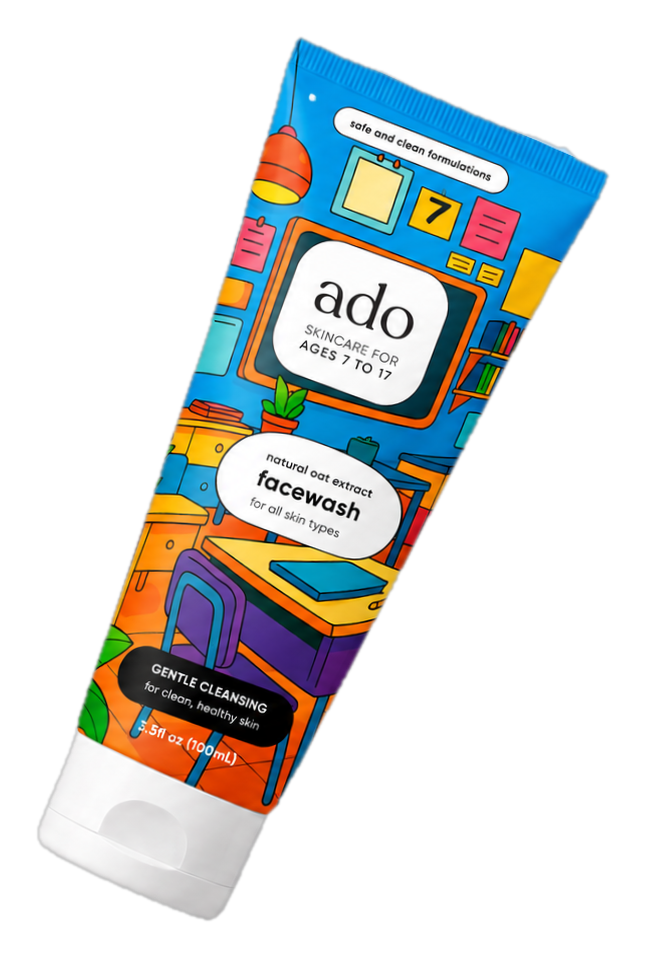
ado is an Indian skincare brand made for kids, tweens and teens aged 7–17, built around these same three steps. ado's Tween's Kit has three 100 mL tubes: a gentle oat face wash, a lightweight, non-greasy daily moisturiser, and ado's mineral SPF 50+ sunscreen, a broad-spectrum (UVA/UVB) formula with zinc oxide as its only UV filter. The face wash is sulfate-free and dye-free, and the face wash and sunscreen are both non-comedogenic. There's oat in every step, and there are no retinoids, exfoliating acids or vitamin C serums.
ado's products contain fragrance (it's the last ingredient on each label); if your child's skin is sensitive, patch-test first or choose a fragrance-free option. It's gentle daily care, not an acne treatment. For more on this age group, visit our hub on skincare for tweens (10–12), or see our skincare routine for a 10-year-old.
Made for growing skin

The complete routine
Tween's Kit
The complete ado routine in one box: cleanse, moisturise, protect.
- Cleanse Facewash
- Hydrate Moisturiser
- Protect Sunscreen
Price
₹2,699Regular price
₹3,297
Save ₹598

ado mineral sunscreen (SPF 50+)
Price ₹1,499
Sources
- Understanding Puberty (reviewed May 2022) · KidsHealth (Nemours)
- Early or delayed puberty · NHS
- Food and Adolescent Acne · American Academy of Pediatrics / HealthyChildren.org
- Teen Acne: How to Treat & Prevent This Common Skin Condition (updated 3 Apr 2025) · American Academy of Pediatrics / HealthyChildren.org
- Face washing 101 · American Academy of Dermatology
- A dermatologist's guide to skincare from growing up to glowing up (28 Oct 2025) · American Academy of Dermatology
- Heat rash (prickly heat) (reviewed 9 May 2024) · NHS
- 12 summer skin problems you can prevent · American Academy of Dermatology
- Deodorant Use for Kids and Teens (reviewed June 2022) · KidsHealth (Nemours)
- Acne: Tips for managing · American Academy of Dermatology
- Are your hair care products causing breakouts? · American Academy of Dermatology
- Pediatric Skin Care Regimens on TikTok (Hales et al., Pediatrics, July 2025; PubMed record) · Pediatrics / American Academy of Pediatrics
- Practical Recommendations for Indians on Sunscreen Use: A Modified Delphi Consensus by Indian Sunscreen Forum (PRISM-ISF), J Cosmet Dermatol 2025 · Journal of Cosmetic Dermatology (PMC)
- Trendy Skin Care for Tweens & Teens: Is It Safe? (updated 7 Aug 2025) · American Academy of Pediatrics / HealthyChildren.org
- 9 things to try when acne won't clear · American Academy of Dermatology
- 10 tips for clearing acne in darker skin tones · American Academy of Dermatology
This guide is general information for parents, not medical advice. If you're worried about your child's skin, please see a dermatologist or paediatrician. How we write these guides.