PimplesAges 10–17
Pimples at 13: What Helps, What to Avoid, When to See a Dermatologist
Why pimples start around 12 or 13, what genuinely helps, which kitchen remedies to skip, and how to support your child through it.

Quick answer
Pimples at 13 are normal: puberty hormones make skin oilier and pores clog. Wash gently twice a day, don't pick, use non-comedogenic products, keep hair oil off the face and be patient. Skip toothpaste, lemon, garlic and steroid creams. See a dermatologist if pimples are painful, leave marks or scars, or aren't better after two to three months.
Pimples at 13 are normal, and most can be managed with gentle, steady care rather than strong products. Wash twice a day, keep hands off, choose products that won't clog pores, and give it time. See a dermatologist if pimples are painful, leave marks or scars, or aren't improving after two to three months.
This guide is for parents of 11 to 14-year-olds, and for teens who want straight answers. It explains why pimples start, what genuinely helps, which home remedies to skip, and how to support your child while their skin settles.
Why do pimples start at 12 or 13?
Puberty hormones make the skin's oil glands produce more sebum, the skin's natural oil. Extra oil mixes with dead skin cells and blocks pores. Normal skin bacteria then multiply inside the blocked pore, causing redness and swelling. That's the process the American Academy of Pediatrics (AAP) describes, and it notes that around 85% of people have acne as teenagers.
The AAP describes four main kinds of spots:
- Blackheads: open, clogged pores with a dark top.
- Whiteheads: closed, clogged pores that bulge slightly.
- Pimples: red bumps, sometimes with pus.
- Nodules and cysts: larger, painful lumps deeper in the skin. These are the most likely to scar.
Pimples can start earlier than parents expect. The AAP notes that oil production can rise up to two years before other signs of puberty, and that acne often runs in families. So pimples at 11 or 12, in girls or boys, are usually a normal early sign of puberty, not a sign of poor hygiene.
What actually helps pimples at 13?
Gentle washing twice a day, not picking, non-comedogenic products, daily sunscreen and patience help most. These habits come from the American Academy of Dermatology (AAD) and the AAP. None of them needs an expensive product.
- Wash gently, twice a day and after sweating. Use a mild cleanser and fingertips. The AAD warns that washcloths, sponges and scrubbing can irritate skin. Acne isn't caused by dirt, the AAP explains, so it can't be scrubbed away.
- Keep hands off. The AAD says picking, popping or squeezing makes acne take longer to clear and raises the risk of scars. On brown skin, a squeezed pimple often leaves a dark spot that can linger for months. The AAP says hydrocolloid pimple patches can help single pimples, and they also make picking harder.
- Choose products labelled "non-comedogenic". This means made not to clog pores. The AAD suggests checking for this label on moisturiser, sunscreen and makeup.
- Keep hair oil off the face. Oils in hair products can cause breakouts along the hairline and forehead, says the AAD. If your family oils hair, oil the scalp before a hair wash, keep oily hair off the forehead, and wash pillowcases, caps and headbands often.
- Put clean padding under helmets and straps. Gear that traps heat and sweat can cause acne mechanica, small rough bumps that can turn into pimples. Wash the face after cricket or football practice.
- Wear sunscreen every morning. The AAP notes that sun protection helps red and brown acne marks fade. See our guide to sunscreen for teenagers with oily, pimple-prone skin.
- Change one thing at a time, then wait. The AAD says that if something works, you should see some improvement in 4 to 6 weeks, and clearing can take two to three months or longer.
- Look after sleep and stress. Stress doesn't cause acne, but the AAP links it with worse breakouts when school is stressful, such as during exams. Exercise, sleep and supportive friends all help.
Boys who have started shaving should shave lightly around pimples and never try to shave one off, the AAD advises. For the full daily routine, see our skincare routine for a 13-year-old, and for choosing a cleanser, face wash for teenagers in India.
Which myths and home remedies should you skip?
Skip toothpaste, lemon or lime juice, raw garlic and steroid creams on pimples, and don't blame chocolate or dirt.
Chocolate, oily food and dirt
The AAP says foods like chocolate or French fries almost never make acne worse, and its page on food and acne adds fried foods and sweets to the list of common myths. Diet isn't irrelevant: the AAD reports that foods which raise blood sugar quickly, and cow's milk, may be linked to breakouts in some people. A balanced diet is good for skin, as it is for the rest of the body, but there's no need to ban samosas or birthday cake.
Dirt doesn't cause pimples either. Scrubbing harder just irritates the skin and can make acne worse.
Toothpaste, lemon and garlic
These kitchen-cupboard remedies are popular in family WhatsApp groups, but they can irritate skin that's already inflamed:
- Toothpaste: DermNet lists flavourings such as mint and cinnamon as common causes of allergic skin reactions, and the foaming agent sodium lauryl sulphate as a skin irritant. On an already inflamed pimple, that can mean more redness and irritation.
- Lemon or lime juice: some plant and fruit juices, including lime, react with sunlight on the skin. DermNet explains that this can cause red, blistering patches followed by pigmentation that may last years, and can be more intense in skin of colour.
- Raw garlic: DermNet notes that garlic applied to skin can cause significant burns.
Traditional packs such as besan, haldi or multani mitti haven't been well studied for acne. If your family likes them, keep them gentle: test on a small patch first, don't rub, and stop if the skin stings.
Why should you never put a steroid cream on pimples?
Because steroid creams tend to make pimples worse: in Indian studies, acne is one of the most common side effects of using them on the face. This is the most important "don't" for Indian families. Steroid creams, and combination creams that contain a steroid, are easy to buy and are sometimes suggested for pimples by friends, relatives or a chemist counter.
In a 12-centre Indian study in IJDVL, acne was one of the most common reasons people put steroid creams on their faces, and acne or worsening acne was the most common side effect. A Kolkata study in the Indian Journal of Dermatology found acne was the top reason for using steroid creams on the face, and acne flares were a common side effect. Read our guide to steroid creams on your child's face to learn how to spot them on a label.
Do periods make pimples worse?
Often, yes. The AAP says many teens notice more pimples just before a period, because of hormone changes. This is normal and usually needs no extra products; keep the routine steady rather than adding something new each month.
The AAP also notes that, occasionally, severe or stubborn acne in girls is linked to a hormone imbalance, and the NHS lists a hormonal condition affecting the ovaries (PMOS, previously called PCOS) among possible causes of acne. If acne is severe and comes with very irregular periods or unusual hair growth on the face or body, mention it to your doctor.
How can you support your child emotionally?
Take their worry seriously, go easy on reminders and watch for low mood. Pimples can feel huge at 13, especially with class photos, school functions and filtered faces on every screen. The AAD offers practical advice for parents:
- Take it seriously. "It's just a phase" can sound dismissive while your teen's confidence is dropping.
- Go easy on reminders. The AAD reports that teens felt daily reminders were nagging, and used their treatment less.
- Watch for low mood. Acne can lead to depression, anxiety or both. Sadness lasting two weeks or more, losing interest in things, or pulling away from friends are signs to talk to your doctor.
- Protect them from comments. At family functions, relatives may remark on skin or offer remedies. A calm "we're handling it with the doctor" can end the conversation.
A 2026 viewpoint in the Indian Journal of Dermatology, Venereology and Leprology links beauty filters with unrealistic standards and low self-esteem in young people. It helps to say out loud that most faces online are edited.
For you, if you're 13: Most people your age get pimples. They are not your fault, and they do settle. Washing gently and leaving them alone means fewer marks later.
When should you see a dermatologist?
See a dermatologist for deep, painful lumps, scars or dark marks, or acne that hasn't improved after two to three months of gentle care.
See a dermatologist if:
- there are deep, painful lumps (nodules or cysts), which are the most likely to scar
- pimples are leaving scars or dark marks
- acne hasn't improved after two to three months of steady, gentle care
- acne is affecting your child's mood, sleep or confidence
- skin stings, burns or peels after products
- a steroid or "all-in-one" cream has been used on the face
- acne comes with very irregular periods or unusual hair growth
The AAD explains that treating acne early can reduce the risk of scars and of dark marks that linger. The AAD also suggests letting your teen spend some of the appointment alone with the dermatologist. For signs of puberty before age 8, the NHS advises seeing a doctor, as this could be early puberty.
Read next: skincare routine for a 14 or 15-year-old
How ado fits in
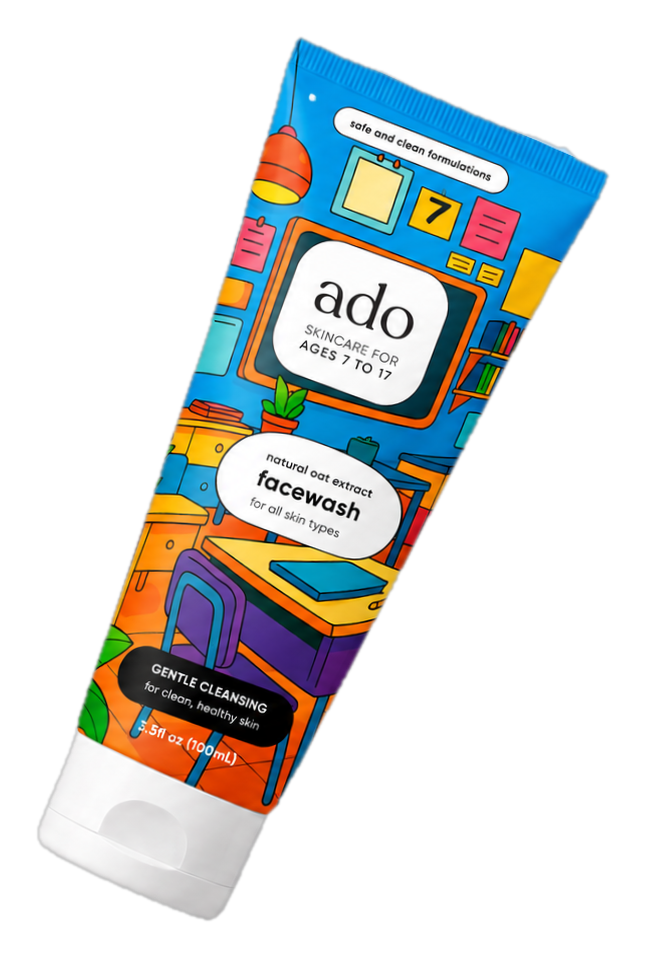
ado isn't an acne product, and it won't make pimples disappear; what it offers is a gentle base routine for ages 7–17. The ado Gentle Oat Face Wash is a sulfate-free, non-comedogenic gel for a non-stripping wash, and ado's mineral SPF 50+ sunscreen is also labelled non-comedogenic, with zinc oxide as its only UV filter. The ado Daily Moisturiser is a lightweight gel-cream with squalane and colloidal oatmeal that helps skin hold on to moisture; its label doesn't say non-comedogenic, and all three products list fragrance last, so patch-test first if your teen's skin is sensitive. If a dermatologist adds an acne product, ask them how it fits with the rest of the routine.
More for each age: skincare for tweens (10–12) and skincare for teens (13–17).
Made for growing skin
ado gentle oat face wash
Price ₹849

ado daily moisturizer
Price ₹949
Sources
- Teen Acne: How to Treat & Prevent This Common Skin Condition (2025) · American Academy of Pediatrics / HealthyChildren.org
- What makes teen acne worse? · American Academy of Pediatrics / HealthyChildren.org
- Food and Adolescent Acne · American Academy of Pediatrics / HealthyChildren.org
- A dermatologist's guide to skincare from growing up to glowing up (28 Oct 2025) · American Academy of Dermatology
- Acne: Tips for managing · American Academy of Dermatology
- 9 things to try when acne won't clear · American Academy of Dermatology
- Are your hair care products causing breakouts? · American Academy of Dermatology
- Is sports equipment causing your acne? · American Academy of Dermatology
- 7 reasons to treat acne early · American Academy of Dermatology
- 5 ways to help your teenager survive acne · American Academy of Dermatology
- Can the right diet get rid of acne? · American Academy of Dermatology
- Hair removal: How to shave · American Academy of Dermatology
- Contact reactions to toothpaste and other oral hygiene products · DermNet
- Phytophotodermatitis · DermNet
- Garlic · DermNet
- Topical corticosteroid abuse on the face: a prospective, multicenter study of dermatology outpatients (2011) · Indian Journal of Dermatology, Venereology and Leprology
- Topical Steroid Damaged/Dependent Face (TSDF): A Study from a Tertiary Care Hospital in Eastern India (2018) · Indian Journal of Dermatology
- Acne · NHS
- Acne (for teens) · KidsHealth (Nemours)
- Early or delayed puberty · NHS
- The digital dermatosis: social media's unintended impact on pre-adolescent skincare (2026) · Indian Journal of Dermatology, Venereology and Leprology
This guide is general information for parents, not medical advice. If you're worried about your child's skin, please see a dermatologist or paediatrician. How we write these guides.