Face washAges 10–12
Face Wash for a 12-Year-Old (10–12): What to Look For in India
Gentle, sulfate-free and no scrubbing: how to choose a face wash for a 10, 11 or 12-year-old, and what to leave on the shelf.
Quick answer
A 12-year-old needs a gentle, sulfate-free face wash with a soft lather, used morning and night and after sweaty sport. Look for mild cleansers such as coco-glucoside and little or no fragrance. Skip scrubs, exfoliating acids, adult de-tan or skin-lightening washes, and acne washes unless a doctor suggests one. The same advice suits 10 and 11-year-olds.
A 12-year-old needs a gentle, sulfate-free face wash with a soft lather, used in the morning, at night and after sweaty sport. Skip scrubs, exfoliating acids, adult de-tan or skin-lightening washes, and acne washes with benzoyl peroxide or salicylic acid unless a doctor has suggested one.
This guide is for parents of 10, 11 and 12-year-olds in India, and for tweens reading it themselves. It covers how to read a face wash label, what to leave on the shelf, how often to wash on school and sports days, and what to do about first pimples. If your child hasn't used a face wash yet, start with our guide on when kids should start using a face wash.
What changes at 10–12 that a face wash has to handle?
Puberty brings more oil, more sweat and often the first pimples, so at this age the face wash has a real job to do. KidsHealth (Nemours) says most girls start puberty between 8 and 13 and most boys between 9 and 14, and that hormones from the adrenal glands lead to body odour and acne.
Pimples can arrive earlier than many parents expect. The American Academy of Dermatology (AAD) says dermatologists now see 7-to-12-year-olds with acne. The American Academy of Pediatrics (AAP) explains that acne is "not caused by dirt on top of the skin but rather by extra oil combined with bacteria inside the skin". So a stronger, harsher wash isn't the answer; a gentle one used regularly is.
A 12-year-old's day also gives the face wash more to lift off: a sweaty PE period or cricket practice, a cap worn all afternoon, dust from the school bus, and sunscreen that needs to come off at night. The wash should clear all of that without leaving skin tight.
Girl or boy: does it change the face wash?
No. A face wash for a 12-year-old girl and one for a 12-year-old boy need exactly the same things. Girls often start puberty a little earlier, so oiliness may show up sooner, and any child who plays a lot of outdoor sport needs an extra wash after games. Pink or blue packaging doesn't change what's inside the tube.
What should a face wash for a 12-year-old have?
Look for a gentle, non-abrasive, alcohol-free cleanser without harsh sulfates, and ideally fragrance-free (the AAP lists fragrance among cleanser ingredients to avoid). That combines the AAD's face-washing advice with the cleanser checklist in the AAP's guide to trendy skincare for tweens and teens. The AAP lists glycerin, ceramides, hyaluronic acid and coco-glucoside as cleanser ingredients to look for, and sulfates such as sodium lauryl sulfate (SLS), alcohols, fragrances and physical scrubs as ones to avoid.
| On the label | What it means | For a 10–12-year-old |
|---|---|---|
| "Sulfate-free" or "SLS-free" | No sodium lauryl sulfate, a strong foaming cleanser | Look for it. The AAP lists sulfates among cleanser ingredients to avoid. |
| Coco-glucoside, glycerin, ceramides | A mild coconut-derived cleanser and skin-friendly moisturising ingredients | Good signs: all three are on the AAP's look-for list. |
| "Non-comedogenic" | Formulated not to clog pores | Helpful once pimples start. The AAD suggests non-comedogenic products on the face. |
| Fragrance, parfum or perfume | Added scent | Choose fragrance-free if your child has eczema, very sensitive skin or reacts to fragrance. |
| Alcohol or alcohol denat. near the top of the list | A drying solvent | Skip. The AAD advises a cleanser that doesn't contain alcohol. |
| Beads, granules, shell powder or "scrub" | Physical exfoliants | Skip. The AAP lists scrubs among cleanser ingredients to avoid. |
| Salicylic acid, glycolic acid, benzoyl peroxide | Acne and exfoliating actives | Only if a doctor suggests one (see below). |
| "De-tan" or "skin lightening" | Adult claims about changing skin colour | Skip. A tan fades on its own. |
Two more checks happen at the sink. First, how the skin feels afterwards: clean and comfortable is right, while tight, dry or stinging means the wash is too harsh. As the AAP puts it, "A product that stings or burns is a red flag—irritation isn't a sign it's working." Second, the amount: the AAD suggests using enough cleanser to remove dirt and oil, but not so much that you see a thick lather. A soft lather is plenty.
A word on fragrance. DermNet puts fragrance allergy at around 1.8% of children and adolescents, and the AAD's 2025 guide notes that added scents can trigger irritation or allergic reactions. If your child has eczema or skin that reacts easily, a fragrance-free label is the safer pick, and a patch test on the inner arm is worth doing before any new product goes on the face.
Which face washes should a 12-year-old skip?
Skip anything built for adult skin problems or for scrubbing. The AAD says children's skin is "thinner, more sensitive, and more prone to irritation than adult skin", and that retinol, vitamin C and exfoliating acids "target concerns like wrinkles, sun damage, and uneven skin tone, issues that children don't have".
- Scrubs and grainy washes. "Scrubbing can irritate your skin, causing acne to flare," the AAD warns. Fingertips do the job.
- Exfoliating-acid washes. Glycolic and lactic acid washes are made for adult skin concerns. The AAD says these actives "can cause redness, burning, or peeling, and provide no benefit to such young skin."
- Vitamin C or "glow" washes. Vitamin C is on the same AAD list of ingredients children don't need. "Glow" and "glass skin" are marketing words, not skin needs.
- Adult de-tan and skin-lightening washes. A tan fades on its own, and a child's skin colour isn't a problem to fix. A 2026 viewpoint in the Indian Journal of Dermatology, Venereology and Leprology (IJDVL) points to social media videos that emphasise "lighter, brighter skin", implicitly promoting "racialised beauty ideals". Our guide to tan after the summer holidays covers gentle care instead.
- Benzoyl peroxide or salicylic acid washes, unless a doctor suggests one. These are genuine acne ingredients, but the AAD notes that both "can cause dry skin and irritation". For the odd pimple, a gentle wash comes first.
- Strongly perfumed washes. The AAP lists fragrances and alcohols among cleanser ingredients to avoid.
- A parent's or older sibling's face wash, until you've read the label. If it lists any of the actives above, it isn't meant for a 12-year-old.
For the full list of adult actives and why dermatologists advise against them, see skincare ingredients tweens should avoid.
How often should a 12-year-old wash their face, and what about sport?
Twice a day, morning and night, plus after heavy sweating. That's the AAD's rule, and it warns that "washing your face several times a day can further irritate your skin, leading to more breakouts". If your child's skin is dry or sensitive, the AAD's 2025 guide says washing once, in the evening, may be enough.
Here's how that looks on a school day:
- Morning, before school: lukewarm water, a little face wash on the fingertips, gentle circles, rinse and pat dry with a soft towel. Then moisturiser, and sunscreen as the last step.
- After PE, cricket, football or dance: blot sweat with a clean towel or handkerchief rather than wiping it. "Wiping sweat off can irritate your skin, which can lead to a breakout," the AAD says. Wash once there's a sink, and reapply sunscreen before heading back out.
- After swimming class: rinse off the pool water, then wash gently at home. The AAP advises reapplying sunscreen every 2 hours and after swimming, sweating or drying off with a towel.
- Night: wash off sunscreen, sweat and dust, then moisturise.
A few habits matter as much as the wash. The AAD suggests washing sweaty headbands, caps, towels and clothes before wearing them again, and keeping oily hair off the face, because "the oil from your hair can cause acne on your forehead" (AAD acne tips). That includes hair oil on school mornings.
Weather changes how often, not what. In monsoon humidity, skin may feel stickier, so add a wash after sweaty activities rather than extra washes through the day. In a North Indian winter, if skin feels tight, a splash of lukewarm water in the morning and the face wash at night can be enough. Our skincare routine for a 12-year-old shows how the wash fits with moisturiser and sunscreen.
Should a 12-year-old use an acne face wash for first pimples?
Not as a first step. For a few pimples, a gentle wash twice a day, hands off and patience come first. An acne wash with benzoyl peroxide or salicylic acid is worth discussing with a doctor if pimples keep coming back.
The AAD's advice is to wash gently up to twice a day and after sweating, and to keep hands off, because picking, popping or squeezing "will make the acne take longer to clear and increase your risk for scarring". On brown skin, the AAD notes that dark spots after acne "can last much longer than the acne" itself, which is one more reason not to squeeze. Give any change time: the AAD says it "may take several weeks to few months" to see a difference.
If breakouts are regular, the AAD's 2025 guide mentions adding salicylic acid or benzoyl peroxide, while warning that both can dry and irritate the skin. A paediatrician or dermatologist can say whether your child needs one, which one and how often. If one is suggested, use one acne product at a time, and know that benzoyl peroxide bleaches fabric: the AAP suggests using an old towel and pillowcase.
Our guide to pimples at 13 goes further, and our page on steroid creams on a child's face explains why a chemist's "pimple cream" can be the wrong answer.
When should a 12-year-old see a doctor about their skin?
See a paediatrician or dermatologist if pimples are painful or leaving marks, if a gentle wash still causes redness or stinging, or if skin worries are affecting your child's mood.
See a doctor if:
- pimples are deep, painful or lumpy, or are leaving dark marks or scars
- pimples haven't improved after a few months of gentle care, which is when the AAD suggests seeing a dermatologist
- the face turns red, stings, peels or itches after washing, even with a gentle product (stop the product and rinse with water first)
- dry, itchy patches keep coming back
- a chemist, relative or friend has suggested a steroid or "mixed" cream for pimples or marks; never use one on the face unless a doctor has prescribed it for that purpose
- your child seems sad or withdrawn about their skin; the AAD lists sadness that lasts two weeks or longer and avoiding social activities as signs to act on
How ado fits in
ado Gentle Oat Face Wash is a soft-lather gel made for ages 7–17, with coconut-derived cleansers (coco-glucoside among them), glycerin and oat kernel extract. It's sulfate-free (so SLS-free), dye-free, paraben- and phthalate-free and non-comedogenic, and it's non-stripping, so it suits morning, night and after-sport washing. ado's products contain fragrance (it's the last ingredient on each label); if your child has eczema, very sensitive skin or reacts to fragrance, patch-test first or choose fragrance-free. It's gentle daily care, not an acne treatment; for the rest of the routine, see our hub on skincare for tweens (10–12).
Made for growing skin
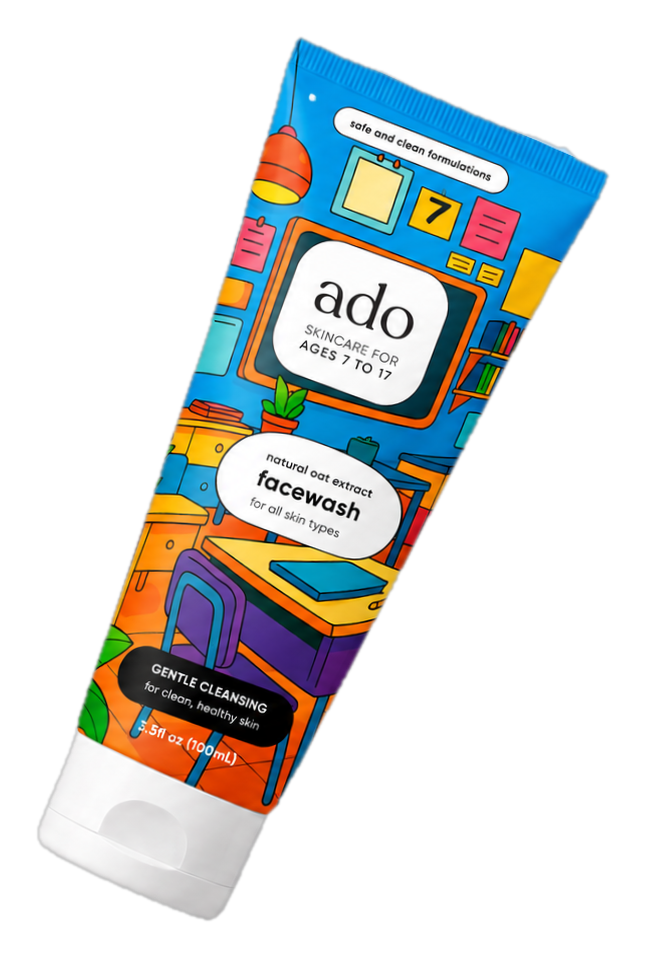
ado gentle oat face wash
Price ₹849
Sources
- Understanding Puberty (reviewed May 2022) · Nemours KidsHealth
- 7 reasons to treat acne early · American Academy of Dermatology
- Teen Acne: How to Treat & Prevent This Common Skin Condition (updated 3 Apr 2025) · American Academy of Pediatrics / HealthyChildren.org
- Trendy Skin Care for Tweens & Teens: Is It Safe? (updated 7 Aug 2025) · American Academy of Pediatrics / HealthyChildren.org
- Face washing 101 · American Academy of Dermatology
- A dermatologist's guide to skincare from growing up to glowing up (28 Oct 2025) · American Academy of Dermatology
- 10 skin care habits that can worsen acne · American Academy of Dermatology
- Acne: Tips for managing · American Academy of Dermatology
- 12 summer skin problems you can prevent · American Academy of Dermatology
- Dermatologists' top tips for relieving dry skin · American Academy of Dermatology
- 10 tips for clearing acne in darker skin tones · American Academy of Dermatology
- 5 ways to help your teenager survive acne · American Academy of Dermatology
- Sun Safety: Information for Parents About Sunburn & Sunscreen (updated 9 Aug 2024) · American Academy of Pediatrics / HealthyChildren.org
- Fragrance allergy (2020) · DermNet
- The digital dermatosis: social media's unintended impact on pre-adolescent skincare (viewpoint, 23 Feb 2026) · Indian Journal of Dermatology, Venereology and Leprology
This guide is general information for parents, not medical advice. If you're worried about your child's skin, please see a dermatologist or paediatrician. How we write these guides.