Skincare by age
Skincare for Kids Aged 7–9: A Gentle Guide for Parents
What 7, 8 and 9 year olds actually need for their skin, what they can skip, and how to make it a habit they own.
Quick answer
Most 7–9 year olds need very little: a gentle face wash when their face is sweaty or dirty, a light moisturiser if their skin feels dry, and a broad-spectrum sunscreen before time outdoors. Skip adult serums, acids and retinol. Keep it to a couple of minutes, and let your child do it themselves.
A 7, 8 or 9 year old needs very little skincare: a gentle wash when their face is sweaty or grimy, a light moisturiser if their skin feels dry, and sunscreen before time outdoors. That's the whole routine, and it takes about two minutes.
This guide is for Indian parents of 7 to 9 year olds: what's different about skin at this age, what's worth doing, what to skip, and how to make it a habit your child owns. If your child is older, see skincare for tweens (10–12) or skincare for teens (13–17).
How is a 7–9 year old's skin different from baby skin and adult skin?
It isn't adult skin yet. Paediatric dermatologists writing for the American Academy of Pediatrics describe the skin of tweens and teens as thinner, more sensitive and more easily irritated than adult skin. A 2026 viewpoint in the Indian Journal of Dermatology, Venereology and Leprology (IJDVL) adds that younger skin is more delicate and more permeable than adult skin, meaning more of what you put on it can pass into the skin.
Put simply, young skin tends to be more reactive and more absorbent than yours. That's why products made for adult concerns are more likely to cause redness or stinging.
It isn't baby skin either, at least not in how it's used. A 7-year-old's day includes morning assembly in the sun, PT period, cricket or football after school, swimming class and a sticky bus ride home. Baby products were made for a baby's day, not for sweat, dust and sunscreen that needs washing off at night.
Puberty is also on the horizon. KidsHealth (Nemours) says most girls start puberty between 8 and 13 and most boys between 9 and 14, so some 8 and 9 year olds will begin to notice changes such as body odour.
What does a 7–9 year old's skin actually need?
Three things, and only when they're needed.
- A gentle cleanse when the face is sweaty or dirty. After school, sport or a day of sunscreen, wash with lukewarm water and a mild face wash, using fingertips rather than a cloth, then pat dry. The American Academy of Dermatology (AAD) advises against scrubbing because it irritates skin. In its 2025 skincare guide, the AAD notes that washing once a day in the evening may be enough for dry or sensitive skin. More in our guide to face wash for kids.
- Moisturiser if the skin feels dry. Many kids this age don't need one every day. Smooth a thin layer onto slightly damp skin after a bath or face wash, especially in North Indian winters, in air-conditioned classrooms, or after swimming. When you shop for a kids' facewash or moisturizer, keep it plain and gentle, and choose fragrance-free if your child has eczema, very sensitive skin or reacts to fragrance; the AAD's guide for tweens suggests a fragrance-free moisturiser.
- Sunscreen on days outdoors. For children over six months, the Indian Sunscreen Forum's 2025 consensus recommends a broad-spectrum sunscreen of at least SPF 15, applied before going out and every two hours, or more often with sweating or swimming. It prefers mineral filters (zinc oxide and titanium dioxide) for children, because some chemical filters can trigger allergies. The AAD and the American Academy of Pediatrics (AAP) suggest SPF 30 or higher. SPF (sun protection factor) shows how well a sunscreen protects against UVB, the rays that burn; broad-spectrum means it covers UVA too. See our guides to sunscreen for a 9-year-old and sunscreen for kids in India.
The same consensus suggests avoiding direct sun between 10 am and 4 pm where you can, with shade, hats and sunglasses. School timings make that hard, so sunscreen plus a cap for outdoor games is a realistic middle ground.
Every skin tone needs sun protection. Brown skin still tans and can develop darker patches, and the Indian Sunscreen Forum notes that pigmentation problems are more common in deeper skin types. A tan fades on its own, so there's no need for de-tan packs; our guide to tan after the summer holidays explains gentle care.
| When | What to do | Good to know |
|---|---|---|
| Before school | Splash face with water. Moisturiser if dry. Sunscreen on face, ears and neck. | Put sunscreen on at home, so it's done before assembly. |
| After school or sport | Gentle face wash and lukewarm water. | Washes off sweat, dust and sunscreen. Pat dry, don't rub. |
| Outdoor games or sports day | Reapply sunscreen about every two hours. | Also after sweating or towel drying. |
| Swimming class | Sunscreen before. Shower with fresh water after, then moisturise. | Reapply if they're heading back into the sun. |
| Bedtime | Moisturiser only if skin feels dry or tight. | Nothing else needed. |
What can kids this age skip?
Most of what's in an adult bathroom cabinet. The AAD says ingredients like retinol, vitamin C and exfoliating acids target adult concerns such as wrinkles, sun damage and uneven tone. The AAP's dermatologists list redness, peeling and rashes among the risks when young skin meets these products.
- Retinol and other retinoids
- Exfoliating acids (AHAs such as glycolic acid, BHAs such as salicylic acid) and face scrubs
- Vitamin C serums, toners, essences and anything sold as anti-ageing
- Bleach, de-tan packs and skin-lightening creams
- Any cream from the chemist on the face without a doctor's advice, especially steroid creams (read why dermatologists warn against steroid creams)
If a product stings or burns, stop using it. The AAP's dermatologists point out that stinging is a warning sign, not proof a product is working. Curious about sunscreen filters? See mineral vs chemical sunscreen for kids.
What about school, sports and swimming?
Put sunscreen on at home, top it up for outdoor games, and wash off sweat, sunscreen and pool water afterwards.
- School days: Assembly, PT and lunch-break games add up. Apply sunscreen at home, and if the school allows it, pack a small tube for afternoon games.
- Cricket, football and sports day: A cap, sunscreen every two hours and plenty of water. The AAD suggests blotting sweat with a clean towel, because wiping can irritate skin. A quick face wash after play washes off sweat and sunscreen.
- Swimming classes: Pool water can leave skin dry and irritated. The AAD advises showering with fresh, clean water straight after the pool, then moisturising. Sunscreen goes on before, and again after towel drying if they're staying outdoors.
- Monsoon and humid months: Use less moisturiser, or none when skin feels oily. Keep up the sunscreen: the AAP advises it every day, even when it's cloudy.
Is body odour at 8 or 9 a sign of puberty?
Often, yes. KidsHealth explains that body odour usually starts around puberty, typically between 8 and 13 in girls and 9 and 14 in boys, as hormones change. A daily bath, especially after sweating or on hot days, and clean clothes, underwear and socks usually handle it. Our guide to body odour and a first deodorant covers when a deodorant makes sense.
When to see a doctor: Talk to your paediatrician if your daughter has body odour before about 7 or 8, or your son before 9, or if you notice any other signs of puberty before 7 in a girl or 9 in a boy (KidsHealth). See a doctor, too, for a rash, swelling or redness that doesn't settle after you stop a product, or for dry, itchy patches that keep coming back.
How do you make skincare fun, and something they do themselves?
Keep it short, let your child do it themselves, and tie it to things they already do.
- Keep it short. Two steps on most days, three before outdoor time. One favourite song is a good timer.
- Let them do it. Show them once: dot sunscreen on the forehead, both cheeks, nose and chin, then blend outwards, not forgetting the ears and the back of the neck.
- Put things where they'll be used. Sunscreen next to the school shoes, face wash at their height by the sink.
- Make it a game. A sticker chart on the mirror for a week of "sunscreen before school" helps the habit stick.
- Talk about what skin does, not how it looks. Skin protects us from sun, germs and scrapes. Skincare is looking after it, not changing it.
- Do it together. Kids copy what they see. If you put sunscreen on before leaving the house, they're more likely to as well.
For your child to read: Your skin works hard all day. Wash off the sweat and dust, keep it comfy, and shield it from strong sun. That's all it needs from you.
Still using baby products? Our ado vs baby skincare page explains when a baby product is still fine and when to switch.
Read next: skincare by age, from 7 to 17 · SPF 30 vs SPF 50 for kids · best skincare for kids in India: ado and 9 other brands
How ado fits in
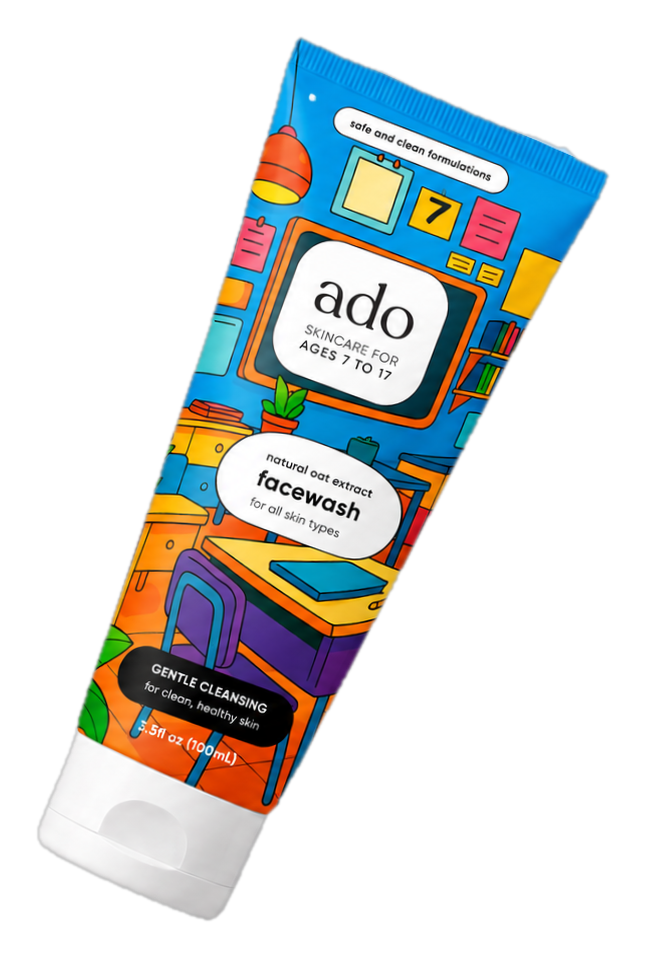
ado is an Indian skincare brand made for growing skin aged 7–17, with oat in every step and no retinoids, exfoliating acids or vitamin C serums in the range. For most 7–9 year olds, the gentle oat face wash (sulfate-free, dye-free and non-comedogenic) and ado's mineral SPF 50+ sunscreen, where zinc oxide is the only UV filter, cover everyday needs, with the lightweight daily moisturiser for dry spells. ado's products contain fragrance (it's the last ingredient on each label); if your child's skin is sensitive, patch-test first or choose a fragrance-free option. If you'd rather have all three, the Tween's Kit has the full routine.
Sources
- Trendy Skin Care for Tweens & Teens: Is It Safe? · American Academy of Pediatrics (HealthyChildren.org)
- The digital dermatosis: social media's unintended impact on pre-adolescent skincare · Indian Journal of Dermatology, Venereology and Leprology (IJDVL)
- Practical Recommendations for Indians on Sunscreen Use: A Modified Delphi Consensus by Indian Sunscreen Forum (PRISM-ISF) · Journal of Cosmetic Dermatology (via PubMed Central)
- A dermatologist's guide to skincare from growing up to glowing up · American Academy of Dermatology
- Face washing 101 · American Academy of Dermatology
- 12 summer skin problems you can prevent · American Academy of Dermatology
- Understanding Puberty · Nemours KidsHealth
- Deodorant Use for Kids and Teens · Nemours KidsHealth
This guide is general information for parents, not medical advice. If you're worried about your child's skin, please see a dermatologist or paediatrician. How we write these guides.