

Sun careAges 7–17
Sunscreen for Kids in India: A Parent's Guide (Ages 7–17)
Why Indian children need sunscreen, how much to use, a school-day plan and the myths worth ignoring, for ages 7 to 17.

Quick answer
Yes, sunscreen is safe and recommended for children over six months. In India, most school-age children need it on most days. Use a broad-spectrum sunscreen with SPF 30 or higher, put it on every morning as the last step, and reapply before PE, sports or swimming, and about every two hours outdoors.
Sunscreen is safe and recommended for children older than six months, and in most of India, school-age children need it on most days, not only on holidays. Choose a broad-spectrum sunscreen with SPF 30 or higher, put it on every morning as the last step before school, and top it up before long spells outdoors such as PE, sports practice or swimming class.
This guide is for parents of children aged 7 to 17, and for teens reading it themselves. It covers what SPF and PA mean, mineral versus chemical sunscreen (some people still call it sunblock), how much to use, a simple school-day plan, what changes with age, the myths worth ignoring and when to see a doctor.
Why do children in India need sunscreen?
Because the sun here is strong for much of the year. The UV index is a scale that shows how intense the sun's ultraviolet (UV) rays are. The World Health Organization recommends sun protection from a UV index of 3, and says that at 8 and above, shade, a shirt, a hat and sunscreen are a must.
Indian cities often go well past that. A study of satellite UV data for four Indian megacities found monthly average UV index readings from March to May 2019 of about 9.5 to 12 in New Delhi and about 12.8 to 13.8 in Chennai, with Mumbai and Kolkata above 11 in every month studied. In March 2026, India TV News reported that Bengaluru's UV index reached 13, even though the weather felt mild. An index above 11 counts as extreme.
For Indian children, the effects you notice first are usually a tan, uneven patches, and pimple marks that stay dark for longer. A tan isn't a problem with skin colour; it's the skin reacting to UV. The American Academy of Dermatology (AAD) explains that when skin darkens after sun, it is responding to damage to its DNA from UV rays. A tan fades by itself over time, and our guide to tan after the summer holidays covers gentle care in the meantime.
There's a longer-term reason too. A review in the Indian Dermatology Online Journal notes that UV exposure in childhood carries a higher skin cancer risk than exposure later in life, while also pointing out that data for darker Indian skin types is limited. Either way, sun protection is a habit that is easiest to build young.
School life adds up. Morning assembly, PE, recess games, sports day, cricket or football practice and the wait at the bus stop can mean a lot of time in the sun. The same review suggests schools keep children indoors during peak sun hours and avoid sports practice at those times, which not every school can manage.
What do SPF, PA and "broad spectrum" mean?
SPF measures protection from UVB (the sunburn rays), PA grades protection from UVA (the tanning rays), and broad spectrum means both are covered. Sunlight contains two kinds of UV that matter for skin. UVB rays are the main cause of sunburn. UVA rays play a big part in tanning and dark patches. A good sunscreen protects against both.
- SPF (sun protection factor) tells you how well a sunscreen filters UVB. According to the American Academy of Dermatology, SPF 15 filters about 93% of UVB and SPF 30 about 97%. Higher numbers filter slightly more, but no sunscreen blocks everything, and the AAD adds that a high SPF doesn't last any longer on the skin than a lower one.
- PA (protection grade of UVA) is a UVA rating you'll see on many sunscreens sold in India. It is based on how well a sunscreen stops UVA from tanning the skin. It runs from PA+ to PA++++, and more plus signs mean more UVA protection.
- Broad spectrum means the sunscreen protects against both UVA and UVB.
Which SPF should you pick? The Indian Sunscreen Forum consensus (PRISM-ISF, 2025) sets SPF 15 as the minimum for children over six months. The AAD and the American Academy of Pediatrics' HealthyChildren.org advise SPF 30 or higher for daily use in tweens and teens. SPF 50 adds a margin for long outdoor days, and that margin is useful because most people put on far less sunscreen than the amount used in lab tests.
Mineral or chemical sunscreen?
Mineral sunscreens use zinc oxide or titanium dioxide as their UV filters. Chemical (also called organic) sunscreens use filters such as avobenzone or octocrylene. For children, the AAD suggests sunscreens with zinc oxide or titanium dioxide because they are less likely to irritate sensitive skin, and PRISM-ISF prefers these filters because chemical filters may contain potential allergens. Both types work when used properly. Our guide to mineral vs chemical sunscreen for kids goes through the evidence, the white cast trade-off and how to read an ingredient list.
How much sunscreen does a child need, and how often?
Enough for a visible layer on the face, ears and neck before blending, topped up about every two hours outdoors and after swimming, sweating or towel drying. Most people use too little. The lab tests behind an SPF number use a generous layer, and a 2002 letter in the BMJ estimated that people typically apply so much less that they get perhaps a third of the SPF on the label.
For adults, the AAD suggests at least one teaspoon for the face, about the length of the index and middle fingers. PRISM-ISF suggests one to two teaspoons for the face and neck. A child's face is smaller, so they need a little less, but the aim is the same: a layer you can see before you blend it in, covering the face, ears, neck and any skin the uniform leaves bare.
How often to reapply depends on the day. The AAD and HealthyChildren.org say to reapply about every two hours when outdoors, and after swimming, sweating or towel drying. PRISM-ISF adds a useful point for indoor days: if enough was applied in the morning, sunscreen doesn't simply wear off with time; sweat, swimming and rubbing are what remove it. So a child who spends most of the day in class needs a good morning layer and a top-up before time outdoors.
A school-day sunscreen plan
- Before school: after washing and moisturising, put sunscreen on as the last step, ideally 15 to 30 minutes before heading out. Dot it on the forehead, cheeks, nose and chin, then blend outwards. Don't forget the ears, the back of the neck and the hands.
- In the school bag: pack a small tube or stick in the pencil pouch or the front pocket, where your child will see it.
- Before outdoor PE, recess games or lunch outside: a quick top-up on the face, ears and neck.
- Sports practice, sports day or a match: reapply before starting, then about every two hours, and after heavy sweating. Pat the face dry with a towel first.
- Swimming class: reapply once your child is out of the pool and towelled dry.
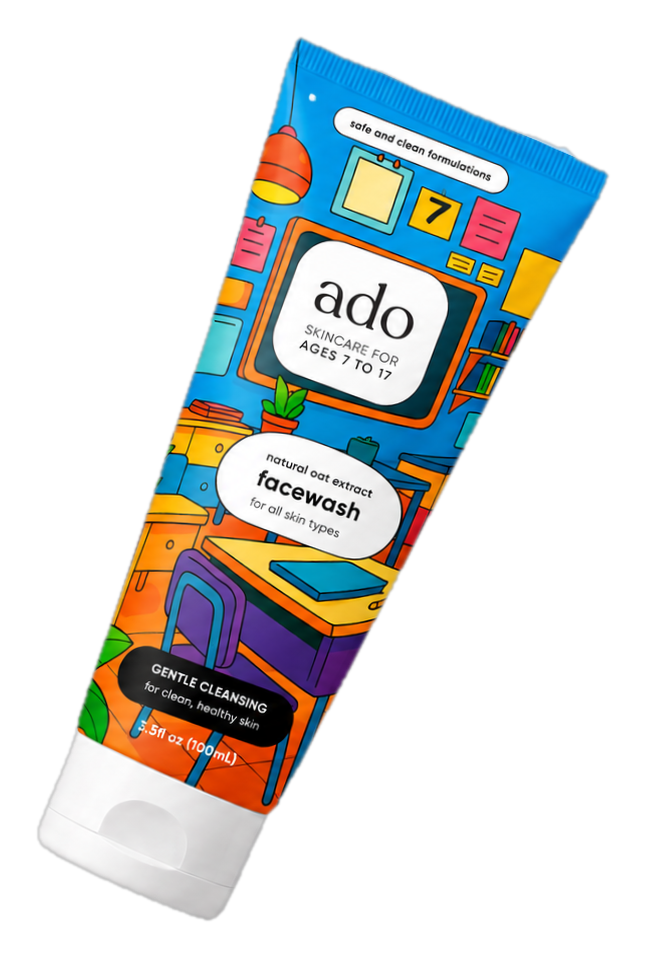
- Evening: wash the face with a gentle face wash to take off sunscreen, sweat and dust. Our guide to face wash for kids explains what to use.
Tip: Keep the sunscreen next to the toothbrush or the school ID card. A habit sticks when it's tied to something your child already does every morning.
Hats, shade and timing matter too
Sunscreen is one layer of protection, not the whole plan. The AAD reminds families that no sunscreen blocks all UV, so shade and clothing matter as well. HealthyChildren.org suggests a hat with a brim of about 3 inches (roughly 7.5 cm) all round, and limiting sun between 10 am and 4 pm, when UV is strongest.
- A brimmed cap or wide-brimmed hat for sports day, outings and long walks.
- Light, loose, full-sleeved cotton for long outdoor events.
- Sunglasses for long hours outside.
- Shade for breaks and water stops during practice.
What changes between ages 7 and 17?
The basics stay the same: broad spectrum, enough of it, reapplied when needed. What changes is the skin, and who does the applying.
Ages 7–9: you apply, they learn
Younger children often dislike sticky textures and stinging eyes, so a gentle mineral sunscreen and a simple dot-and-blend routine help. This is also a good age to teach them to do it themselves. See sunscreen for a 9-year-old (and 7–8 year olds) and our hub on skincare for kids aged 7–9.
Ages 10–12: puberty begins
During puberty, oil glands become more active, so skin can get oilier and the first pimples appear. This is also when social-media skincare, including tinted and "glow" sunscreens with adult actives, starts to appeal. Our sunscreen checklist for a 10–12-year-old and the hub on skincare for tweens (10–12) cover this stage.
Ages 13–17: pimples, white cast and sport
Teens often worry that sunscreen will cause pimples or leave a white cast, and long match days make reapplying harder. Labels such as "non-comedogenic", lighter gel textures and thin, well-blended layers help. Read sunscreen for teenagers in India and the hub on skincare for teens (13–17).
Which sunscreen myths can you ignore?
Four common ones: that dark skin doesn't need sunscreen, that cloudy days don't count, that cool weather means low UV, and that sunscreen causes vitamin D deficiency.
"Dark skin doesn't need sunscreen"
Melanin-rich skin still needs protection. KidsHealth (Nemours) advises that all children, whatever their skin tone, wear SPF 30 or higher, because darker skin can still get painful sunburns. The AAD also notes that visible light from the sun can deepen dark patches, particularly in darker skin tones. Sunscreen isn't about changing your child's skin colour; it's about protecting the skin they have.
"Cloudy and monsoon days don't count"
Up to 80% of the sun's UV rays can get through clouds, according to HealthyChildren.org. In monsoon humidity a lighter lotion or gel feels better than a heavy cream, but the habit stays the same.
"If it isn't hot, the UV isn't high"
UV isn't the same as heat. Bengaluru's pleasant March weather came with an extreme UV index of 13. North Indian winters bring gentler sun, but the AAD points out that skin is exposed to UV every time you go outside, even on cloudy days and in winter.
"Sunscreen will cause vitamin D deficiency"
Vitamin D deficiency is common in Indian children, and the reasons go well beyond sunscreen. A 2025 Indian expert consensus on vitamin D cites a multicentre study in which more than half of Indian children and adolescents were deficient or insufficient, and the IDOJ review notes this happens despite sunshine almost all year round. PRISM-ISF concludes that sunscreens have minimal impact on vitamin D levels when used as advised.
The picture isn't completely simple. A 2025 study of 277 children in Jamnagar found that children who got less than an hour of sun a day were more often deficient, and that sunscreen users had higher deficiency rates, although a study of this kind can't show cause and effect. The Indian vitamin D consensus suggests healthy adolescents get 30 to 45 minutes of sun on uncovered forearms and legs, without sunscreen, between 10 am and 3 pm. That sits alongside advice to limit midday sun, which is one reason to decide with your child's doctor. Ask your paediatrician about testing, diet and whether a supplement is needed, and read what Indian studies say about sunscreen and vitamin D.
What should you check on the label?
Check for broad spectrum, SPF 30 or higher, the UV filter, fragrance and pore-clogging wording, and the expiry date.
- "Broad spectrum", or clear protection against both UVA and UVB.
- SPF 30 or higher for daily use. SPF 15 is the Indian consensus minimum for children.
- A PA rating. More plus signs mean more UVA protection.
- Zinc oxide or titanium dioxide as the filter if your child has sensitive skin or eczema. Children's Hospital of Philadelphia suggests mineral sunscreens for young children and anyone with sensitive skin or eczema.
- Fragrance. For sensitive skin, the AAD suggests avoiding fragrance, parabens and oxybenzone.
- "Non-comedogenic" or "won't clog pores" if your child gets pimples. A comedone is a clogged pore, so the label means the product is made not to clog pores.
- No adult actives. The AAD says retinol, vitamin C and exfoliating acids can cause redness, burning or peeling and don't help young skin. A child's sunscreen doesn't need them.
- A texture your child will actually wear: a gel or light lotion for humid months and oily skin, something creamier for dry winter skin.
- The right format: lotion for the face, a stick for around the eyes. The AAD advises spraying spray sunscreens into your hands first, never straight at the face.
- The expiry date. Throw out sunscreen that has expired, or one you've had so long you can't remember when you bought it.
When to see a doctor
See a doctor if: a sunburn blisters, or comes with pain or fever. HealthyChildren.org advises calling your child's doctor for any of these.
- A rash, itching, redness or swelling appears after a new sunscreen. Stop using it and ask a paediatrician or dermatologist. HealthyChildren.org notes that a product that stings or burns is a red flag.
- Dark patches keep spreading, or haven't faded after a few months.
- Your child takes a medicine, including some acne medicines, that can make skin more sensitive to the sun. The AAD flags this for acne medicines in particular.
- You're worried about vitamin D, your child's diet or how much time they get outdoors.
Comparing brands? Our guide to the best sunscreen for kids in India sums up what we found reading 19 labels.
How ado fits in
ado's mineral SPF 50+ sunscreen is made for ages 7–17, with zinc oxide as its only UV filter, colloidal oatmeal and a lightweight, non-greasy, non-comedogenic finish. No PA rating is stated; it's labelled broad spectrum (UVA/UVB), and it's paraben- and phthalate-free, with the full ingredient list on the product page. ado's products contain fragrance (it's the last ingredient on each label); if your child's skin is sensitive, patch-test first or choose a fragrance-free option. It's step three of a simple morning routine, and the ado Tween's Kit puts the face wash, moisturiser and sunscreen together.
Made for growing skin

ado mineral sunscreen (SPF 50+)
Price ₹1,499

The complete routine
Tween's Kit
The complete ado routine in one box: cleanse, moisturise, protect.
- Cleanse Facewash
- Hydrate Moisturiser
- Protect Sunscreen
Price
₹2,699Regular price
₹3,297
Save ₹598
Sources
- Radiation: The ultraviolet (UV) index · World Health Organization
- Variation and correlation between ultraviolet index and tropospheric ozone during COVID-19 lockdown over megacities of India (Stoch Environ Res Risk Assess, 2021) · Bera B, et al. (via PubMed Central)
- Bengaluru UV index hits 'Extreme' 13: Doctor warns of serious sun exposure risks (11 Mar 2026) · India TV News
- AAD survey: half of Gen Z got sunburned in 2024 (20 May 2025) · American Academy of Dermatology
- Sun Exposure in Children: Balancing the Benefits and Harms (Indian Dermatol Online J, 2020) · Indian Dermatology Online Journal (via PubMed Central)
- How to decode a sunscreen label · American Academy of Dermatology
- Sunscreen FAQs · American Academy of Dermatology
- Practical Recommendations for Indians on Sunscreen Use: A Modified Delphi Consensus by Indian Sunscreen Forum (PRISM-ISF), J Cosmet Dermatol 2025 · Journal of Cosmetic Dermatology (via PubMed Central)
- Trendy Skin Care for Tweens & Teens: Is It Safe? (2025) · American Academy of Pediatrics / HealthyChildren.org
- Simple dosage guide for suncreams will help users (BMJ, 2002) · BMJ (via PubMed Central)
- How to apply sunscreen · American Academy of Dermatology
- Sun Safety: Information for Parents About Sunburn & Sunscreen · American Academy of Pediatrics / HealthyChildren.org
- 5 common sunscreen mistakes and how to avoid them · American Academy of Dermatology
- How to Choose & Use Sunscreen · KidsHealth (Nemours)
- Sunscreen FAQs (media resource) · American Academy of Dermatology
- Prevention and Treatment of Vitamin D Deficiency in India: An Expert Group Consensus (Indian J Endocrinol Metab, 2025) · Indian Journal of Endocrinology and Metabolism (via PubMed Central)
- Prevalence and determinants of vitamin D deficiency among children aged 9 months to 12 years at a tertiary care center in western India (BMC Pediatrics, 2025) · BMC Pediatrics (via PubMed Central)
- Is Sunscreen Safe? (19 May 2025) · Children's Hospital of Philadelphia
- How do I know if I'm using the right sunscreen? · American Academy of Dermatology
- A dermatologist's guide to skincare from growing up to glowing up (28 Oct 2025) · American Academy of Dermatology
- How to use stick and spray sunscreens · American Academy of Dermatology
- Acne: Tips for managing · American Academy of Dermatology
This guide is general information for parents, not medical advice. If you're worried about your child's skin, please see a dermatologist or paediatrician. How we write these guides.


