RoutinesAges 13–17
Skincare Routine for a 14 or 15-Year-Old: What Actually Helps and What to Buy
Acne often peaks in the mid-teens. A calm routine for oily skin, sport, exams and first shaves, and the signs that need a dermatologist.
Quick answer
A 14 or 15-year-old needs three basics: a gentle face wash morning, night and after sport, a light moisturiser, and broad-spectrum sunscreen (SPF 30 or higher) every morning. Acne often peaks around this age, so don't pick, choose non-comedogenic products, and see a dermatologist if pimples are painful, scarring or not better after a few months.
A 14 or 15-year-old needs a short, steady routine: a gentle face wash morning and night and after sport, a light moisturiser, and a broad-spectrum sunscreen with SPF 30 or higher every morning. Acne commonly peaks around this age, so the aim is calm, consistent care rather than stronger products, plus a dermatologist if pimples turn painful, leave marks or won't settle.
This guide is for parents of 14 and 15-year-olds, and for teens reading it themselves. It covers oily skin, sport and helmets, exam stress and sleep, a sunscreen they'll actually wear, shaving basics, and the specific signs that mean it's time to see a dermatologist.
Why does skin get oilier and spottier at 14 and 15?
Because puberty hormones are in full swing, and acne commonly peaks in the mid-teens. A review in Adolescent Health, Medicine and Therapeutics (2016) reports that new cases of acne peak at about age 15 in both girls and boys, then decline in the late teens as puberty completes. The American Academy of Pediatrics (AAP) says around 85% of people have acne as teens.
Hormones tell the oil glands to make more sebum, the skin's natural oil. Oil and dead skin cells block pores, and normal skin bacteria multiply inside them. The AAP is clear that acne isn't caused by dirt, and it can't be scrubbed off.
At this age you might notice:
- a shiny forehead, nose and chin by the end of the school day
- blackheads and whiteheads (clogged pores), plus red pimples
- spots on the neck, shoulders, upper back or chest, which the AAP says acne can also affect
- flare-ups around exams, or just before a period
Girls usually start puberty earlier, and the 2016 review links this with more acne in girls at younger ages.
What's a simple skincare routine for a 14 or 15-year-old?
Three steps in the morning, two at night, and a wash after sport. That's enough for most teens, oily skin included.
| When | Step | What to look for |
|---|---|---|
| Morning | 1. Cleanse | Gentle, sulfate-free face wash (no SLS) |
| Morning | 2. Moisturise | Light gel or gel-cream; "non-comedogenic" (made not to clog pores) if pimple-prone |
| Morning | 3. Protect | Broad-spectrum sunscreen, SPF 30 or higher, as the last step |
| After sport | Wash | Same face wash; reapply sunscreen if going back out |
| Night | 1. Cleanse | Same face wash, to remove sunscreen, sweat and dust |
| Night | 2. Moisturise | Same light moisturiser |
- Wash up to twice a day and after sweating. That's the American Academy of Dermatology (AAD) advice for acne-prone skin, using fingertips, not scrubs.
- Keep the moisturiser. The AAP notes that many acne treatments cause dryness, so a daily oil-free moisturiser helps.
- Change one thing at a time. The AAD warns that switching acne products too often can irritate skin.
ado is an Indian skincare brand made for kids, tweens and teens aged 7–17: a gentle oat face wash, a moisturiser and a zinc oxide SPF 50+ sunscreen. Any gentle products that match the table will work. See face wash for teenagers in India for step one, and skincare ingredients to skip for why retinol, acids and vitamin C can wait.
How should a sporty teen handle sweat, helmets and kit?
Wash the face soon after sport, keep kit clean, and put soft padding between gear and skin. Heat and sweat trapped under helmets, straps and tight clothing can set off breakouts where the gear sits.
The AAD calls this acne mechanica: bumps that appear where equipment rubs, such as a cricket helmet, chin strap, shoulder pads or a heavy backpack strap. The AAP also says equipment or tight clothing that presses on the skin may make acne worse in that area.
A kit-bag checklist:
- face wash or a clean-water rinse, and a clean towel to pat the face dry
- clean, soft padding under helmets and straps, which the AAD says can stop the rubbing
- loose, moisture-wicking clothes next to the skin
- caps and headbands washed often; the AAD notes unwashed caps collect sweat and oil that can make acne flare
- sunscreen, to reapply after towel drying
Back and chest spots follow the same rules: shower soon after practice and change out of a sweaty jersey. If bumps under gear last beyond 6 to 8 weeks of care, the AAD says a dermatologist can help.
Can exam stress and late nights make pimples worse?
They can. Stress doesn't cause acne, but the AAP says research shows teenagers tend to have worse acne when school is stressful, and it lists regular exercise, healthy sleep and supportive relationships as ways to lower stress.
For many Indian families, 15 means Class 10 board exams, tuition and late-night revision. A flare in exam season doesn't mean the routine has failed, and it isn't the moment to start a new serum.
Sleep matters too. A consensus statement from the American Academy of Sleep Medicine, endorsed by the AAP, recommends 8 to 10 hours of sleep in every 24 for teenagers aged 13 to 18. The AAP explains that sleep-wake cycles shift up to two hours later at puberty, so many teens feel wide awake at midnight.
- Keep the skincare routine the same through exams.
- Keep hands off the face while studying; the AAD says touching the face through the day can make acne flare.
- Switch off screens at least an hour before bed, as the AAP suggests.
- If stress or low mood feels heavy, talk to a doctor.
Which sunscreen will a teenager actually wear?
One that feels light, doesn't look shiny and doesn't leave a white cast, in broad-spectrum SPF 30 or higher. For oily or acne-prone skin, India's sunscreen consensus, PRISM-ISF (2025), suggests non-comedogenic, oil-free gels, water-based lotions or silicone-based "dry-touch" sunscreens.
It matters more at this age than most teens think: pimples often leave dark marks on brown skin, and the AAP says sun protection helps red and brown marks fade. The amount matters too: the AAD notes that many people apply only 20–50% of the sunscreen needed to get the SPF on the label.
- Let your teen pick the texture: gel, fluid or lotion.
- Two thin, well-blended layers show less than one thick one. For darker skin, the AAD suggests a tinted sunscreen to avoid a white residue.
- Keep a small tube in the school bag; reapply before outdoor practice and after towel drying.
- Tie it to an existing habit, such as brushing teeth.
See sunscreen for teenagers in India for white cast and match days, and our parent's guide to sunscreen for kids in India for SPF and PA.
What are the shaving basics for a teenage boy?
Soften the hair first, use a shaving gel or cream, shave in the direction the hair grows, and never try to shave a pimple off. There's no set age to start.
The AAD's shaving steps:
- Wet the skin and hair to soften them, ideally after a shower.
- Apply a shaving cream or gel.
- Shave in the direction the hair grows.
- Rinse the razor after each swipe, and change the blade or throw away a disposable razor after 5 to 7 shaves.
- Store the razor somewhere dry.
The AAD also warns that shaving can irritate skin and make acne worse, so shave lightly around pimples. If a pimple or cut sits right where he shaves, KidsHealth suggests switching to an electric razor for a while or taking a few days off. Razor bumps, the itchy or painful bumps shaving can cause, can often be prevented with simple changes such as shaving when the hair is soft; if they keep coming back, see a dermatologist.
Girls who've started threading will find tips in our skincare routine for a 13-year-old.
When does acne need a dermatologist?
When pimples are deep or painful, are leaving dark marks or scars, or haven't improved after a few months of steady care. That's the line the AAD's 2025 guide for tweens and teens draws, and treating early can mean fewer marks.
See a dermatologist if:
- there are deep, painful lumps under the skin (nodules or cysts)
- breakouts leave dark marks, or dents and pits (scars)
- there's no real improvement after two to three months of steady care
- the skin around spots is hot, swollen and red, which the NHS lists as a sign of infection
- acne comes with other hormone changes, such as unusual hair growth; the AAD advises a dermatologist's check before trying a retinoid
- skin stings, burns or peels after products (for eczema, very sensitive skin or fragrance reactions, the AAD suggests fragrance-free products)
- acne is affecting mood, sleep or confidence
On medium to dark skin, a dark spot can appear when a pimple clears and last for months, the AAD explains, one more reason not to wait. Never put a steroid cream on pimples: our guide to steroid creams on your child's face explains why, and pimples at 13 covers myths and home remedies.
What should you buy for a 14 or 15-year-old's skin?
Still three basics, picked for acne-prone skin and a sports bag, plus a shaving cream or gel if your teen has started shaving. Look for "non-comedogenic" or "won't clog pores" on everything that stays on the face.
- Face wash: "gentle" and "sulfate-free", in a size that fits the kit bag for a wash after practice. The AAP says to avoid harsh or gritty scrubs.
- Moisturiser: an oil-free gel or gel-cream, labelled non-comedogenic if your teen is pimple-prone.
- Sunscreen: "broad spectrum", SPF 30 or higher, and "non-comedogenic" or "won't clog pores", the label words the AAD suggests for acne-prone skin. Zinc oxide or titanium dioxide filters are still a good pick: PRISM-ISF prefers them for children.
- If shaving: a shaving cream or gel. For dry or sensitive skin, the AAD suggests one that says "sensitive skin" on the label.
Skip at 14 and 15: retinoids unless a dermatologist advises one, at-home acid peels, vitamin C serums, alcohol-heavy toners, skin-lightening or de-tan creams, and multi-product acne kits.
Budget: three basics cover most teens. An acne treatment is a dermatologist's call, not an extra item on the shopping list.
Read next: skincare routine for a 16 or 17-year-old · SPF 30 vs SPF 50 for kids · skincare for teenage boys
How ado fits in
ado's Tween's Kit covers the three daily steps for ages 7–17: a sulfate-free oat face wash, a pH-balanced moisturiser and a mineral SPF 50+ sunscreen where zinc oxide is the only UV filter. The face wash and sunscreen are non-comedogenic, and the range has no retinoids, exfoliating acids or vitamin C serums, so if a dermatologist adds an acne product, ask them how it fits with the routine. ado's products contain fragrance (it's the last ingredient on each label); if your teen's skin is sensitive, patch-test first or choose a fragrance-free option. More for this age group: skincare for teens (13–17).
Made for growing skin

The complete routine
Tween's Kit
The complete ado routine in one box: cleanse, moisturise, protect.
- Cleanse Facewash
- Hydrate Moisturiser
- Protect Sunscreen
Price
₹2,699Regular price
₹3,297
Save ₹598
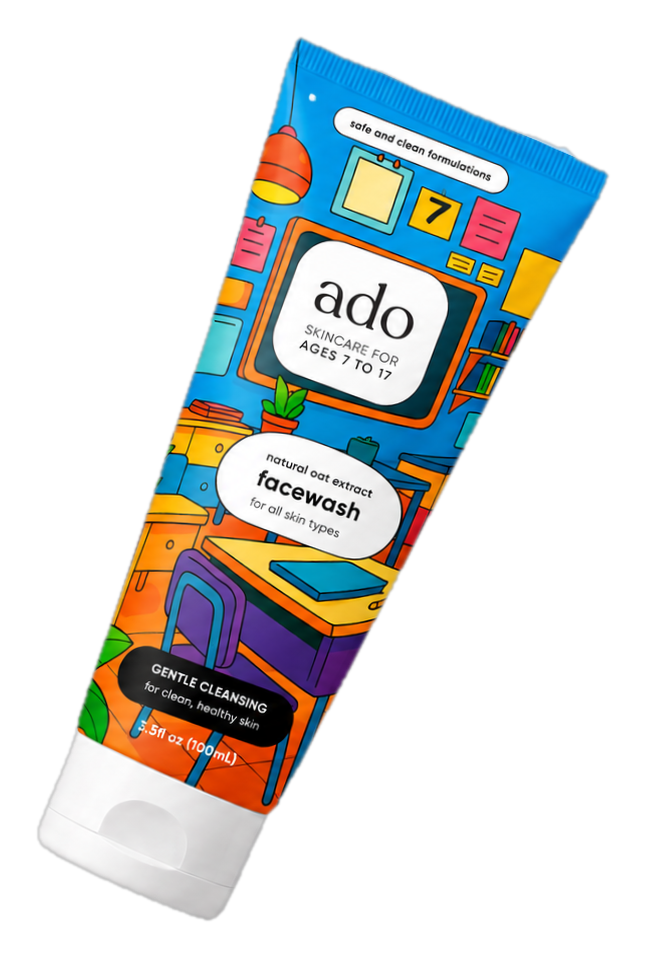
ado gentle oat face wash
Price ₹849

ado mineral sunscreen (SPF 50+)
Price ₹1,499
Sources
- The epidemiology of acne vulgaris in late adolescence (Adolesc Health Med Ther, 2016) · Adolescent Health, Medicine and Therapeutics (via PubMed Central)
- Teen Acne: How to Treat & Prevent This Common Skin Condition (updated 2025) · American Academy of Pediatrics / HealthyChildren.org
- What makes teen acne worse? · American Academy of Pediatrics / HealthyChildren.org
- Healthy Sleep Habits: How Many Hours Does Your Child Need? · American Academy of Pediatrics / HealthyChildren.org
- Recommended Amount of Sleep for Pediatric Populations: A Consensus Statement of the American Academy of Sleep Medicine (J Clin Sleep Med, 2016) · Journal of Clinical Sleep Medicine (via PubMed Central)
- A dermatologist's guide to skincare from growing up to glowing up (28 Oct 2025) · American Academy of Dermatology
- Acne: Tips for managing · American Academy of Dermatology
- Is sports equipment causing your acne? · American Academy of Dermatology
- 10 tips for clearing acne in darker skin tones · American Academy of Dermatology
- Sunscreen FAQs (updated 11 Feb 2025) · American Academy of Dermatology
- How do I know if I'm using the right sunscreen? · American Academy of Dermatology
- Practical Recommendations for Indians on Sunscreen Use: A Modified Delphi Consensus by Indian Sunscreen Forum (PRISM-ISF), J Cosmet Dermatol 2025 · Journal of Cosmetic Dermatology (via PubMed Central)
- Hair removal: How to shave · American Academy of Dermatology
- 6 razor bump prevention tips from dermatologists · American Academy of Dermatology
- Shaving (for teens) · KidsHealth (Nemours)
- Acne · NHS
- Retinoid or retinol? · American Academy of Dermatology
- 7 reasons to treat acne early · American Academy of Dermatology
This guide is general information for parents, not medical advice. If you're worried about your child's skin, please see a dermatologist or paediatrician. How we write these guides.