Sun careAges 7–17
SPF 30 vs SPF 50 for Kids: Which Does Your Child Need in India?
What SPF and PA+++ really measure, what doctors advise for children, and why the amount you apply matters more than the number.

Quick answer
Both protect well. The AAD recommends SPF 30 or higher for children, and India's PRISM-ISF consensus sets SPF 15 as the minimum. SPF 30 filters about 97% of UVB and SPF 50 about 98%. Applied generously, SPF 30 is enough; because most people apply far less than the tested amount, SPF 50 leaves more margin.
For most children, SPF 30 and SPF 50 both work, as long as the sunscreen is broad spectrum and put on generously. The American Academy of Dermatology recommends SPF 30 or higher, and India's sunscreen consensus sets SPF 15 as the minimum for children. SPF 50 filters only a little more UVB, but it leaves more margin when a child applies too little, which most people do.
This guide is for parents of children aged 7 to 17. It explains what SPF and PA+++ mean, what doctors in India and the US recommend, why the amount matters more than the number, and how to choose for school days, sport and holidays. ado is an Indian skincare brand made for kids, tweens and teens aged 7–17: a gentle oat face wash, a moisturiser and a zinc oxide SPF 50+ sunscreen, so we explain where our own sunscreen fits at the end.
What do SPF and PA+++ mean on a sunscreen?
SPF measures protection from UVB, the rays behind sunburn. PA grades protection from UVA, the rays behind tanning. "Broad spectrum" on the label means the sunscreen protects against both.
India's PRISM-ISF consensus (2025) defines SPF (sun protection factor) as the ratio between the UVB dose that reddens protected skin and the dose that reddens bare skin, tested with a thick 2 mg/cm² layer. According to the American Academy of Dermatology (AAD), SPF 15 filters about 93% of UVB and SPF 30 about 97%. MD Anderson Cancer Center puts SPF 50 at about 98%.
The AAD calls UVA the "aging rays", which pass through window glass. PA (protection grade of UVA) is based on how much UVA-induced tanning a sunscreen prevents, PRISM-ISF explains, graded like this:
| PA grade on the label | UVA protection factor measured |
|---|---|
| PA+ | 2 to under 4 |
| PA++ | 4 to under 8 |
| PA+++ | 8 to under 16 |
| PA++++ | 16 or more |
So PA+++ means a UVA protection factor of 8 to under 16; each extra plus sign means more UVA protection. Some sunscreens print a PA grade, and others are labelled broad spectrum without one.
What SPF do doctors recommend for children?
SPF 30 or higher is the most common advice, and SPF 15 is the floor. Here is what major bodies say for children older than six months.
| Source | SPF | Also advises |
|---|---|---|
| American Academy of Dermatology | 30 or higher | Zinc oxide or titanium dioxide from 6 months, as they are less likely to irritate |
| American Academy of Pediatrics: sun safety | At least 15, up to 50 | SPF 15 or 30 is fine for most people; more research is needed on whether above 50 adds protection |
| American Academy of Pediatrics: tweens and teens (2025) | 30+ every day | A mineral sunscreen, even when it's cloudy |
| Indian Sunscreen Forum (PRISM-ISF, 2025) | 15+ | Inorganic filters (zinc oxide, titanium dioxide) preferred; reapply every 2 hours, or more often with sweating or swimming |
| World Health Organization | No number given | Broad-spectrum sunscreen on skin clothes can't cover, with shade and clothing first |
Nothing in this advice suggests SPF 30 is unsafe for children, or that SPF 50 is too strong. For babies under six months, the AAD and PRISM-ISF advise shade and clothing rather than sunscreen, so ask your doctor.
Is SPF 50 better than SPF 30 for kids?
Slightly in the lab, and more usefully in real life. SPF 50 filters about 98% of UVB against 97% for SPF 30; its real advantage is margin, because most people put on far less sunscreen than the test uses.
PRISM-ISF notes that most people apply only 0.5–1.5 mg/cm² instead of the tested 2 mg/cm², which "greatly reduces effectiveness". The AAD says many people apply just 20–50% of the amount needed, and that high-SPF sunscreens help to compensate for this under-application.
PRISM-ISF also cites research showing SPF rises and falls in line with the amount applied. As a rough illustration, half the tested amount gives roughly half the SPF: nearer 25 from an SPF 50, and nearer 15 from an SPF 30, which is still the Indian minimum for children.
What SPF 50 doesn't do:
- Last longer. High-number SPFs last the same time as low-number ones, the AAD says.
- Replace shade and a hat. The WHO says sunscreen shouldn't be used to stay longer in the sun.
- Block everything. No sunscreen filters 100% of UVB.
Applied generously and reapplied, SPF 30 protects well. SPF 50 is the more forgiving choice for a child who rushes it.
Is SPF 50 safe for kids?
Yes. The SPF number tells you how much UVB a sunscreen filters, the AAD explains. It says nothing about harshness: how gentle a sunscreen is depends on its UV filters and the rest of the formula.
For children six months and older, the AAD recommends sunscreens with zinc oxide or titanium dioxide, which are less likely to irritate sensitive skin. PRISM-ISF goes further, saying a sunscreen with these inorganic filters is preferred for children over any other. Our guide to mineral vs chemical sunscreen for kids goes through the evidence.
For sensitive skin, the AAD suggests avoiding fragrance, parabens and oxybenzone, and using a sunscreen whose only filters are zinc oxide or titanium dioxide if skin stings. For pimple-prone teens, it suggests looking for "non-comedogenic" on the label.
The American Academy of Pediatrics sums up the bigger picture: using any sunscreen is better than not using sunscreen at all.
Why does SPF matter more under India's sun?
Because India sits much closer to the equator than Europe or North America, and the World Health Organization notes that UV levels are higher the closer you are to it. Children here also spend long hours outdoors at school and sport.
The UV index is a scale of how strong the sun's UV rays are. The WHO recommends sun protection from a UV index of 3, and says that at 8 and above, a shirt, sunscreen and a hat are a must. UV can be high even under cloud, and it rises with altitude and near water and sand, so hill-station trips and beach holidays count. Our parent's guide to sunscreen for kids in India has UV figures for Indian cities.
The WHO adds that children and adolescents are particularly vulnerable to UV because of their skin and eye structure. On brown skin, the effects parents notice first are often tanning and dark marks left by pimples. PRISM-ISF says these marks, called post-inflammatory hyperpigmentation, are more common in darker skin types, and recommends broad-spectrum sunscreen of at least SPF 30 as part of treatment.
How do you choose between SPF 30 and SPF 50?
Pick a sunscreen your child will put on generously every day, then match the SPF to the day. First, the checklist:
- "Broad spectrum" (UVA and UVB) on the label
- SPF 30 or higher for daily use; never below 15
- A PA grade if printed: more plus signs, more UVA protection
- Zinc oxide or titanium dioxide for younger or sensitive skin
- "Non-comedogenic" for pimple-prone teens
- Fragrance-free if your child has eczema, very sensitive skin or reacts to fragrance
- A texture they'll use, and a tube big enough to use generously
| Situation | Suggestion | Why |
|---|---|---|
| School day, mostly indoors | SPF 30+, applied generously before school | PRISM-ISF: a good layer doesn't wear off indoors unless sweat or rubbing removes it |
| Sports day, cricket or football practice | SPF 50, reapplied every 2 hours and after sweating | More margin for long hours outdoors |
| Swimming class | Either; reapply after towel drying | PRISM-ISF advises reapplying after swimming or wiping |
| A child who rushes or applies a thin layer | SPF 50 | AAD: a high SPF helps make up for under-application |
| Acne marks or dark patches | SPF 30+ broad spectrum every day | PRISM-ISF recommends at least SPF 30 for post-acne marks |
| Hill station or beach holiday | SPF 50, plus a hat and shade | WHO: UV rises with altitude and near water and sand |
| Sensitive skin or eczema | Either SPF, with zinc oxide or titanium dioxide | The AAD and PRISM-ISF prefer these filters for children |
When should you see a doctor about sun or sunscreen?
Call a doctor for a sunburn that blisters or comes with pain or fever, and stop any sunscreen that causes a rash.
See a doctor if:
- a sunburn blisters, or comes with pain or fever; HealthyChildren.org advises calling your child's doctor
- a rash, itching or swelling appears after a new sunscreen; stop it and ask a paediatrician or dermatologist
- dark patches keep spreading, or haven't faded after several months
- your child takes a medicine that can make skin more sensitive to the sun, including some acne medicines, as the AAD notes
- you need sun protection for a baby under six months
Comparing brands? Our guide to the best sunscreen for kids in India sums up what we found reading 19 labels. For older children, see sunscreen for teenagers in India; for ages 7 to 9, our hub on skincare for kids aged 7–9.
Read next: best skincare for kids in India: ado and 9 other brands · every ado ingredient, explained
How ado fits in
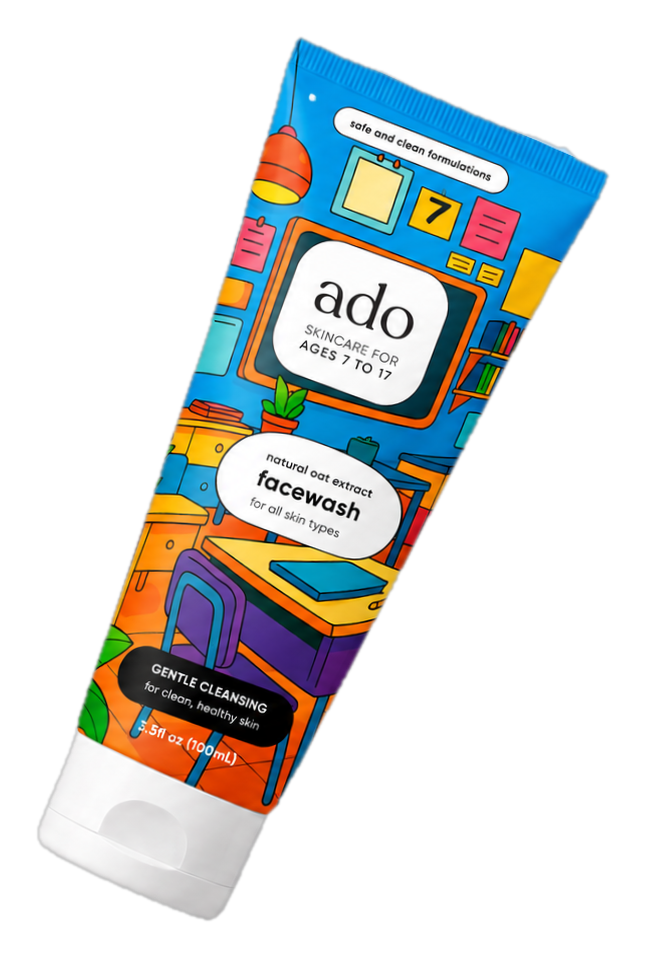
ado's mineral sunscreen is broad-spectrum SPF 50+, and zinc oxide is its only UV filter, the type of filter the AAD and PRISM-ISF prefer for children. No PA rating is stated on the label; it's labelled broad spectrum (UVA/UVB). It's non-comedogenic, with oat kernel flour (colloidal oatmeal) in a lightweight base, comes in a 100 mL tube made for ages 7–17, and is step three of the ado Tween's Kit. ado's products contain fragrance (it's the last ingredient on each label); if your child's skin is sensitive, patch-test first or choose a fragrance-free option.
Made for growing skin

ado mineral sunscreen (SPF 50+)
Price ₹1,499

The complete routine
Tween's Kit
The complete ado routine in one box: cleanse, moisturise, protect.
- Cleanse Facewash
- Hydrate Moisturiser
- Protect Sunscreen
Price
₹2,699Regular price
₹3,297
Save ₹598
Sources
- How to decode a sunscreen label · American Academy of Dermatology
- Sunscreen FAQs (updated 11 Feb 2025) · American Academy of Dermatology
- Should you use very high SPF sunscreen? · MD Anderson Cancer Center
- Practical Recommendations for Indians on Sunscreen Use: A Modified Delphi Consensus by Indian Sunscreen Forum (PRISM-ISF), J Cosmet Dermatol 2025 · Journal of Cosmetic Dermatology (via PubMed Central)
- Sun Safety: Information for Parents About Sunburn & Sunscreen · American Academy of Pediatrics / HealthyChildren.org
- Trendy Skin Care for Tweens & Teens: Is It Safe? (2025) · American Academy of Pediatrics / HealthyChildren.org
- Ultraviolet radiation (fact sheet) · World Health Organization
- Radiation: The ultraviolet (UV) index · World Health Organization
- How do I know if I'm using the right sunscreen? · American Academy of Dermatology
- Acne: Tips for managing · American Academy of Dermatology
This guide is general information for parents, not medical advice. If you're worried about your child's skin, please see a dermatologist or paediatrician. How we write these guides.