RoutinesAges 10–17
Skincare for Teenage Boys in India: A 3-Step Routine That Sticks
Face wash, moisturiser, sunscreen: a quick routine for boys aged 12 to 17 that survives cricket practice, helmets and the first shave.
Quick answer
Most teenage boys need three steps: a gentle face wash morning and night (plus after sport), a light moisturiser, and a broad-spectrum sunscreen every morning. Wash off sweat soon after training, put clean padding under helmets and straps, and shave with the grain using a sharp blade. See a dermatologist for painful or scarring acne.
Teenage boys need the same short skincare routine as anyone else: a gentle face wash, a light moisturiser and sunscreen, in about two minutes a day. What's different for many boys is how much sweat, sport and gear their skin deals with, and, a little later, shaving.
This guide is for Indian parents of boys aged about 12 to 17, and for the boys themselves. It's built to be quick enough that a 13 or 15-year-old will actually do it. For the full teen picture, see our hub on skincare for teens (13–17).
Do teenage boys really need a skincare routine?
Yes, a short one. Puberty makes boys' skin oilier just as it does girls', and sun and sweat don't care who's wearing the helmet.
KidsHealth (Nemours) says most boys start puberty between 9 and 14. As hormones rise, the skin makes more oil. The American Academy of Pediatrics (AAP) explains that this oil clogs pores and lets normal skin bacteria multiply inside them, and that around 85% of people have acne as teenagers.
Many boys skip skincare because it feels like it isn't meant for them. It helps to frame it as kit, like shin pads or a water bottle: sunscreen before practice, a face wash after. Moisturiser (or moisturizer) is just as normal for boys as for girls, and a light gel sinks in within a minute without feeling greasy.
The American Academy of Dermatology (AAD) puts it simply: skincare "doesn't have to be complicated to be effective". Three steps, done most days, beat a shelf of products used once.
What's a simple 3-step routine for a teenage boy?
Wash, moisturise and protect in the morning; wash and moisturise at night; and a quick wash after sport. That's the whole plan.
| When | Step | What to use | Make it quick |
|---|---|---|---|
| Morning | 1. Wash | Gentle face wash, lukewarm water, fingertips | Fine to do in the shower, as long as the water isn't hot |
| Morning | 2. Moisturise | Light gel or lotion; "non-comedogenic" (made not to clog pores) if he gets pimples | A thin layer is enough |
| Morning | 3. Protect | Broad-spectrum sunscreen, SPF 30 or higher | Face, ears and the back of the neck |
| After sport or gym | Wash | Same face wash; shower and change out of sweaty kit | Keep a small tube in the kit bag |
| Night | 1. Wash | Same face wash | Takes off sunscreen, sweat and dust |
| Night | 2. Moisturise | Same moisturiser | Also helps if skin feels tight after shaving |
What to look for in a face wash for a teenage boy:
- Gentle and non-abrasive, without alcohol: that's the AAD's advice for any face wash (or "facewash").
- No scrubs and no harsh sulfates such as sodium lauryl sulfate (SLS): the AAP's 2025 advice on skin care for tweens and teens lists sulfates, alcohols, fragrances and physical scrubs as cleanser ingredients to avoid.
- Twice a day plus after sweating, no more: the AAD advises limiting washing to that, and says scrubbing irritates skin.
- No need for a special "for men" version: packaging aimed at boys doesn't change what skin needs.
For more on choosing one, see our guide to face wash for teenagers in India.
Why do sweat, sport and helmets cause breakouts?
Because gear traps heat and sweat against the skin and rubs it, which can set off pimples exactly where it sits. Dermatologists call this acne mechanica.
The AAD lists helmets and chin straps, shoulder pads, face guards and backpack straps among the usual culprits, with breakouts showing up wherever the gear touches: the chin, forehead or shoulders. For Indian boys, that means cricket helmets, cycle helmets, pads and straps worn for hours in the heat, football headbands and a heavy school bag.
Before, during and after practice
- Before: put clean, soft padding between gear and skin, and wear moisture-wicking clothes next to the skin, as the AAD suggests. Loose kit rubs less than tight kit. Sunscreen goes on at home.
- During: blot sweat with a clean towel rather than wiping it. The AAD says wiping can irritate skin and lead to a breakout.
- After: shower and change out of sweaty clothes as soon as possible, wash the face, and wash workout clothes after each use, as the AAD's advice on back acne recommends. Reapply sunscreen if he's heading back out.
Hair matters too. The AAD says oil from the hair can cause acne on the forehead, and suggests shampooing more often if hair is oily and keeping it off the face. For breakouts along the hairline, the AAD suggests switching to a hair product that contains water or glycerin instead of oil.
Sweat also brings body odour. KidsHealth says body odour usually starts between 9 and 14 in boys, that a daily bath and clean clothes and socks help, and that deodorants and antiperspirants are safe for kids. More in our guide to body odour and a first deodorant.
How should a teenage boy start shaving?
Slowly, with a sharp blade, shaving cream and strokes in the direction the hair grows. Start when he wants to; there's no need to rush it.
- Shave after a shower or a warm-water wash, so skin and hair are soft. The AAD and KidsHealth both suggest wetting the skin and hair first.
- Use a shaving cream or gel; one labelled for sensitive skin if he gets irritated (AAD).
- Shave in the direction the hair grows, with short, slow strokes. KidsHealth says shaving against the grain causes irritation.
- Rinse the blade after each swipe (AAD).
- Change the blade, or throw away a disposable razor, after 5 to 7 shaves, and store it somewhere dry (AAD).
- Rinse, pat dry, and use a light moisturiser if skin feels tight. If an aftershave stings, skip it: the AAP says stinging is a red flag, not a sign a product is working.
With pimples: the AAD suggests trying an electric or disposable razor, using a sharp blade, shaving lightly and never trying to shave off a pimple. KidsHealth suggests switching to an electric razor for a while if cuts or bumps keep happening.
Razor bumps: these are itchy or painful bumps caused when shaving irritates the skin. The AAD suggests shaving after a shower, finding which way the hair grows and shaving with it, and replacing the razor every 5 to 7 uses. If bumps keep coming back after changing habits, it advises seeing a dermatologist, because untreated razor bumps can leave lasting scars.
Does a teenage boy really need sunscreen?
Yes, on every day he's outdoors, which for most boys is every day. Brown skin still tans and burns, and acne marks stay dark for longer without sun protection.
- Every skin tone: KidsHealth points out that darker skin can still burn, and that a tan is itself a sign of sun damage.
- Acne marks: the AAP says sun protection helps acne marks fade, and the Indian Sunscreen Forum's 2025 consensus notes that pigmentation triggered by visible light lasts longer in darker skin tones.
- What the label means: SPF (sun protection factor) measures protection from UVB, the rays that burn; broad-spectrum means UVA, which tans, is covered too.
- A texture he'll wear: for oily or acne-prone skin, the consensus prefers non-comedogenic, oil-free formulas such as gels or water-based lotions. The AAD suggests a non-comedogenic sunscreen with SPF 30 or higher.
- Enough, and again: the consensus notes that most people apply far less than the tested amount, which "greatly reduces effectiveness", and advises reapplying every two hours outdoors, or more often when sweating.
Put it where he'll see it, next to his keys or phone charger, and let him pick the texture. Our guide to sunscreen for teenagers in India has more on white cast, textures and long match days.
When should he see a dermatologist?
If pimples keep coming despite a steady routine, the AAD's 2025 guide says teens may add an acne ingredient such as salicylic acid or benzoyl peroxide, while keeping skin hydrated and using sunscreen daily. A dermatologist can choose the right product and strength. Book a visit if you notice any of these:
See a dermatologist if:
- pimples are deep, painful or lumpy
- breakouts are leaving dark marks or scars, or haven't improved after a few months of over-the-counter care (AAD)
- bumps under gear, or on the back and chest, show no difference after 6 to 8 weeks of care (AAD)
- razor bumps keep coming back even after changing shaving habits (AAD)
- a product stings, burns or causes a rash that doesn't settle once he stops it
- acne is affecting his mood (talk to your paediatrician too): the AAD suggests watching for sadness that lasts two weeks or more, losing interest in things he enjoyed, or avoiding friends
- someone has suggested a steroid or "mixed" cream from the chemist; read why dermatologists warn against steroid creams on the face
The AAD also suggests letting teens meet the dermatologist alone for part of the visit, so the dermatologist can find out what your teen wants and build a bond with him.
Read next: skincare routine for a 13-year-old · skincare routine for a 14 or 15-year-old · skincare by age, from 7 to 17
How ado fits in
ado is an Indian skincare brand for ages 7–17, and the Tween's Kit is this three-step routine: a sulfate-free gentle oat face wash, a lightweight, non-greasy daily moisturiser and ado's mineral SPF 50+ sunscreen, where zinc oxide is the only UV filter. The face wash and sunscreen are labelled non-comedogenic (the moisturiser's label doesn't say so), and this is gentle daily care, not an acne treatment. ado's products contain fragrance (it's the last ingredient on each label). If he has eczema, very sensitive skin or reacts to fragrance, patch-test first or choose fragrance-free.
Made for growing skin

The complete routine
Tween's Kit
The complete ado routine in one box: cleanse, moisturise, protect.
- Cleanse Facewash
- Hydrate Moisturiser
- Protect Sunscreen
Price
₹2,699Regular price
₹3,297
Save ₹598
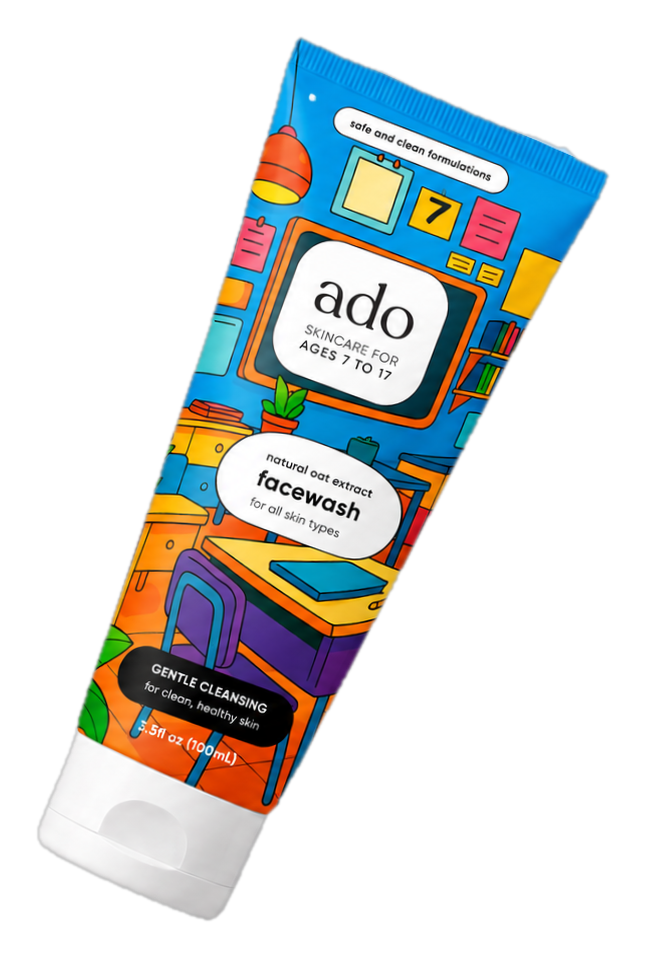
ado gentle oat face wash
Price ₹849

ado mineral sunscreen (SPF 50+)
Price ₹1,499
Sources
- Understanding Puberty (reviewed May 2022) · KidsHealth (Nemours)
- Teen Acne: How to Treat & Prevent This Common Skin Condition (updated 3 Apr 2025) · American Academy of Pediatrics / HealthyChildren.org
- Acne · NHS
- A dermatologist's guide to skincare from growing up to glowing up (28 Oct 2025) · American Academy of Dermatology
- Face washing 101 · American Academy of Dermatology
- Trendy Skin Care for Tweens & Teens: Is It Safe? (updated 7 Aug 2025) · American Academy of Pediatrics / HealthyChildren.org
- Is sports equipment causing your acne? · American Academy of Dermatology
- 12 summer skin problems you can prevent · American Academy of Dermatology
- Back acne: How to see clearer skin · American Academy of Dermatology
- Acne: Tips for managing · American Academy of Dermatology
- 10 tips for clearing acne in darker skin tones · American Academy of Dermatology
- Deodorant Use for Kids and Teens (reviewed June 2022) · KidsHealth (Nemours)
- Hair removal: How to shave · American Academy of Dermatology
- Shaving (for teens) · KidsHealth (Nemours)
- 6 razor bump prevention tips from dermatologists · American Academy of Dermatology
- How to Choose & Use Sunscreen (reviewed July 2021) · KidsHealth (Nemours)
- Practical Recommendations for Indians on Sunscreen Use: A Modified Delphi Consensus by Indian Sunscreen Forum (PRISM-ISF), J Cosmet Dermatol 2025 · Journal of Cosmetic Dermatology (PMC)
- 5 ways to help your teenager survive acne · American Academy of Dermatology
This guide is general information for parents, not medical advice. If you're worried about your child's skin, please see a dermatologist or paediatrician. How we write these guides.