Growing upAges 10–9
Body Odour at 9 or 10: What's Normal and When to Start Deodorant
Why kids start to smell at 9 or 10, the daily habits that help, and when a first deodorant makes sense.
Quick answer
Body odour at 9 or 10 is usually normal. It comes with adrenarche, the hormone shift before puberty, when sweat starts carrying oils that skin bacteria turn into smells. A daily bath and clean cotton clothes handle most of it, with a mild deodorant if wanted. See a paediatrician if it starts before 8 in girls or 9 in boys.
Body odour at 9 or 10 is usually normal. It is often one of the first signs that your child's hormones are starting to shift, a stage called adrenarche that comes before puberty. A daily bath, clean cotton clothes and fresh socks handle most of it, and a mild deodorant is fine whenever your child wants one.
Check with a paediatrician if body odour starts before 8 in a girl or 9 in a boy, or arrives with other early signs of puberty. This guide is for parents of children aged 7 to 12, with a few lines for the children themselves.
Why does my 9-year-old suddenly smell?
Usually because of adrenarche, the hormone shift before puberty that switches on the underarm sweat glands. Between about 6 and 8, the adrenal glands start making more of a hormone called DHEA. Cleveland Clinic calls this adrenarche. Over the next few years it can bring underarm hair, oilier skin and hair, a few pimples and body odour, and it usually comes around two years before puberty itself.
Sweat on its own does not smell. Body odour is what you notice when sweat meets the bacteria that live on skin, according to Cleveland Clinic. The sweat glands in the armpits and groin, called apocrine glands, only become active as these hormone changes kick in. The American Academy of Pediatrics' HealthyChildren.org explains that these glands release oil along with sweat, and skin bacteria break those oils down into stronger smells.
That is why a child who came home from football smelling of nothing but grass last year can now need a bath straight away. Nothing is wrong. Their body is changing, and their routine needs to change with it.
What age is normal for body odour to start?
From about 8 in girls and 9 in boys, body odour is within the usual range. Puberty usually starts between 8 and 13 in girls and between 9 and 14 in boys, according to KidsHealth. Adrenarche comes a little before that, so body odour at 9 or 10 sits well within the usual range.
| When it starts | What it usually means | What to do |
|---|---|---|
| Girls under 8, boys under 9 | Earlier than expected. Cleveland Clinic calls body odour, underarm or pubic hair before these ages premature adrenarche. It is generally not a physical health problem, but it is worth checking. | See your paediatrician. KidsHealth suggests talking to the doctor if body odour starts before 7 or 8 in girls or 9 in boys. |
| Girls from 8, boys from 9 | Within the usual range for adrenarche and puberty. | A daily hygiene routine, and deodorant when your child wants one. |
| Any young age, together with breast development, genital changes or a sudden growth spurt | These can point to early puberty rather than adrenarche alone, says Cleveland Clinic. | See your paediatrician soon. |
What daily habits keep body odour in check?
Most body odour at this age is managed with habits, not products. These basics build on advice from KidsHealth, HealthyChildren.org and Cleveland Clinic:
- A daily bath, especially after sport and on hot, humid days. Soap and water on the underarms, groin and feet washes away sweat, oil and odour-causing bacteria.
- Dry properly, including the underarms and between the toes, before getting dressed.
- Fresh clothes, underwear and socks every day. Yesterday's vest or socks bring yesterday's smell with them.
- Cotton and other breathable fabrics. HealthyChildren.org suggests cotton or natural fabrics such as linen, and Cleveland Clinic suggests loose cotton clothing. A cotton vest under a school shirt can help on long days.
- Socks that breathe. Cotton or moisture-wicking socks, changed often, per HealthyChildren.org. Let school shoes air out overnight.
- A PE-day kit. A spare T-shirt or vest, socks and a small towel in a zip bag, for changing after games or before tuition.
- Wash sports kit after every use, including caps and shin guards that sit against the skin.
Tip: in the monsoon, clothes can stay damp for days and start to smell even after washing. Dry school uniforms and socks fully, under a fan if needed, before they go back in the cupboard.
When should a child start using deodorant?
There is no set age, says KidsHealth. A good time is when your child still smells by the end of the school day despite a daily bath, or when they ask for one. Both early and late starters are normal.
- Pick a stick, roll-on or cream. KidsHealth suggests these over sprays for younger children, so they do not spray it in their face or breathe it in.
- Apply to clean, dry underarms in the morning after a bath.
- Go gentle for sensitive skin. HealthyChildren.org suggests fragrance-free or aluminium-free options if skin is sensitive.
- Try it on a small area first for a couple of days if your child has eczema or reacts easily.
- Remember it is an add-on. Deodorant does not replace a bath.
Deodorant or antiperspirant: what is the difference?
A deodorant covers the smell of sweat, while an antiperspirant reduces the sweat itself; KidsHealth says both are safe for kids. Many products are sold as both, so check the label.
| Deodorant | Antiperspirant | |
|---|---|---|
| What it does | Covers up the smell of body odour, usually with fragrance | Reduces sweat by temporarily blocking the pores sweat comes from, usually with aluminium salts |
| Suits | Mild odour | Children who sweat a lot or hate damp patches on their uniform |
| Safe for kids? | Yes, according to KidsHealth | Yes, according to KidsHealth |
KidsHealth also notes that deodorants labelled "natural" are not better for health than regular ones. If you have read worries about aluminium, the US National Cancer Institute states that no scientific evidence links antiperspirants or deodorants to breast cancer.
How do you talk to your child about body odour without embarrassing them?
Raise it privately and matter-of-factly, as a normal part of growing up rather than a hygiene failure. Children are often the last to notice their own smell, and the first to be teased about it. How you raise it matters.
- Choose a private moment, not the dinner table or a family gathering.
- Keep it matter-of-fact. "Your body is growing up, and growing-up bodies need a slightly different routine" works better than "you smell".
- Explain the why. Hormones plus skin bacteria make the smell; it is not about being dirty. That takes the blame out of it.
- Let them choose. Their own deodorant, their own towel, their own PE-day kit. Ownership makes the habit stick.
- No teasing at home, from parents or siblings, and no nicknames.
- Praise the habit, not the smell. "Good call packing your spare socks" builds the routine.
If you are reading this yourself: everyone's body goes through this, usually around your age. It is not something you did wrong, and a quick routine sorts it out.
If sweating is affecting your child's mood or friendships, HealthyChildren.org suggests talking to your paediatrician.
When should you see a paediatrician?
See your paediatrician if body odour starts before 8 in a girl or 9 in a boy, comes with other early signs of puberty, or changes suddenly.
See your paediatrician if:
- body odour, underarm hair or pubic hair starts before 8 in a girl or 9 in a boy
- it comes with other early changes, such as breast development or periods in girls, or a deepening voice or genital enlargement in boys; Cleveland Clinic advises calling your child's doctor about any signs of early puberty, especially under age 8
- there is a sudden change in body odour, or the smell is fruity or bleach-like; Cleveland Clinic notes these can be signs of other health conditions
- sweating is constant or heavy enough to soak clothes or affect daily life
- there is a rash, redness or itching in the armpits that does not settle after stopping a product
- your child is worried or upset about the changes in their body
For the other changes this age brings, see our pages on skincare for kids aged 7–9 and skincare for tweens aged 10–12, and our guide to pimples in the early teens if breakouts arrive too.
Read next: skincare routine for an 11-year-old
How ado fits in
ado makes face care, not deodorant, so we cannot help with underarms. But the same hormones that start body odour can also make skin and hair oilier and bring the first pimples, according to Cleveland Clinic, so this is a natural time to start a simple face routine too. ado Gentle Oat Face Wash, a sulfate-free, non-comedogenic gel with oat kernel extract made for ages 7–17, fits into the evening bath and after sweaty games. Our guides to face wash for kids and the skincare routine for a 10-year-old show how to keep it simple.
Made for growing skin
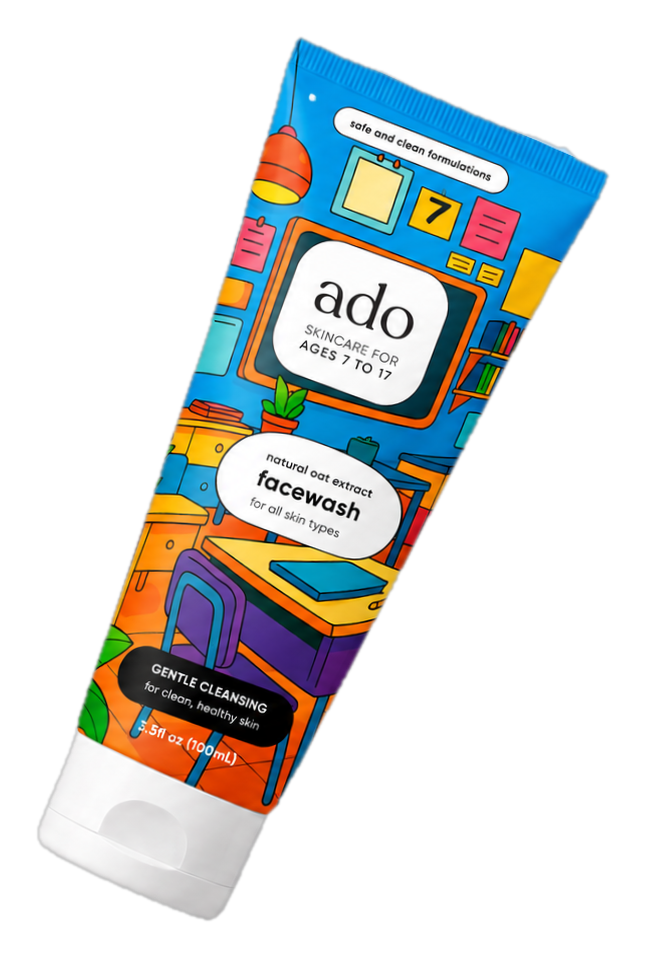
ado gentle oat face wash
Price ₹849
Sources
- Adrenarche / Premature Adrenarche · Cleveland Clinic
- Precocious Puberty (Early Puberty) · Cleveland Clinic
- Body Odor: Causes, Changes, Underlying Diseases & Treatment · Cleveland Clinic
- Deodorant Use for Kids and Teens · Nemours KidsHealth
- Body Odor in Kids & Teens · HealthyChildren.org (American Academy of Pediatrics)
- Antiperspirants/Deodorants and Breast Cancer · National Cancer Institute
This guide is general information for parents, not medical advice. If you're worried about your child's skin, please see a dermatologist or paediatrician. How we write these guides.