IngredientsAges 10–17
Retinol, Acids, Vitamin C: Skincare Ingredients Tweens Should Avoid
What the viral routines contain, why young skin doesn't need it, and the few times a dermatologist might say yes.

Quick answer
Tweens don't need retinol, exfoliating acids (AHAs and BHAs such as glycolic or salicylic acid), vitamin C serums or anti-ageing creams. These target adult concerns like wrinkles and sun damage, and can cause redness, burning and peeling on young skin. If your child has eczema or sensitive skin, choose fragrance-free too. The exception is acne, where a dermatologist may choose one.
Tweens don't need retinol, exfoliating acids (such as glycolic or salicylic acid), vitamin C serums or anti-ageing creams. These ingredients target adult concerns like wrinkles and sun damage, and on young skin they can cause redness, burning and peeling. The main exception is acne, where a dermatologist may sometimes choose one of them.
This guide is for parents of 9 to 14-year-olds whose children have discovered skincare videos, or received a serum as a birthday gift. It explains each ingredient in plain words, why it isn't needed yet, and what to use instead.
Why are tweens using adult skincare?
Short "get ready with me" videos have turned skincare into a hobby for many children. The trend is often called "Sephora kids", after the beauty store, and it has reached India too. A 2024 column in ThePrint describes Indian tweens of 12 who can explain the difference between AHAs and BHAs, and who buy premium skincare after seeing it in Instagram reels.
Researchers have looked at what these videos actually show. A 2025 study in the journal Pediatrics analysed 100 TikTok skincare routines by creators aged 7 to 18, which averaged 1.1 million views each. It found:
- an average of six products per routine, costing about US$168
- sunscreen in only about a quarter of the videos
- an average of 11, and up to 21, potentially irritating active ingredients in the 25 most-viewed videos
The authors concluded that these routines offer little to no benefit for children, while carrying risks of irritation, allergy and sun sensitivity. A 2025 review in the Journal of Drugs in Dermatology adds that retinol, exfoliating acids and vitamin C have not been thoroughly tested in children.
Which skincare ingredients should tweens avoid, and why?
The American Academy of Dermatology (AAD) recommends that tweens and teens avoid retinol, vitamin C and exfoliating acids, because they target wrinkles, sun damage and uneven skin tone, problems children don't have. The American Academy of Pediatrics (AAP) adds fragrance, alcohols, harsh sulfates and physical scrubs.
| Ingredient (label names) | What it does | Why tweens don't need it | The exception |
|---|---|---|---|
| Retinol and other retinoids (retinol, retinal, retinyl palmitate) | Forms of vitamin A that speed up skin renewal; sold for wrinkles, dark spots and acne | Aimed at ageing skin; can cause dryness, redness, peeling and sun sensitivity | A dermatologist may prescribe a retinoid for acne |
| AHAs (glycolic, lactic, mandelic acid) | Exfoliate the skin's surface | Not needed for young skin; easy to over-exfoliate, which leaves skin raw and sun-sensitive | Rarely needed; only on a dermatologist's advice |
| BHA (salicylic acid) | Exfoliates inside pores; used for blackheads and acne | Not needed for skin without acne; can dry and irritate | A dermatologist may suggest it for acne |
| Vitamin C serums (ascorbic acid and related forms) | An antioxidant sold for sun damage and uneven tone | Targets concerns children don't have; can sting and redden young skin | Not usually needed at this age |
| Anti-ageing creams, peptides, eye creams | Aimed at fine lines and firmness | There are no fine lines to fix | None |
| Peel pads, peeling gels, scrubs | Remove the outer layer of skin, chemically or by rubbing | The AAP advises against physical scrubs; overuse damages the skin barrier | None |
| Fragrance and essential oils (fragrance, parfum, plant oils) | Scent | A common cause of skin allergy, which can be long-lasting | Choose fragrance-free if your child has eczema, very sensitive skin or reacts to fragrance |
| Alcohol-heavy toners and astringents | Make skin feel "tight" or matte | Dry and irritate; the AAD advises against astringents and toners for acne-prone skin | None |
| Steroid creams (such as betamethasone, clobetasol) | Medicines that calm inflammation | Not skincare; can damage the face with unsupervised use | Only as prescribed, for the stated time |
For more on that last row, read why Indian dermatologists warn against steroid creams on a child's face.
Is retinol safe for kids?
Not as an everyday skincare product. Retinol is a form of vitamin A that makes skin cells turn over faster. That's useful for wrinkles and sun-damaged adult skin, but children's skin is, as the AAD puts it, thinner, more sensitive and more prone to irritation. Retinol and similar ingredients can cause redness, burning or peeling, with no benefit to young skin.
They can also make skin more sensitive to the sun, which matters in India's strong sunshine. If your child has already used retinol, daily sunscreen is especially important; see our parent's guide to sunscreen for kids in India.
The exception is acne. The AAD says a dermatologist may, in some cases, recommend a retinoid for a tween or teen, and the AAP lists topical retinoids among acne medicines. Experts at Boston Children's Hospital note that retinoids can be very irritating and drying, and advise tweens and teens to speak to a doctor before starting them. So retinol isn't forbidden forever; it's a medicine-like ingredient that should come with a dermatologist's plan, not a video's.
Can an 11-year-old use salicylic acid or a vitamin C serum?
Usually, there's no need for either.
Salicylic acid is a BHA (beta-hydroxy acid) that clears out pores. For an 11-year-old without acne, it has nothing to do. If blackheads and pimples are building up, the AAD notes that a dermatologist may suggest salicylic acid, and that it can cause dryness and irritation. One gentle acne product chosen with a dermatologist is very different from stacking a salicylic wash, an acid toner and a peel pad from three different videos. For breakouts, start with our guide to pimples at 13.
Vitamin C serums are on the AAD's list of ingredients for tweens and teens to avoid. They're sold for sun damage and uneven tone, which children don't need to correct, and they can sting. For a 12-year-old, daily sunscreen is a far more useful step.
What over-exfoliation looks like
Exfoliating acids and scrubs remove the outer layer of skin, the skin barrier, which keeps water in and irritants out. A 2026 viewpoint in the Indian Journal of Dermatology, Venereology and Leprology warns that overusing exfoliants damages this barrier, makes skin more sensitive and can even worsen acne. Signs include:
- stinging when applying plain water or moisturiser
- redness, tightness or a shiny, "raw" look
- flaking or peeling
- new bumps or breakouts
Why do fragrance and essential oils matter?
Fragrance is a common cause of allergic contact dermatitis, an itchy rash that develops after repeated contact with something the skin has become allergic to. The AAP reports that nearly 76% of the top 25 most-viewed videos in the TikTok study promoted products with known allergens such as fragrance. The study itself found 20 inactive ingredients from the standard allergy patch-test list used for children.
The IJDVL viewpoint warns that exposing young skin to many ingredients can cause allergies that last into adulthood, with fragrances among the usual culprits. "Natural" doesn't mean safe from this: DermNet notes that natural plant extracts can cause fragrance allergy too, and that products described as "botanical", "herbal" or "natural" may contain fragrance ingredients that aren't named.
- If your child has eczema, very sensitive skin or reacts to fragrance, look for "fragrance-free" on the label, and check the ingredient list for "fragrance" or "parfum".
- Be cautious with products that list several essential oils.
- Test any new product on a small patch of skin first, as the AAD suggests, and add only one new product at a time.
What should you do if your child's skin is already red or peeling?
Stop the active products and go back to the basics. This is common, and skin often settles once the irritating products stop. The AAP's rule of thumb is useful to share with your child: a product that stings or burns is a warning sign, not proof that it's working.
- Stop every active product: serums, acids, retinol, toners, peel pads and scrubs.
- Go back to three basics: a gentle cleanser, a plain fragrance-free moisturiser and sunscreen. The skincare routine for a 10-year-old lays this out.
- Wash with fingertips only, no cloths or scrubbers, as the AAD advises.
- Wait until the skin feels normal before adding anything new, then add one product at a time.
When should you see a doctor?
See a doctor if the skin swells, blisters or oozes, or if redness doesn't settle after stopping the products.
See a dermatologist or your paediatrician if:
- there is swelling, blistering or oozing
- redness or burning doesn't settle after stopping the products
- an itchy rash spreads beyond where a product was applied, or appears near the eyes
- pimples are painful, leaving marks, or not improving after a few months of gentle care
- your child wants to use an active ingredient for acne; a dermatologist can choose one safely
- you think a cream might contain a steroid
If skincare seems to be making your child anxious about their looks, that's worth a conversation too. KidsHealth (Nemours) suggests reminding children that some creators are paid, so their videos are really adverts.
Weighing up teen brands? Our ado vs generic teen-care brands page shows which actives each range uses and who they suit.
How ado fits in
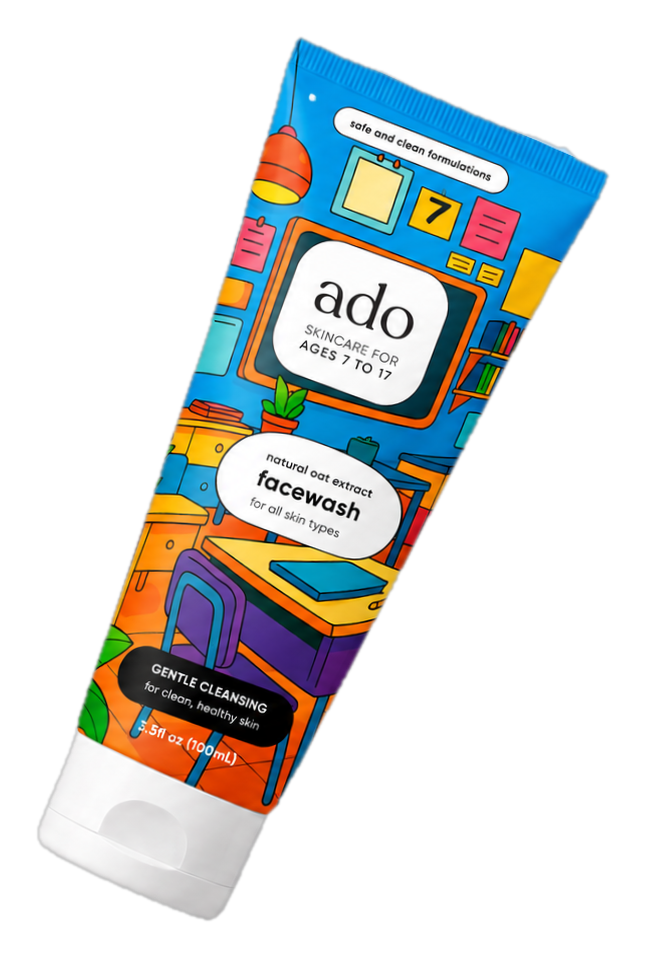
ado's range for ages 7–17 has no adult actives: no retinoids, no exfoliating acids and no vitamin C serums. ado's Tween's Kit covers the three basics (a sulfate-free face wash with oat kernel extract, a pH-balanced moisturiser and an SPF 50+ sunscreen where zinc oxide is the only UV filter), with oat in every step and the full ingredient list on each product page. ado's products contain fragrance (it's the last ingredient on each label); if your child's skin is sensitive, patch-test first or choose a fragrance-free option.
For gentler ingredients like niacinamide, see our guide on whether a 12-year-old can use niacinamide or adult skincare. For more by age, visit skincare for tweens (10–12) or skincare for teens (13–17).
Made for growing skin


The complete routine
Tween's Kit
The complete ado routine in one box: cleanse, moisturise, protect.
- Cleanse Facewash
- Hydrate Moisturiser
- Protect Sunscreen
Price
₹2,699Regular price
₹3,297
Save ₹598
Sources
- A dermatologist's guide to skincare from growing up to glowing up (28 Oct 2025) · American Academy of Dermatology
- Trendy Skin Care for Tweens & Teens: Is It Safe? (2025) · American Academy of Pediatrics / HealthyChildren.org
- Teen Acne: How to Treat & Prevent This Common Skin Condition (2025) · American Academy of Pediatrics / HealthyChildren.org
- Pediatric Skin Care Regimens on TikTok (Pediatrics, 2025; PubMed record) · Pediatrics / American Academy of Pediatrics
- The digital dermatosis: social media's unintended impact on pre-adolescent skincare (2026) · Indian Journal of Dermatology, Venereology and Leprology
- Dermatological Safety of Cosmetic Products Marketed to Children: Insights on the Sephora Kids Phenomenon (2025) · Journal of Drugs in Dermatology
- 'Sephora kids' falling for luxury skincare. Where does it all end? (31 Jul 2024) · ThePrint
- What ingredients are in tween skin care products? (Dec 2024) · Boston Children's Hospital
- Fragrance allergy · DermNet
- Acne: Tips for managing · American Academy of Dermatology
- Is It OK for My Child to Use Skin Care Products? · KidsHealth (Nemours)
This guide is general information for parents, not medical advice. If you're worried about your child's skin, please see a dermatologist or paediatrician. How we write these guides.