RoutinesAges 10–12
Skincare for an 11 or 12-Year-Old Girl (India): Puberty, Pimples, Periods
Periods, first pimples, makeup requests and a phone full of filters: a calm skincare plan for your 11 or 12-year-old daughter.
Quick answer
An 11 or 12-year-old girl needs three steps: a gentle face wash morning and night, a light moisturiser and a broad-spectrum sunscreen every morning. Pimples before a period are common and don't need extra products; keep the routine steady and hands off. If she wears makeup or kajal, keep it simple and take it off every night.
An 11 or 12-year-old girl needs a simple skincare routine: a gentle face wash morning and night, a light moisturiser and a broad-spectrum sunscreen every morning. Puberty adds oilier skin, pimples that often flare before a period, and questions about makeup and kajal, but none of that calls for serums or a 10-step routine.
This guide is for Indian parents of 11 to 13-year-old girls, and for girls reading along. It covers what puberty does to skin, period pimples, makeup and kajal, social media and body image. For the general plan for any 12-year-old, boys included, see our skincare routine for a 12-year-old, and for the wider age band, our hub on skincare for tweens (10–12).
What's happening to an 11 or 12-year-old girl's skin?
Puberty. For most girls, 11 and 12 fall somewhere in the middle of it, and the main skin change is more oil, which brings blackheads, whiteheads and pimples.
KidsHealth (Nemours) says most girls start puberty between 8 and 13, usually with breast buds, and get their first period about two years later, usually between 9 and 16. The NHS puts the average age of a first period at around 12.
Hormones tell the skin's oil glands to make more sebum, the skin's natural oil. The American Academy of Pediatrics (AAP) explains that the extra oil clogs pores and lets normal skin bacteria multiply inside them, causing redness and swelling. Around 85% of people have acne as teenagers, it says, so your daughter is far from alone.
What you might notice at 11 or 12:
- a shiny T-zone (forehead, nose and chin) by lunchtime
- blackheads on the nose and small whiteheads on the chin
- red pimples on the forehead, chin or jawline, often in the week before a period
- more sweat and underarm odour; KidsHealth says body odour usually starts between 8 and 13 in girls
- stretch marks on the hips, thighs or breasts during growth spurts
Stretch marks worry a lot of girls, so they're worth naming. The NHS lists puberty as a common cause and says they usually fade over time, though they may not disappear completely. It adds that there's very little evidence that creams sold to remove them work, so there's no need to buy one.
Do periods make pimples worse?
Often, yes, and it's normal. Many girls notice more pimples in the days before a period, and they tend to settle once it starts.
The AAP lists hormone changes before a period among the things that make teen acne worse. KidsHealth includes acne among the symptoms of premenstrual syndrome (PMS), alongside moodiness, sadness, anxiety and bloating, and its guide for teens says PMS symptoms usually ease in the first few days of a period. The NHS also names periods among the hormone changes that can trigger acne.
What helps in the period week is the same routine, done steadily:
- Don't add a new product every month. Period pimples come from hormones, not from a gap in the routine. The American Academy of Dermatology (AAD) advises introducing one new product at a time.
- Hands off. The AAD says picking, popping or squeezing makes acne take longer to clear and raises the risk of scars and dark spots. On brown skin, the AAD notes, those dark spots can last much longer than the acne itself.
- Sleep and stress. The AAP says stress can make acne worse during demanding school periods, so an exam week that lands on a period week may bring a bigger flare. That's not a sign the routine has failed.
- Patience. The AAP says acne takes at least two months to get better after starting treatment, so judge any change over weeks, not days.
What's a simple skincare routine for an 11 or 12-year-old girl?
Three steps in the morning and two at night: cleanse, moisturise, protect. The same routine works in her period week, on sports days and on exam days.
| When | Step | What to look for |
|---|---|---|
| Morning | 1. Cleanse | Gentle face wash (or "facewash") with lukewarm water and fingertips; no scrubs, and no harsh sulfates such as SLS |
| Morning | 2. Moisturise | Light gel or lotion; "non-comedogenic" (made not to clog pores) if she gets pimples |
| Morning | 3. Protect | Broad-spectrum sunscreen, SPF 30 or higher, applied generously as the last step |
| After games or a sweaty day | Blot or wash | Blot sweat with a clean handkerchief; wash the face and reapply sunscreen if she's heading back out |
| Night | 1. Remove and cleanse | Take off any makeup or kajal first, then the same face wash |
| Night | 2. Moisturise | Same light moisturiser |
This follows the three steps the AAP sets out in its 2025 advice on trendy skin care for tweens and teens: a gentle, pH-balanced cleanser morning and night, a lightweight non-comedogenic moisturiser (moisturizer in US spelling), and a broad-spectrum SPF 30+ mineral sunscreen every day. SPF (sun protection factor) measures protection from UVB, the rays that burn; broad-spectrum means UVA, which tans, is covered too. The AAD advises washing no more than twice a day plus after sweating.
Her checklist for the bathroom shelf:
- Wash with fingertips, not a cloth or scrubber, and pat dry.
- A thin layer of moisturiser, even if her skin is oily.
- Sunscreen last, on the face, ears and neck, every school day.
- Makeup and kajal off every night, before the face wash.
- One new product at a time; if it stings or burns, stop. The AAP calls stinging a red flag, not a sign a product is working.
- Hands off pimples, however tempting.
Sunscreen matters at 12 for a reason she'll care about: marks. The AAP says sun protection helps acne marks fade, and the Indian Sunscreen Forum's 2025 consensus notes that visible-light pigmentation lasts longer in darker skin tones. The same consensus prefers mineral filters (zinc oxide or titanium dioxide) for children and advises reapplying every two hours outdoors, or more often with sweating. Our sunscreen checklist for 10 to 12-year-olds has more.
Can a 12-year-old girl wear makeup or kajal?
That's a family decision, and a little is fine for most girls if it comes off every night. What matters more is choosing products that don't clog pores and being careful about what goes near the eyes.
Makeup
For skin that gets pimples, the AAD suggests makeup labelled "oil-free", "won't clog pores" or "non-comedogenic". It advises removing all makeup, including eye makeup, before bed, cleaning brushes every week, and not sharing makeup, brushes or applicators. The NHS gives the same advice about taking makeup off at the end of the day. If pimples get worse where makeup sits, a break of a few weeks will show whether it's the cause.
Kajal, kohl and surma
Kajal is part of many Indian girls' lives, from school functions to weddings. The concern with traditional eye cosmetics is lead. A 2024 study in Pediatrics tested 220 samples of traditional eye cosmetics and cultural powders collected in New York City. Lead levels in surma and kohl were much higher than in kajal, but the authors found these products can add to children's lead exposure, and that they're used on children as young as newborns.
An Indian study in the Indian Journal of Clinical Biochemistry found high lead levels in 34 surma samples of every colour except white, and much higher blood lead levels in children who used surma regularly than in those who didn't.
- If she wears kajal, pick a packaged eye cosmetic rather than traditional surma or kohl, which had the highest lead levels in these studies. Lead isn't listed on labels, so no label can promise a product is lead-free; if you're unsure about one, leave it out.
- Keep eye pencils her own, and take kajal off every night.
- Keep traditional surma and kohl away from younger siblings and babies too.
How do you handle skincare trends and body image kindly?
Start on her side: wanting to look after her skin is healthy. Then help her tell real skincare apart from what's sold through filters.
The trend is real. A July 2025 study in Pediatrics describes videos of girls as young as 7 demonstrating multistep routines. Across 100 TikTok routines by creators aged 7 to 18, the average used 6 products and cost about US$168, and only 26.2% included sunscreen. A 2026 viewpoint in the Indian Journal of Dermatology, Venereology and Leprology calls "glass skin" an unattainable goal and links beauty filters and social media with body image dissatisfaction and low self-esteem in young people.
- Talk about filters. Say out loud that most faces online are filtered or edited. The AAP encourages helping children feel confident in their skin "without the filters, fads or 10-step routines".
- Explain who's selling. KidsHealth suggests telling children that some people who show routines are paid, so the video is really a kind of advert.
- Keep comments off her body. No remarks at home about pimples, weight, height or skin colour, and ask relatives at family functions to skip them too.
- Praise what her body does. KidsHealth's advice for teens is to avoid self-criticism, stop comparing yourself with others and focus on what your body can do.
- Offer a swap, not just a no. Her own shelf, and her choice of face wash, moisturiser and sunscreen from a shortlist you're happy with.
For you, if you're 11 or 12: Pimples before a period, stretch marks and a shiny nose are part of growing up, not something you did wrong. A gentle wash, moisturiser and sunscreen are all your skin needs, and no filter shows what real skin looks like.
When should she see a doctor?
Most girls never need more than the basics. See a paediatrician, dermatologist or gynaecologist if you notice any of these:
See a doctor if:
- pimples are deep, painful or lumpy, or leaving dark marks or scars; the AAD's 2025 guide also advises a dermatologist if acne hasn't improved after a few months of over-the-counter care
- acne is severe and her periods are still very irregular more than two years after they started (KidsHealth); the NHS lists a hormonal condition affecting the ovaries, PMOS (previously called PCOS), among possible causes of acne
- PMS is severe enough to disrupt school or daily life, or bleeding is very heavy (KidsHealth)
- her periods haven't started by 15 (NHS)
- a product or eye cosmetic causes redness, burning, swelling or a rash that doesn't settle once she stops it
- low mood lasts two weeks or more, or she's avoiding friends or activities because of her skin; the AAD notes acne can lead to depression and anxiety
- someone has suggested a steroid or "mixed" cream for her face; read why dermatologists warn against steroid creams first
The AAD also suggests letting a teen spend some of the appointment alone with the dermatologist, so she can ask her own questions.
How ado fits in
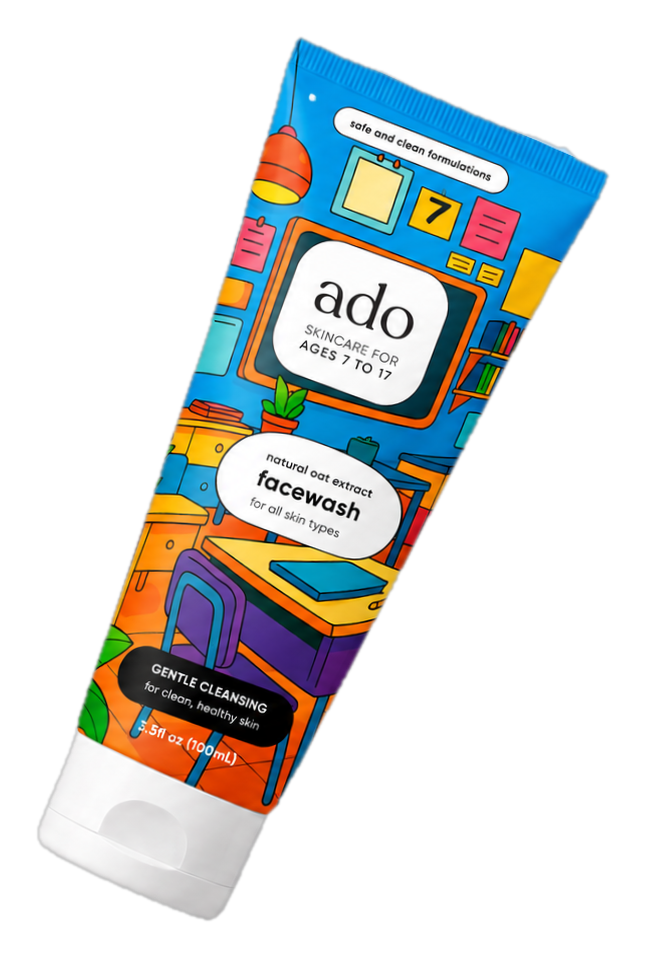
ado is an Indian skincare brand for ages 7–17, and ado's Tween's Kit is this three-step routine: a sulfate-free oat face wash, a lightweight daily moisturiser and ado's mineral SPF 50+ sunscreen, where zinc oxide is the only UV filter. The face wash and sunscreen are labelled non-comedogenic (the moisturiser's label doesn't say so), and this is gentle daily care, not an acne treatment. ado's products contain fragrance (it's the last ingredient on each label). If your daughter has eczema, very sensitive skin or reacts to fragrance, patch-test first or choose fragrance-free.
Made for growing skin

The complete routine
Tween's Kit
The complete ado routine in one box: cleanse, moisturise, protect.
- Cleanse Facewash
- Hydrate Moisturiser
- Protect Sunscreen
Price
₹2,699Regular price
₹3,297
Save ₹598

ado mineral sunscreen (SPF 50+)
Price ₹1,499
Sources
- Understanding Puberty (reviewed May 2022) · KidsHealth (Nemours)
- Starting your periods · NHS
- Teen Acne: How to Treat & Prevent This Common Skin Condition (updated 3 Apr 2025) · American Academy of Pediatrics / HealthyChildren.org
- Deodorant Use for Kids and Teens (reviewed June 2022) · KidsHealth (Nemours)
- Stretch marks · NHS
- Talking to Your Child About Periods (reviewed October 2018) · KidsHealth (Nemours)
- All About Periods (Menstruation) (for teens, reviewed May 2026) · KidsHealth (Nemours)
- Acne · NHS
- A dermatologist's guide to skincare from growing up to glowing up (28 Oct 2025) · American Academy of Dermatology
- Acne: Tips for managing · American Academy of Dermatology
- 10 tips for clearing acne in darker skin tones · American Academy of Dermatology
- Trendy Skin Care for Tweens & Teens: Is It Safe? (updated 7 Aug 2025) · American Academy of Pediatrics / HealthyChildren.org
- Face washing 101 · American Academy of Dermatology
- Practical Recommendations for Indians on Sunscreen Use: A Modified Delphi Consensus by Indian Sunscreen Forum (PRISM-ISF), J Cosmet Dermatol 2025 · Journal of Cosmetic Dermatology (PMC)
- I have acne! Is it okay to wear makeup? · American Academy of Dermatology
- Traditional Eye Cosmetics and Cultural Powders as a Source of Lead Exposure (Hore and Sedlar, Pediatrics, Oct 2024; PubMed record) · Pediatrics / American Academy of Pediatrics
- Eye cosmetic 'surma': hidden threats of lead poisoning (Goswami, 2013) · Indian Journal of Clinical Biochemistry (PMC)
- Pediatric Skin Care Regimens on TikTok (Pediatrics, July 2025; PubMed record) · Pediatrics / American Academy of Pediatrics
- The digital dermatosis: social media's unintended impact on pre-adolescent skincare (viewpoint, 23 Feb 2026) · Indian Journal of Dermatology, Venereology and Leprology
- Is It OK for My Child to Use Skin Care Products? (reviewed April 2024) · KidsHealth (Nemours)
- Body Image and Self-Esteem (for teens, reviewed June 2023) · KidsHealth (Nemours)
- 5 ways to help your teenager survive acne · American Academy of Dermatology
This guide is general information for parents, not medical advice. If you're worried about your child's skin, please see a dermatologist or paediatrician. How we write these guides.