Face washAges 13–17
Face Wash for a 13-Year-Old (and Teens) in India
Gentle beats harsh: how to choose and use a face wash for oily, sweaty, pimple-prone teenage skin.
Quick answer
A 13-year-old needs a gentle, SLS-free face wash used twice a day and after sweaty sport. Teenage oil and pimples come from hormones, not dirt, so harsh or frequent washing makes things worse. Boys and girls need the same basics. If pimples are frequent, painful or leaving marks, see a dermatologist rather than switching to a stronger wash.
A 13-year-old needs a gentle, non-stripping face wash used twice a day and after sweaty sport, not the strongest "oil control" or scrub wash on the shelf. Teenage oiliness and pimples are driven by hormones, not dirt, so washing more often or harder usually makes things worse.
If pimples are frequent, painful or leaving marks, the next step is a dermatologist's plan rather than a stronger wash. This guide is for parents of teens aged 12 to 17, and for teens reading it themselves.
Why does a teenager's face get so oily and spotty?
During puberty, hormones called androgens make the skin's oil glands bigger, and they start producing more oil, which can clog pores, explains the American Academy of Dermatology (AAD). That is why the T-zone, the forehead, nose and chin, often turns shiny first. The AAD also notes that nearly everyone gets at least a few breakouts during their teenage years.
It is not about being dirty. KidsHealth puts it plainly: acne cannot be scrubbed away, and scrubbing can make it worse by irritating the skin and pores. A face wash's job is to lift off sweat, extra oil, sunscreen and the day's grime gently, not to scour the skin.
Two things teens often miss are hair and hair products. Oil from hair can cause pimples on the forehead, and oily products such as pomade can worsen acne, according to the AAD. Keeping hair off the face and shampooing oily hair more often both help (AAD acne tips).
What should a face wash for a 13-year-old have, and what should it skip?
The AAD's face-washing advice is to use a gentle, non-abrasive cleanser that does not contain alcohol. AAP's HealthyChildren.org adds sulfates such as SLS (sodium lauryl sulphate, a strong foaming agent), alcohols, fragrance and scrubs to the list of things to skip in a teen's cleanser.
| Your teen's skin | Look for | Skip |
|---|---|---|
| Oily T-zone, shiny by lunch | A gentle gel cleanser with a soft lather, SLS-free | Harsh "oil control" or alcohol-heavy washes. The AAD lists over-drying the skin with astringents as a habit that can worsen acne. |
| A few blackheads or pimples | The same gentle wash, used every day | Scrubs, beads and brushes. Scrubbing aggressively is on the AAD's list of habits that worsen acne. |
| Dry, sensitive or easily stung | A mild cleanser with little or no fragrance; once a day may be enough | Strongly perfumed or "tingling" washes. Added scents can trigger irritation or allergic reactions, says the AAD. |
| Frequent or painful pimples | A plan from a dermatologist | Switching acne products every week, which the AAD warns against, or piling several on at once |
A simple test: after washing, skin should feel clean and comfortable. If it feels tight or stings, that wash is too harsh for daily use.
How often should a teenager wash their face?
Twice a day, morning and night, plus after sweating heavily, according to the AAD. That is enough. The AAD warns that washing several times a day can further irritate the skin and lead to more breakouts.
A simple routine for a 13-year-old
- Morning: gentle face wash, a light moisturiser, then sunscreen before school.
- After sport or PE: a quick wash with lukewarm water and a little cleanser. If there is no sink nearby, blot sweat with a clean towel rather than rubbing, as the AAD advises, and wash properly at home.
- Evening: remove any makeup or tinted sunscreen, wash with the gentle cleanser, then moisturise.
- How to wash: lukewarm water, fingertips, about 30 to 60 seconds of gentle circles, rinse well and pat dry with a soft towel.
Sport, school and the monsoon
Cricket nets, football practice, a crowded bus, a cap all afternoon and tuition straight after school: Indian teens spend a lot of time hot and damp. Pat sweat off rather than wiping hard, wash once home, and wash caps, headbands and face towels often.
In monsoon humidity, skin can feel oilier and stickier. The answer is a wash after sweaty activities, not extra washes through the day.
Our skincare routine for a 13-year-old shows how the wash fits with moisturiser and sunscreen, and our sunscreen guide for teenagers covers non-greasy options for oily skin. For the bigger picture, see our page on skincare for teens aged 13–17.
Does hard water or a bar of soap make a difference?
It can. An Indian study in the Indian Journal of Dermatology measured common bath soaps with a pH meter and found most had a pH of 9 to 10, while healthy skin sits at about 5.4 to 5.9. The authors explain that high-pH soap raises skin pH, which can leave skin drier and more easily irritated, and they specifically ask doctors to consider pH for people with sensitive and acne-prone skin. A bath soap is fine for the body; the face does better with a gentle face wash.
Water matters too. In a UK lab study, skin washed with SLS in hard water held on to more SLS residue, which increased water loss from the skin and caused irritation, particularly in some people with eczema. If your tap water leaves white, chalky marks on taps and buckets, it is probably hard, and an SLS-free cleanser is a sensible choice.
In a North Indian winter, a teen's skin can swing from oily to dry. If it feels tight in the morning, a splash of lukewarm water then and the face wash at night may be enough until the weather warms up.
When does an acne face wash make sense?
An acne face wash can help a teen with regular breakouts, ideally chosen with a dermatologist; it isn't needed for the odd pimple. Acne washes usually contain salicylic acid or benzoyl peroxide. The AAD describes benzoyl peroxide as one of the most effective and commonly used acne ingredients, and salicylic acid as common in acne cleansers. For teens whose hormones are causing breakouts, it says adding one of these may help, as long as the skin is kept moisturised, because both can cause dryness and irritation.
Ask a dermatologist which one and how often, and remember that it does not replace gentle daily care. If one is suggested:
- use one acne product at a time unless the dermatologist says otherwise
- give it time rather than swapping products every week
- keep using a moisturiser, and stop and check with the doctor if skin becomes very red, dry or sore
- do not pick or squeeze; the AAD says it makes acne take longer to clear and raises the risk of scars and dark spots
- never use a steroid cream on the face unless a doctor has prescribed it for that purpose; our guide to steroid creams on a child's face explains why
Our guide to pimples at 13 goes further into what helps and what to avoid.
Do boys and girls need different face washes?
No. The basics are the same for a face wash for a teenage boy or a teenage girl: a gentle, SLS-free cleanser twice a day and after sweat. Blue bottles and pink bottles are packaging, not different skin needs. The differences are in habits:
- More outdoor sport: add a quick wash after games, and blot sweat rather than rubbing.
- Makeup or tinted sunscreen: remove it at the end of the day before washing, as the NHS advises, and look for non-comedogenic products, meaning products made not to clog pores.
- Hair oil, gel or pomade: keep it off the forehead and wash hair regularly.
- When shaving starts: the same gentle face wash works; a separate "men's" facewash is not needed.
When should a teen see a dermatologist?
See a dermatologist if pimples haven't improved after a few months of gentle care, or if they are painful, scarring or affecting your teen's mood.
Book a dermatologist if:
- pimples have not improved after a few months of gentle care and over-the-counter products, as the AAD suggests
- breakouts are leaving dark marks or scars
- there are painful, deep lumps under the skin
- the skin is reacting to products with redness, stinging or peeling
- acne is affecting your teen's mood, confidence or friendships; the NHS lists this as a reason to see a doctor
- spots look infected
- a chemist, friend or relative has suggested a cream, especially one that may contain a steroid
Weighing up teen brands? Our ado vs generic teen-care brands page sets out what each teen range contains.
How ado fits in
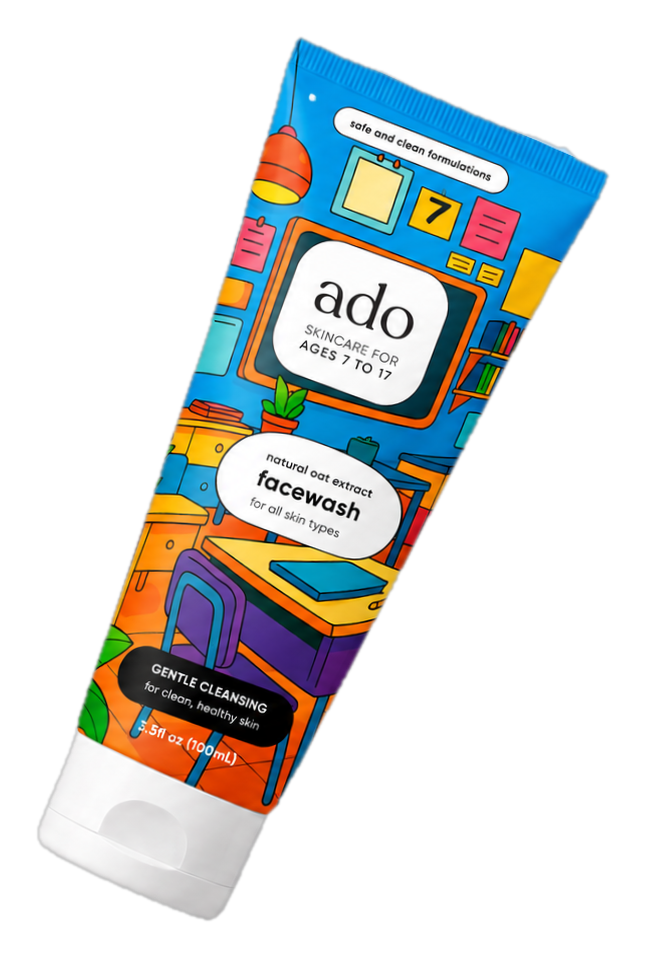
ado Gentle Oat Face Wash is a soft-lather gel with coconut-derived cleansers and oat kernel extract, made for ages 7–17: sulfate-free (so SLS-free), dye-free, paraben- and phthalate-free and non-comedogenic. It is non-stripping, so it suits twice-a-day and after-sport washing, but it is not an acne product: for regular breakouts, pair gentle daily care with a dermatologist's advice. ado's products contain fragrance (it's the last ingredient on each label); if your teen's skin is sensitive, patch-test first or choose a fragrance-free option. If your teen wants the whole routine in one go, the ado Tween's Kit has the face wash, moisturiser and mineral SPF 50+ sunscreen together.
For younger siblings, our guide to face wash for kids aged 7–12 covers when to start.
Made for growing skin
ado gentle oat face wash
Price ₹849


The complete routine
Tween's Kit
The complete ado routine in one box: cleanse, moisturise, protect.
- Cleanse Facewash
- Hydrate Moisturiser
- Protect Sunscreen
Price
₹2,699Regular price
₹3,297
Save ₹598
Sources
- What causes acne · American Academy of Dermatology
- Acne: Tips for managing · American Academy of Dermatology
- 10 skin care habits that can worsen acne · American Academy of Dermatology
- Face washing 101 · American Academy of Dermatology
- A dermatologist's guide to skincare from growing up to glowing up · American Academy of Dermatology
- Acne (for teens) · Nemours KidsHealth
- Acne · NHS
- Trendy Skin Care for Tweens & Teens: Is It Safe? · HealthyChildren.org (American Academy of Pediatrics)
- The Effect of Water Hardness on Surfactant Deposition after Washing and Subsequent Skin Irritation in Atopic Dermatitis Patients and Healthy Control Subjects · Journal of Investigative Dermatology (2018), via PubMed
- Evaluation of pH of Bathing Soaps and Shampoos for Skin and Hair Care · Indian Journal of Dermatology (2014), via PubMed
This guide is general information for parents, not medical advice. If you're worried about your child's skin, please see a dermatologist or paediatrician. How we write these guides.