RoutinesAges 10–12
Skincare Routine for a 10-Year-Old: A Simple Plan and What to Buy in India
Three steps, a few minutes, no serums: what doctors actually suggest for a 10-year-old's skin, fitted around Indian school days.
Quick answer
Most 10-year-olds need only three steps: a gentle cleanser, a light moisturiser (fragrance-free if skin is sensitive), and broad-spectrum sunscreen, SPF 30 or higher, in the morning. They don't need serums, retinol, acids, vitamin C or anti-ageing creams. Keep it simple and consistent, and see a doctor for rashes, painful pimples or anything that stings.
A 10-year-old needs a very short skincare routine: a gentle face wash, a light moisturiser and sunscreen. That's the whole plan. No serums, no retinol, no acids and no 10-step routine.
This guide is for parents of 9 to 11-year-olds who are noticing oilier skin, the odd pimple, or a sudden interest in skincare videos. It covers what to use, what to skip, and how to make it work around school, sport and screens.
Does a 10-year-old need a skincare routine at all?
Yes, but only a simple one. This is the age when a few basic habits start to pay off.
Puberty can start any time between 8 and 14, according to the NHS. The American Academy of Pediatrics (AAP) adds that oil production in the skin can rise up to two years before other signs of puberty, and some children as young as 9 notice small bumps and bigger-looking pores around the nose.
So your child doesn't need "skincare" in the social-media sense. They need three basic habits, learned now while they're easy to build. As a dermatologist put it in the American Academy of Dermatology's 2025 guide, consistency matters more than a 10-step routine.
Girls and boys need exactly the same basics. Boys often get left out of these conversations, yet they sweat, play in the sun and get pimples just as much. If sweat and smell are the bigger worry right now, read our guide to body odour at 9 or 10 and when to start deodorant.
What are the three basics for a 10-year-old's skin?
The AAD's 2025 guide and the AAP's 2025 advice on trendy skin care for tweens land on the same three steps: cleanse, moisturise, protect.
1. A gentle cleanser
Look for a mild face wash (many parents search "facewash") without scrubbing beads, strong fragrance or alcohol. The AAP suggests a gentle, fragrance-free cleanser and says to avoid harsh sulfates such as sodium lauryl sulfate (SLS), alcohols and physical scrubs.
Your child should use their fingertips, not a washcloth or scrubber. The AAD warns that scrubbing irritates skin. Twice a day suits most children; for dry or sensitive skin, the AAD guide says once in the evening may be enough. Our guide to face wash for kids goes into more detail.
2. A light moisturiser
A moisturiser (or moisturizer, if you're searching US sites) keeps skin comfortable and helps with dryness and itch. Choose a lightweight one. The AAD's guide suggests a fragrance-free moisturiser for tweens, because added scents can irritate skin; that matters most if your child has eczema, very sensitive skin or reacts to fragrance. The AAP suggests a non-comedogenic moisturiser, which means one made not to clog pores.
The AAP suggests gel textures for oily skin and light creams for dry skin. In practice, many Indian families switch with the seasons: a gel in sticky monsoon months, something a little richer during a dry North Indian winter.
3. Sunscreen
The AAD recommends a broad-spectrum sunscreen with SPF 30 or higher every day for tweens. SPF (sun protection factor) tells you how well it protects against the UVB rays that cause sunburn. "Broad-spectrum" means it also covers UVA rays, which tan and age skin.
The Indian Sunscreen Forum's 2025 consensus for Indians prefers mineral filters (zinc oxide or titanium dioxide) for children and advises reapplying after swimming, heavy sweating or wiping the face. Brown skin still tans, burns and picks up dark marks, so sunscreen matters for every Indian skin tone. For the details, see our parent's guide to sunscreen for kids in India and our checklist for sunscreen for a 10 to 12-year-old.
What does a 10-year-old's morning and evening routine look like?
In the morning, a 10-year-old washes, moisturises and puts on sunscreen; in the evening, they wash and moisturise. The whole thing takes a few minutes.
| When | Step | What to use | Why |
|---|---|---|---|
| Morning | 1. Cleanse | Gentle face wash, or just water if skin is dry | Freshens skin before school |
| Morning | 2. Moisturise | Light moisturiser (fragrance-free if skin is sensitive) | Keeps skin comfortable all day |
| Morning | 3. Protect | Broad-spectrum sunscreen, SPF 30 or higher | Assembly, PE, the walk to the bus stop |
| Evening | 1. Cleanse | Same gentle face wash | Removes sunscreen, sweat and dust |
| Evening | 2. Moisturise | Same moisturiser | Skin rests overnight |
How to do it, step by step:
- Wet the face, then massage a small amount of face wash in with fingertips.
- Rinse well and pat dry with a clean towel. Don't rub.
- Smooth on a thin layer of moisturiser.
- In the morning, finish with sunscreen: dot it on the forehead, cheeks, nose and chin, then blend outwards. Don't forget ears and the back of the neck.
- In the evening, wash and moisturise again. That's it.
Tip: Tie skincare to something your child already does, like brushing teeth. Keep the products at their eye level in the bathroom so they can do it without asking.
What doesn't a 10-year-old need?
A 10-year-old doesn't need serums, retinol, acids, toners, scrubs or anti-ageing creams, which rules out quite a lot of what's on sale. The AAD guide says tweens and teens should avoid retinol, vitamin C and exfoliating acids, because these target wrinkles, sun damage and uneven tone: problems children don't have. Children's skin is thinner and more easily irritated, so these ingredients can cause redness, burning or peeling, with no benefit.
- Serums and "actives": retinol, AHAs (such as glycolic acid), BHAs (such as salicylic acid) and vitamin C serums. See our full list of skincare ingredients tweens should avoid.
- Toners and astringents: the AAD advises against astringents, toners and exfoliants because they dry the skin.
- Scrubs and peel-off masks: the AAP lists physical scrubs as something to avoid. An occasional sheet mask isn't needed; if your child enjoys one, check the label for fragrance and acids.
- Anti-ageing creams and eye creams: there's nothing for them to do on a 10-year-old's face.
- Long routines: a 2025 study in the journal Pediatrics looked at 100 TikTok skincare videos by creators aged 7 to 18. The routines used an average of six products, costing about US$168, and only about a quarter of the videos included sunscreen, even though it's one of the three basics doctors recommend.
How do you fit skincare around school, sport and swimming?
Put sunscreen on at home, pack a small tube for top-ups, and wash the face after sport or swimming. Indian school days are long and often outdoors, and a few small adjustments cover most situations:
- School days: sunscreen goes on at home, before the bus or the walk to school. The Indian Sunscreen Forum suggests reapplying about every two hours outdoors, so a small tube in the school bag helps before a games period.
- Cricket, football and sports day: the AAD suggests washing the face after sweating. If your child wears a cap or headband, wash it often, along with pillowcases.
- Swimming classes: reapply sunscreen after swimming and towel drying. Rinse off pool water afterwards and use moisturiser if skin feels tight.
- Monsoon: sticky, humid days call for a lighter gel moisturiser. A clean handkerchief for wiping sweat is better than a sleeve.
- Winter: dry, flaky cheeks usually just need moisturiser twice a day, not a new product.
How do you talk to your child about skincare videos?
Start with curiosity, not a lecture. Wanting to look after their skin is a good instinct; the aim is to point it in the right direction.
- Explain the business side. KidsHealth (Nemours) suggests telling children that some creators are paid, so a routine video can really be an advert.
- Talk about filters. A 2026 viewpoint in the Indian Journal of Dermatology, Venereology and Leprology describes "glass skin" (bright, shiny, flawless skin) as an unattainable goal that keeps people buying, and links beauty filters with low self-esteem.
- Give them some control. Let your child pick their own face wash or moisturiser from a short list you're happy with.
- Agree on two rules. The AAD suggests adding only one new product at a time and testing it on a small patch of skin first. The AAP adds that if a product stings or burns, that's a warning sign, not proof it's working.
For your 10-year-old: Your skin is already doing a great job. Washing, moisturising and sunscreen are the habits grown-ups wish they'd started at your age.
When should you see a doctor?
Most 10-year-olds never need more than the basics. Book a visit with your paediatrician or a dermatologist if you notice any of these:
See a doctor if:
- redness, burning, peeling or a rash appears after a new product and doesn't settle once you stop it
- pimples are painful or deep, or are leaving dark marks or scars
- skin is very dry, itchy or cracked in patches that keep coming back
- signs of puberty (such as body hair, breast development or strong body odour) start before age 8; the NHS says this could be early puberty
- someone has suggested a medicated cream from the chemist for the face; read about why steroid creams don't belong on a child's face first
What should you buy for a 10-year-old's skin?
Three products: a gentle face wash, a light moisturiser and a broad-spectrum sunscreen with SPF 30 or higher. At 10, these are often your child's first products of their own, so read the labels together and pick ones they can use without help.
- Face wash: look for "gentle" or "mild" and "sulfate-free" (no SLS), with no scrubbing grains. The AAP lists glycerin and ceramides among good cleanser ingredients.
- Moisturiser: a light lotion or gel-cream. Ceramides, panthenol or hyaluronic acid on the ingredient list are good signs, the AAP says; choose fragrance-free if your child's skin is sensitive.
- Sunscreen: "broad spectrum" and "SPF 30" or higher on the front, and zinc oxide or titanium dioxide in the active ingredients. The Indian Sunscreen Forum prefers these mineral filters for children. Pick a cream or lotion over a spray, which the AAP says gives uneven coverage.
Skip for now: retinol, exfoliating acids, vitamin C serums, skin-lightening or de-tan creams, and multi-step kits with toners, serums and masks. One or two small spots don't need an acne product.
Budget: three basics are enough. As the AAD puts it, just because a product is expensive "doesn't mean it is good or better for your skin".
Read next: skincare routine for an 11-year-old · skincare by age, from 7 to 17 · skincare routine for a 9-year-old
How ado fits in
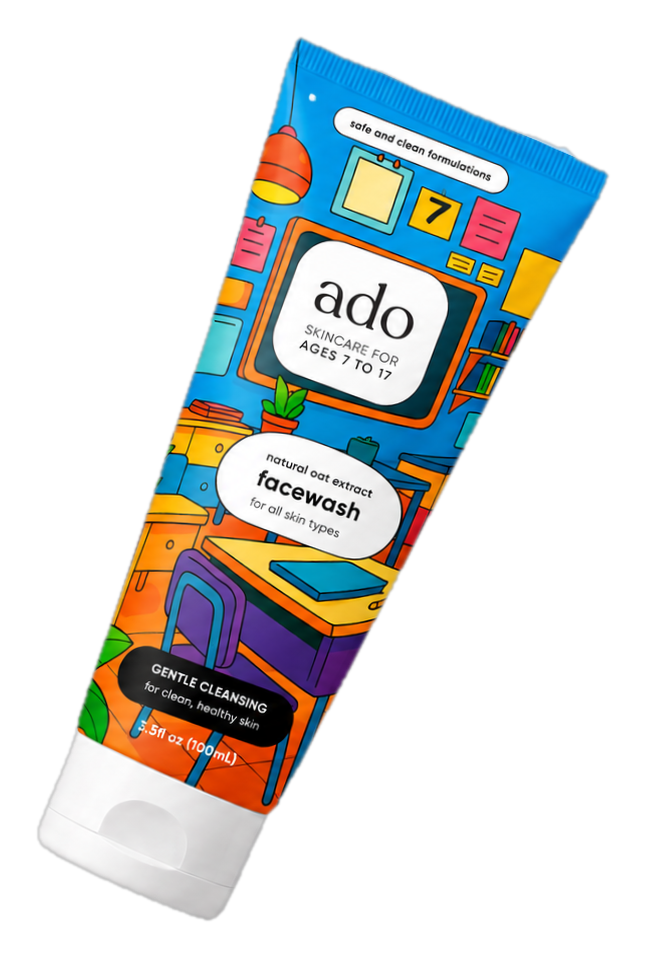
ado's Tween's Kit is this three-step routine, made for ages 7–17: a sulfate-free face wash with oat kernel extract, a lightweight, pH-balanced daily moisturiser and a broad-spectrum SPF 50+ sunscreen where zinc oxide is the only UV filter. There's oat in every step and no adult actives: no retinoids, no exfoliating acids and no vitamin C serums. The face wash and sunscreen are labelled non-comedogenic (the moisturiser's label doesn't say so), and the full ingredient list for each product is on its product page. ado's products contain fragrance (it's the last ingredient on each label); if your child's skin is sensitive, patch-test first or choose a fragrance-free option.
For more on this age, visit our hub on skincare for tweens (10–12). How we research and review these guides is explained in our editorial standards.
Made for growing skin


The complete routine
Tween's Kit
The complete ado routine in one box: cleanse, moisturise, protect.
- Cleanse Facewash
- Hydrate Moisturiser
- Protect Sunscreen
Price
₹2,699Regular price
₹3,297
Save ₹598
Sources
- A dermatologist's guide to skincare from growing up to glowing up (28 Oct 2025) · American Academy of Dermatology
- Trendy Skin Care for Tweens & Teens: Is It Safe? (2025) · American Academy of Pediatrics / HealthyChildren.org
- Food and Adolescent Acne · American Academy of Pediatrics / HealthyChildren.org
- Early or delayed puberty · NHS
- Pediatric Skin Care Regimens on TikTok (Pediatrics, 2025; PubMed record) · Pediatrics / American Academy of Pediatrics
- Practical Recommendations for Indians on Sunscreen Use: A Modified Delphi Consensus by Indian Sunscreen Forum (PRISM-ISF), J Cosmet Dermatol 2025 · Journal of Cosmetic Dermatology (PMC)
- The digital dermatosis: social media's unintended impact on pre-adolescent skincare (2026) · Indian Journal of Dermatology, Venereology and Leprology
- Is It OK for My Child to Use Skin Care Products? · KidsHealth (Nemours)
- Acne: Tips for managing · American Academy of Dermatology
- Are your hair care products causing breakouts? · American Academy of Dermatology
This guide is general information for parents, not medical advice. If you're worried about your child's skin, please see a dermatologist or paediatrician. How we write these guides.