RoutinesAges 7–9
Skincare Routine for a 9-Year-Old: First Oily Skin, Sweat and Sun
Nine is often when oil, sweat and the first bumps show up. The short routine that handles them, fitted around school and sport.
Quick answer
A 9-year-old usually needs three simple steps: a gentle face wash in the evening and after sweaty sport, a light moisturiser if skin feels dry, and a broad-spectrum sunscreen before school and outdoor games. Oilier skin, sweat and body odour can start around 9 and are normal. Skip toners, scrubs, serums and adult actives.
A 9-year-old needs a short, simple skincare routine: a gentle face wash in the evening and after sweaty sport, a light moisturiser if skin feels dry, and sunscreen before school and outdoor games. What's new at 9 is that oily skin, sweat and body odour often start to show up, and the routine grows a little to match.
This guide is for Indian parents of 8 to 10-year-olds. It covers what changes at 9, the daily routine, a first face wash, sweat and sport, and when to see a doctor. For the whole 7–9 age band, see our hub on skincare for kids aged 7–9.
What changes in a 9-year-old's skin?
For many children, 9 is when the nose and forehead start to get oily and sweat starts to smell. Both are normal early signs that the body is getting ready for puberty.
The American Academy of Pediatrics (AAP) says oil production can rise as early as two years before any other sign of puberty, and that boys and girls as young as 9 may have small bumps and bigger-looking pores, especially around the nose and the middle of the face. It adds that acne often runs in families.
Body odour usually comes from a hormone shift called adrenarche. Cleveland Clinic explains that from about 6 to 8, the adrenal glands start making more of a hormone called DHEA. Over the next couple of years this can bring body odour, oilier skin, a few pimples and underarm hair, often before other signs of puberty.
Timing varies a lot. KidsHealth (Nemours) says most girls start puberty between 8 and 13 and most boys between 9 and 14, so two 9-year-olds in the same class can be at very different stages. Signs you might notice at 9:
- a shiny nose and forehead by the time they're home from school
- tiny bumps or blackheads on and around the nose
- sweat that smells after games or a hot bus ride
- hair that looks oily a day or two after washing
What's a good daily skincare routine for a 9-year-old?
Three steps at most: wash, moisturise if needed, and protect. On a school day it takes about two minutes.
| When | Step | What to use | Why |
|---|---|---|---|
| Morning | Rinse | Lukewarm water; face wash only if the face already feels oily | Freshens skin without over-washing |
| Morning | Moisturise | A thin layer of light moisturiser, if skin feels dry | Many 9-year-olds can skip it on sticky monsoon days |
| Morning | Protect | Broad-spectrum sunscreen, SPF 30 or higher | Assembly, PT and the walk to the bus stop |
| After sport | Wash | Gentle face wash, fingertips, pat dry | Takes off sweat, dust and sunscreen |
| Evening | Wash, then moisturise if dry | Same face wash and moisturiser | Ends the day clean; skin rests overnight |
How to make it stick:
- Keep the face wash, moisturizer (or moisturiser) and sunscreen at your child's height, next to the toothbrush, so the habits join up.
- Wash with lukewarm water and fingertips, no scrubbing, then pat dry with their own towel, as the American Academy of Dermatology (AAD) advises.
- Don't wash more than twice a day plus after sweating; the AAD's advice is to limit washing to that.
- Add one new product at a time, as the AAD's 2025 skincare guide suggests.
- If anything stings or burns, stop. The AAP's dermatologists call that a red flag, not a sign it's working.
Is 9 the right age for a first face wash?
Often, yes. If your 9-year-old's face is oily by the afternoon, sweaty after games or covered in sunscreen every day, a gentle face wash (or "facewash") does a better job than water alone.
Look for a gentle, non-abrasive cleanser without alcohol, as the AAD suggests. The AAP's 2025 advice on trendy skin care for tweens and teens lists sulfates, alcohols, fragrances and physical scrubs among cleanser ingredients to avoid, and suggests a gentle, pH-balanced cleanser.
Start with once a day, in the evening. The AAD's 2025 guide notes that for dry or sensitive skin, washing once a day in the evening may be enough. If the nose and forehead are shiny by lunchtime, add a morning wash too.
Our guide to face wash for kids compares soap bars and face washes, and shows how to teach a good wash.
How do you handle sweat, body odour and sport at 9?
Mostly with water, fresh clothes and a few habits rather than new products. A bath after sport, clean cotton clothes and a quick face wash solve most sweat problems at this age.
- A daily bath: KidsHealth says bathing every day, especially after a lot of sweating or in hot weather, helps with body odour, as do clean clothes, underwear and socks each day.
- Deodorant, if wanted: KidsHealth says deodorants and antiperspirants are safe for kids, and suggests a stick, roll-on or cream rather than a spray for younger children. Our guide to body odour at 9 or 10 explains when to start.
- Blot, don't wipe: the AAD suggests blotting sweat with a clean towel or cloth, because wiping can irritate skin and lead to breakouts. A clean handkerchief in the pocket works well.
- Heat rash: the AAD suggests light, loose cotton clothes and exercising in the coolest part of the day where possible.
- Hair oil: the AAD says oil from the hair can cause acne on the forehead, and suggests keeping oily hair away from the face. If your family oils hair, try doing it before a hair wash rather than leaving it in for days.
- Swimming class: the AAD suggests showering with fresh, clean water straight after the pool, then moisturising.
- Caps and headbands: wash them often, since they sit against a sweaty forehead.
How do you build a sunscreen habit at 9?
Make it your child's job, with you checking the ears and neck. Nine is a good age to hand sunscreen over.
For children over six months, the Indian Sunscreen Forum's 2025 consensus recommends a broad-spectrum sunscreen of at least SPF 15, prefers mineral filters such as zinc oxide or titanium dioxide for children, and advises reapplying every two hours outdoors, or more often with sweating or swimming. The AAD suggests SPF 30 or higher for tweens. SPF (sun protection factor) measures protection from UVB, the rays that burn; broad-spectrum means UVA, which tans, is covered too.
Use enough. The same consensus notes that most people apply far less sunscreen than the amount used in testing, which "greatly reduces effectiveness". And every skin tone needs it: KidsHealth points out that darker skin can still burn, and that a tan is itself a sign of sun damage.
A small tube in the school bag, used before afternoon games, turns sunscreen from a morning chore into a habit your child owns. Our guides to sunscreen for a 9-year-old and sunscreen for kids in India cover how much to use, how to teach it and what to look for on the label.
What doesn't a 9-year-old need?
Toners, scrubs, serums and anything made for adult skin. The AAD says retinol, vitamin C and exfoliating acids target concerns children don't have, and can cause redness, burning or peeling.
- Toners and astringents: the AAD advises avoiding astringents, toners and exfoliants on acne-prone skin, because they can irritate.
- Scrubs and grainy washes: the AAD says scrubbing irritates skin, and it won't wash away oil or bumps.
- "Glow" serums and multi-step routines: a 2026 viewpoint in the Indian Journal of Dermatology, Venereology and Leprology describes "glass skin" as an unattainable goal that keeps people buying, and links beauty filters with unrealistic expectations about skin.
- De-tan packs, bleach and creams from the chemist: read why steroid creams don't belong on a child's face.
If your 9-year-old has started asking for products they've seen online, KidsHealth suggests explaining that some people who show routines are paid, so the video is really a kind of advert. Letting them choose their own face wash from a short list you're happy with often settles the request.
For your 9-year-old: Oily skin and sweaty days mean your body is growing up. Wash gently, don't squeeze spots, and put on sunscreen before you go out. That's the whole routine.
Do 9-year-old girls and boys need different skincare?
No. A 9-year-old girl and a 9-year-old boy need the same short routine: a gentle wash in the evening and after sweaty sport, a light moisturiser if their skin feels dry, and sunscreen before school and outdoor games.
What can differ is timing. KidsHealth says most girls start puberty between 8 and 13 and most boys between 9 and 14, so at 9, girls are more likely than boys to notice the first changes, such as oilier skin, sweatier underarms or a few small bumps. Both are normal, and the same routine covers them. If changes start very early, the doctor checklist below says when to get them looked at.
Keep the message the same for both: sweat and sun need a plan, and nobody needs a 10-step routine at 9.
When should you see a doctor?
Most 9-year-olds never need more than the basics. See your paediatrician or a dermatologist if you notice any of these:
See a doctor if:
- body odour, underarm hair or pubic hair started before 8 in a girl or 9 in a boy; Cleveland Clinic calls this premature adrenarche, which is worth a check
- other signs of puberty, such as breast buds, started before 7 in a girl, or signs started before 9 in a boy (KidsHealth); the NHS says signs before 8 could mean early puberty
- pimples are deep, painful or leaving dark marks or scars
- a product causes redness, burning or a rash that doesn't settle once you stop it
- skin worries are affecting your child's mood; the AAD suggests watching for sadness that lasts two weeks or more
- someone has suggested a medicated or "mixed" cream for your child's face
Read next: skincare routine for a 10-year-old · skincare for a 7 or 8-year-old · skincare by age, from 7 to 17
How ado fits in
ado is an Indian skincare brand made for kids, tweens and teens aged 7–17: a gentle oat face wash, a moisturiser and a zinc oxide SPF 50+ sunscreen. For a 9-year-old starting a daily wash, the sulfate-free ado Gentle Oat Face Wash, labelled non-comedogenic (made not to clog pores), suits the evening and after-sport wash, and ado's mineral SPF 50+ sunscreen (broad spectrum, with zinc oxide as the only UV filter) covers school days. ado's products contain fragrance (it's the last ingredient on each label). If your child has eczema, very sensitive skin or reacts to fragrance, patch-test first or choose fragrance-free.
Made for growing skin
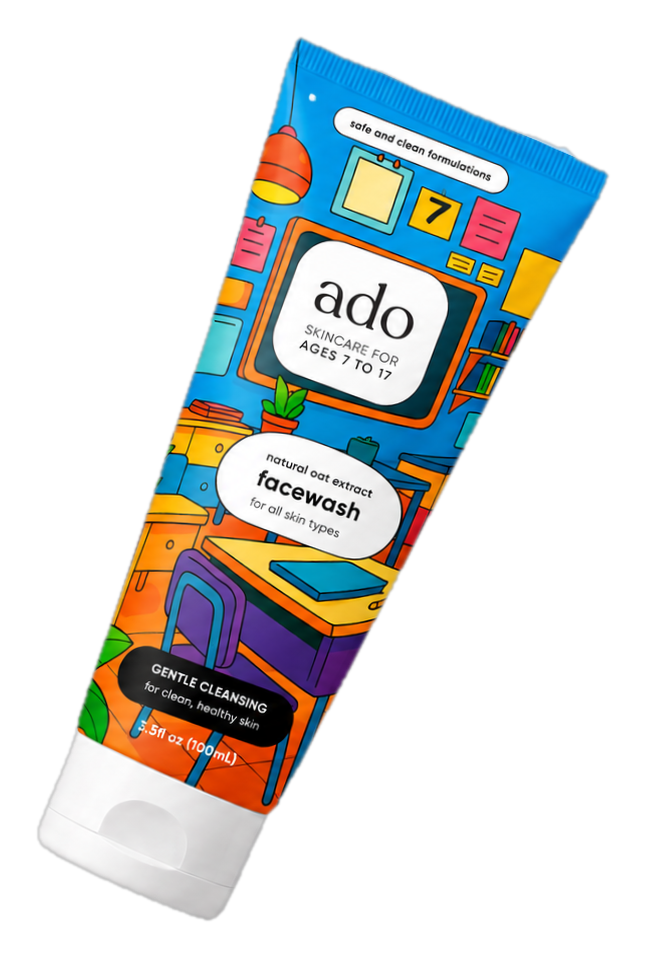
ado gentle oat face wash
Price ₹849

ado mineral sunscreen (SPF 50+)
Price ₹1,499
Sources
- Food and Adolescent Acne · American Academy of Pediatrics / HealthyChildren.org
- Adrenarche and premature adrenarche · Cleveland Clinic
- Understanding Puberty (reviewed May 2022) · KidsHealth (Nemours)
- Face washing 101 · American Academy of Dermatology
- A dermatologist's guide to skincare from growing up to glowing up (28 Oct 2025) · American Academy of Dermatology
- Trendy Skin Care for Tweens & Teens: Is It Safe? (updated 7 Aug 2025) · American Academy of Pediatrics / HealthyChildren.org
- Deodorant Use for Kids and Teens (reviewed June 2022) · KidsHealth (Nemours)
- 12 summer skin problems you can prevent · American Academy of Dermatology
- Acne: Tips for managing · American Academy of Dermatology
- Practical Recommendations for Indians on Sunscreen Use: A Modified Delphi Consensus by Indian Sunscreen Forum (PRISM-ISF), J Cosmet Dermatol 2025 · Journal of Cosmetic Dermatology (PMC)
- How to Choose & Use Sunscreen (reviewed July 2021) · KidsHealth (Nemours)
- The digital dermatosis: social media's unintended impact on pre-adolescent skincare (viewpoint, 23 Feb 2026) · Indian Journal of Dermatology, Venereology and Leprology
- Is It OK for My Child to Use Skin Care Products? (reviewed April 2024) · KidsHealth (Nemours)
- Early or delayed puberty · NHS
- 5 ways to help your teenager survive acne · American Academy of Dermatology
This guide is general information for parents, not medical advice. If you're worried about your child's skin, please see a dermatologist or paediatrician. How we write these guides.