RoutinesAges 7–9
Skincare for a 7 or 8-Year-Old: The Simple Routine (and What to Skip)
Most 7 and 8-year-olds need far less than the videos suggest: the short routine, what to skip, and how to handle eczema and sun.
Quick answer
Most 7 and 8-year-olds need very little skincare: a gentle wash when their face is sweaty or dusty, a plain moisturiser if their skin feels dry, and a broad-spectrum sunscreen before assembly, outdoor play or sport. Skip adult serums, acids, retinol and trend routines seen online. If your child has eczema, keep products few and plain.
Most 7 and 8-year-olds need very little skincare. A gentle wash when their face is sweaty or dusty, a moisturiser if their skin feels dry, and sunscreen before time outdoors is the whole routine, and on many days it's just the sunscreen.
This guide is for Indian parents of 7 and 8-year-olds, especially if your child has started asking for "skincare" after watching videos, or has dry, eczema-prone skin. It's the day-to-day plan for this exact age; for the wider picture, see our hub on skincare for kids aged 7–9.
Does a 7-year-old really need a skincare routine?
Not in the social-media sense. A 7 or 8-year-old needs a few habits, not a regimen: sun protection, washing off a sweaty day, and moisture when skin is dry.
KidsHealth (Nemours) says most kids and teens need just three skin care products: a mild soap, a fragrance-free moisturiser and sunscreen. It adds that most children don't have the problems adult products are made to solve, such as wrinkles, dark spots and sagging.
The American Academy of Dermatology (AAD) explains why less is better. Its October 2025 guide says children's skin is "thinner, more sensitive, and more prone to irritation than adult skin", and that retinol, vitamin C and exfoliating acids target concerns children don't have and can cause redness, burning or peeling.
A 2026 viewpoint in the Indian Journal of Dermatology, Venereology and Leprology (IJDVL) adds that younger skin is more delicate and permeable, so harsh ingredients are more likely to cause a reaction. The basic routine it describes is short: a gentle cleanser, a moisturiser and daily SPF 30+.
So the honest answer to "does my 7 year old need skincare?" is: not products the way adults use them. What helps is two or three easy habits your child can keep for years.
What does a 7 or 8-year-old's routine look like, day by day?
It depends on the day more than the clock. An ordinary school day needs sunscreen and an evening wash; a swimming day or a dry winter day needs a little more.
| Type of day | Morning | After school or evening | Good to know |
|---|---|---|---|
| Ordinary school day | Splash of water; sunscreen on face, ears and neck before the bus | Gentle face wash once, in the evening | The AAD says washing once a day in the evening may be enough for dry or sensitive skin |
| Sports day or outdoor games | Sunscreen at home; cap in the school bag | Wash off sweat and sunscreen; moisturiser if skin feels tight | Top up sunscreen about every 2 hours outdoors, and after sweating |
| Swimming class | Sunscreen before the pool | Rinse with fresh water, then moisturise | Reapply after towel drying if they're going back into the sun |
| Dry North Indian winter day or AC classroom | Moisturiser, then sunscreen | Moisturiser on slightly damp skin after the bath | Cheeks and the skin around the mouth usually dry out first |
| Holiday at home, mostly indoors | Nothing needed | A wash if they got sweaty | Sunscreen before they go out to play |
A 2-minute checklist for your 7 or 8-year-old:
- Sunscreen goes on at home, before school shoes: dots on the forehead, cheeks, nose and chin, blended outwards, then the ears and the back of the neck.
- Cap and water bottle in the bag on games days.
- After school or sport: lukewarm water, a small amount of gentle face wash, fingertips only, then pat dry. The AAD advises against scrubbing because it irritates skin.
- Moisturiser (or "moisturizer", as US sites spell it) only if skin feels dry, tight or itchy.
- One new product at a time, as the AAD suggests. If anything stings, stop using it.
At 7, you'll do most of this together. By 8, many children can put on their own sunscreen with a quick check from you. Our guide to sunscreen for a 9-year-old (and 7 to 8-year-olds) covers how much to use and how to teach it, and face wash for kids explains when a daily wash makes sense.
What should a 7 or 8-year-old skip?
Almost everything in an adult's bathroom cabinet, and any routine that copies a grown-up's. At this age, "skincare" often arrives through a screen.
A July 2025 study in the journal Pediatrics describes online videos of girls as young as 7 demonstrating multistep skincare routines. The researchers analysed 100 TikTok routines by creators aged 7 to 18: they averaged 6 products, only 26.2% included sunscreen, and the authors concluded that such routines offer little to no benefit for the children they target.
Skip for now:
- Adult actives: retinol, exfoliating acids (such as glycolic or salicylic acid), vitamin C serums and anything sold as anti-ageing. Our list of skincare ingredients tweens should avoid applies even more at 7.
- Toners, scrubs, peel-off masks and serums: there's nothing for them to do on a 7-year-old's face.
- Grown-ups' products "just to try": KidsHealth notes that adult skin care products can cause acne, burns and rashes on young skin.
- Trend products: tinted "glow" creams, primers, highlighters and anything bought to copy a routine seen online.
- De-tan packs, bleach and skin-lightening creams: a tan fades on its own, and every skin tone is healthy skin. Our guide to tan after the summer holidays explains gentle care.
- Any cream from the chemist on the face without a doctor's advice. Read why dermatologists warn against steroid creams on a child's face.
If your child is keen, give the interest a healthy outlet. Put them in charge of their own sunscreen, let them choose between two gentle face washes you're happy with, or keep a sticker chart for "sunscreen before school". KidsHealth also suggests explaining that some people who show routines online are paid, so the video is really a kind of advert.
How do you protect a 7 or 8-year-old from the sun at school and sport?
Sunscreen at home before school, a cap for outdoor games, and a top-up when they're outside for long. Seven and eight are outdoor years: assembly, PT, recess, cricket nets, football coaching and the walk to the bus stop.
- What to use: for children over six months, the Indian Sunscreen Forum's 2025 consensus recommends a broad-spectrum sunscreen of at least SPF 15 and prefers mineral filters (zinc oxide or titanium dioxide) for children. KidsHealth suggests SPF 30 or higher for every child, whatever their skin tone, because darker skin can still burn. SPF (sun protection factor) measures protection from UVB, the burning rays; "broad-spectrum" means UVA, which tans, is covered too.
- When it matters most: the World Health Organization says UV peaks in the four hours around solar noon, and recommends sun protection once the UV index reaches 3. That's often lunch break, afternoon games and the ride home.
- How often: the Indian Sunscreen Forum advises reapplying every two hours outdoors, and more often with sweating or swimming. A small tube in the school bag makes that possible, if the school allows it.
- Beyond sunscreen: the American Academy of Pediatrics' HealthyChildren.org suggests a hat with a brim of about 3 inches (7.5 cm) all round, and sunglasses with at least 99% UV protection. The same consensus suggests avoiding direct sun between 10 am and 4 pm where you can.
Brown skin still tans, and the Indian Sunscreen Forum notes that pigmentation caused by visible light lasts longer in darker skin tones. The aim isn't a lighter shade; it's skin that doesn't burn and stays comfortable. For the full picture, see our parent's guide to sunscreen for kids in India.
What if your 7 or 8-year-old has eczema or very dry skin?
Use fewer, plainer products, keep baths short and warm rather than hot, and moisturise often. Eczema-prone skin does best with less.
The NHS says atopic eczema is most common in young children, and lists soap, washing detergent, heat and changes in temperature among the things that can make it worse. Its self-care advice is to use moisturising treatments (emollients) at least twice a day and to wash with an emollient instead of soap.
- Bath time: KidsHealth suggests short baths or showers in warm, not hot, water, then patting the skin dry before cream goes on.
- Moisturiser: KidsHealth suggests moisturising two or three times a day, and says ointments and creams work best because they contain a lot of oil. A light gel may not be enough during a flare.
- Clothes: soft, breathable cotton; KidsHealth notes that wool or polyester can irritate.
- Heat and sweat: the NHS notes that being hot can make eczema itchier. After sport, a quick rinse and a change into dry clothes helps.
- Sunscreen: for skin that reacts easily, the AAD suggests a sunscreen labelled for sensitive skin, without fragrance, parabens or oxybenzone.
- New products: the AAD's 2025 guide suggests trying a small amount of anything new on a patch of skin before using it on the whole face.
If a doctor has prescribed a cream for your child's eczema, use it exactly as advised. The thing to avoid is a medicated cream picked up on someone else's suggestion.
Do 7 and 8-year-old girls and boys need different skincare?
No. Girls and boys this age need the same short routine, and the same sunscreen habit for cricket, football, skating or dance class.
What can differ is timing. KidsHealth says most girls start puberty between 8 and 13 and most boys between 9 and 14, so some 8-year-old girls notice early changes such as breast buds or body odour. For body odour at this age, a daily bath and fresh clothes usually handle it; our guide to body odour and a first deodorant covers the rest.
Keep the message the same for both: every child needs sun protection, and no child needs a 10-step routine.
For your child to read: Your skin already does a great job. Wash off the sweat, keep it comfy, and put on sunscreen before you play outside. That's all it needs.
When should you see a doctor?
Most 7 and 8-year-olds never need more than the basics. See your paediatrician or a dermatologist if you notice any of these:
See a doctor if:
- eczema patches turn red and warm, form pus-filled bumps or blisters, or come with a fever: see a doctor the same day, as KidsHealth and the NHS describe these as possible signs of infection
- dry, itchy patches keep coming back, or the treatment you've been given isn't working (the NHS advises seeing a GP)
- a product causes redness, a rash or swelling that doesn't settle once you stop it
- your daughter shows signs of puberty before 7, or your son before 9 (KidsHealth); the NHS says signs before 8 could mean early puberty
- body odour starts before about 7 or 8 in a girl, or before 9 in a boy (KidsHealth)
- anyone suggests a medicated or "mixed" cream for your child's face
How ado fits in
ado is an Indian skincare brand made for ages 7–17, with no retinoids, exfoliating acids or vitamin C serums in the range. For a 7 or 8-year-old, ado's mineral SPF 50+ sunscreen (broad spectrum, with zinc oxide as the only UV filter) and the sulfate-free gentle oat face wash cover most days, with the lightweight daily moisturiser for dry spells. ado's products contain fragrance (it's the last ingredient on each label). If your child has eczema, very sensitive skin or reacts to fragrance, patch-test first or choose fragrance-free.
Made for growing skin

ado mineral sunscreen (SPF 50+)
Price ₹1,499
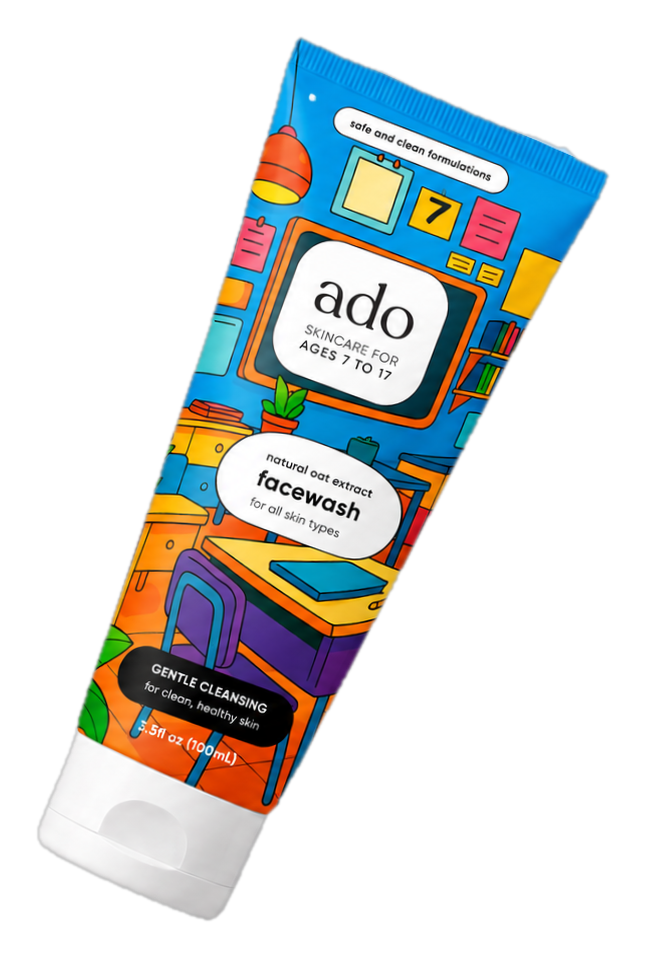
ado gentle oat face wash
Price ₹849

ado daily moisturizer
Price ₹949
Sources
- Is It OK for My Child to Use Skin Care Products? (reviewed April 2024) · KidsHealth (Nemours)
- A dermatologist's guide to skincare from growing up to glowing up (28 Oct 2025) · American Academy of Dermatology
- The digital dermatosis: social media's unintended impact on pre-adolescent skincare (viewpoint, 23 Feb 2026) · Indian Journal of Dermatology, Venereology and Leprology
- Pediatric Skin Care Regimens on TikTok (Pediatrics, July 2025; PubMed record) · Pediatrics / American Academy of Pediatrics
- Face washing 101 · American Academy of Dermatology
- Practical Recommendations for Indians on Sunscreen Use: A Modified Delphi Consensus by Indian Sunscreen Forum (PRISM-ISF), J Cosmet Dermatol 2025 · Journal of Cosmetic Dermatology (PMC)
- How to Choose & Use Sunscreen (reviewed July 2021) · KidsHealth (Nemours)
- Radiation: The ultraviolet (UV) index · World Health Organization
- Sun Safety: Information for Parents About Sunburn & Sunscreen (updated 9 Aug 2024) · American Academy of Pediatrics / HealthyChildren.org
- Trendy Skin Care for Tweens & Teens: Is It Safe? (updated 7 Aug 2025) · American Academy of Pediatrics / HealthyChildren.org
- Atopic eczema · NHS
- Eczema (Atopic Dermatitis) (reviewed May 2023) · KidsHealth (Nemours)
- How do I know if I'm using the right sunscreen? · American Academy of Dermatology
- Understanding Puberty (reviewed May 2022) · KidsHealth (Nemours)
- Early or delayed puberty · NHS
- Deodorant Use for Kids and Teens (reviewed June 2022) · KidsHealth (Nemours)
- I have acne! Is it okay to wear makeup? · American Academy of Dermatology
This guide is general information for parents, not medical advice. If you're worried about your child's skin, please see a dermatologist or paediatrician. How we write these guides.