RoutinesAges 10–12
Skincare Gift for a Tween (10–12): A Parent's Guide for Diwali and Birthdays
Three gentle basics, a patch test and a shelf of their own: how to give a first skincare set that's good for a 10–12-year-old.

Quick answer
A good first skincare gift for a 10–12-year-old is three gentle basics: a mild face wash, a light moisturiser and a broad-spectrum sunscreen. Skip sets with retinol, exfoliating acids, vitamin C serums, heavy fragrance or makeup. Check the age on each label, patch-test each product, and present it as their own routine rather than a fix.
The best skincare gift for a 10, 11 or 12-year-old is a small set of three gentle basics: a mild face wash, a light moisturiser and a broad-spectrum sunscreen. Add a sun-safety extra, such as a hat or sunglasses, and the message that this is their own routine to run. Leave out sets with retinol, exfoliating acids, vitamin C serums, heavy fragrance or makeup.
This guide is for parents, grandparents, aunts and uncles choosing a first skincare gift for a tween, whether it's for a birthday, Diwali (8 November 2026) or Children's Day (14 November). It covers what to put in, what to leave out, how to check a set before you buy it, and how to give it so it builds confidence rather than worry.
What makes a good first skincare gift for a 10–12-year-old?
A good first skincare gift matches what dermatologists recommend at this age: a gentle cleanser, a moisturiser and a sunscreen, all made for young skin. In an October 2025 guide written for parents facing holiday wish lists, the American Academy of Dermatology (AAD) quotes dermatologist Dr Marisa Garshick: "The number one thing I recommend to parents is that it's important to choose age-appropriate products." Her advice is to "stick with gentle cleansers, lightweight moisturizers, and broad-spectrum sunscreen."
KidsHealth (Nemours) agrees that "most kids and teens need just three skin care products", and a 2026 viewpoint in the Indian Journal of Dermatology, Venereology and Leprology (IJDVL) names the same trio for pre-teens. So a three-product set isn't a budget option. It's the right amount.
A first-skincare gift checklist:
- Three products: a face wash, a moisturiser and a sunscreen. Nothing else is needed at this age.
- Made for their age: the pack or product page states an age range that includes your child.
- A gentle, sulfate-free face wash without scrubbing beads. The American Academy of Pediatrics (AAP) lists sulfates such as sodium lauryl sulfate (SLS) and physical scrubs among cleanser ingredients to avoid.
- A light moisturiser: the AAP suggests gel-based for oily or acne-prone skin and light creams for dry skin.
- A broad-spectrum sunscreen, SPF 30 or higher. The AAP suggests a mineral one, with zinc oxide or titanium dioxide, and India's sunscreen consensus, PRISM-ISF (2025), also prefers inorganic filters like these for children.
- No adult actives: no retinol, exfoliating acids or vitamin C.
- A full ingredient list you can read before you buy.
- Fragrance-free if your child has eczema, very sensitive skin or reacts to fragrance.
For how the three steps fit into a school day, see our skincare routine for an 11-year-old and skincare routine for a 12-year-old.
What should you avoid in skincare gift sets for tweens?
Avoid sets built around adult actives, lots of steps, heavy fragrance or makeup trends. The AAD says retinol, vitamin C and exfoliating acids "target concerns like wrinkles, sun damage, and uneven skin tone, issues that children don't have", and that they "can cause redness, burning, or peeling, and provide no benefit to such young skin."
- Serum and "glow" sets. The AAP lists serums with active ingredients (unless prescribed), expensive anti-ageing creams and heavy oils among products tweens should skip.
- Heavily fragranced sets. The IJDVL names fragrances among common allergens in products promoted to young users. The AAP adds that nearly 76% of the 25 most-viewed TikTok skincare videos in a recent study promoted products with known allergens such as artificial fragrance.
- Makeup-trend kits. Glitter palettes, tinted balms and lip-and-cheek kits aren't skincare. If makeup is part of the gift, pass on two AAD rules: never sleep in it ("even non-comedogenic makeup can cause acne if you sleep in it"), and don't share it with friends.
- Spray sunscreens. The AAP advises avoiding spray-on formulas because they give uneven coverage.
- Scrubs, peels and acid masks. Scrubbing irritates skin, and acids are among the actives young skin doesn't need.
- De-tan and skin-lightening sets. A tan fades by itself, and a child's skin colour isn't something to fix. Our guide to tan after the summer holidays explains gentle care.
- Long routines. A 2025 study in Pediatrics of 100 TikTok skincare videos by creators aged 7 to 18 found that routines averaged 6 products costing about US$168, and only 26.2% of videos included sunscreen. The authors concluded these routines "offer little to no benefit" for the children they target.
Look past the packaging too. The IJDVL notes that brands marketing to children use "visually appealing packaging, cartoon logos, and terms like 'age-appropriate,' 'clean' and 'glow'". The ingredient list tells you more than any of those words. Our guide to skincare ingredients tweens should avoid has the full list of actives to look out for.
How do you check a skincare set before you gift it?
Read three things on every product: the age range, the full ingredient list and the directions. Then plan a patch test before anything goes on your child's face.
| Check | What you want to see |
|---|---|
| Age range | A stated age that includes your child |
| Face wash | Sulfate-free; no beads or scrub particles; no glycolic or salicylic acid |
| Moisturiser | A light gel or cream; no retinol, vitamin C or exfoliating acids |
| Sunscreen | Broad spectrum, SPF 30 or higher; zinc oxide or titanium dioxide if you prefer mineral; a lotion or cream rather than a spray |
| Fragrance | If fragrance or parfum is listed and your child has eczema or sensitive skin, patch-test first or choose fragrance-free |
| Ingredient list | The full list printed on the pack or the product page, not just "key ingredients" |
The AAD's patch test is simple. Put a little of the product on a quarter-sized spot "where the product won't be rubbed or washed away, such as the underside of your arm or the bend of your elbow", and apply it there "twice daily for seven to 10 days". If a reaction develops, wash it off and don't use it again.
Then start one product at a time. The AAD's 2025 guide advises introducing one new product at a time so you can tell whether the skin tolerates it. You can patch-test all three at once on separate small spots. Then start the sunscreen first, since daily sun protection matters most, and add the face wash and moisturiser a week apart. For more ways to judge a brand, see our guide to choosing a trusted kids' skincare brand in India.
What non-skincare gifts help with sun safety?
A good hat, UV-protective sunglasses and a water bottle make useful sun-safety gifts to go with a skincare set. The AAP advises sunglasses "with at least 99% UV protection" and "a hat with an all-around 3-inch brim to shield the face, ears, and back of the neck". It also suggests limiting sun exposure between 10 a.m. and 4 p.m., when UV rays are strongest.
Gift ideas that go with a skincare set, no brand needed:
- Sunglasses labelled with at least 99% UV protection, in a style they'll actually wear to the bus stop.
- A wide-brimmed hat for sports day, school trips and weekend cricket or football.
- A refillable water bottle for school and practice.
- A small pouch for the school bag, so sunscreen goes with them. The AAP advises reapplying every 2 hours and after swimming, sweating or drying off with a towel.
- A soft face towel and a headband of their own. The AAD's face-washing steps end with patting dry with a soft towel.
More on sun care at this age in our guide to sunscreen for a 10–12-year-old.
How do you give a skincare gift without sending the wrong message?
Present it as independence, not as a fix. A first skincare set says "you're old enough to look after your own skin", which is very different from "here's something for your pimples". The AAP's advice to parents is to "encourage your child to feel confident in their skin—without the filters, fads or 10-step routines."
- Write the card with care. "For your own morning and night routine" works. Avoid anything about tan, dark skin, pimples or "glowing up".
- Give it a home. A shelf or small basket in the bathroom that's theirs makes the routine feel like their own.
- Do the first wash together, then step back. Show the order once (wash, moisturise, sunscreen in the morning), and let them run it.
- Offer choices within the basics. Letting them pick between two good face washes, or a gel or a cream, keeps it fun without adding actives.
- Talk about the feed. KidsHealth suggests explaining that some creators are paid, "so the video is really a kind of ad", and working out together what products cost and what else that money could go toward.
- Praise habits, not looks. "You remembered sunscreen before cricket" lands better than any comment about their face.
It's normal for tweens to be curious about skincare, the AAD says, and a gift is a good moment to guide that curiosity. Our hub on skincare for tweens (10–12) covers the bigger picture, and skincare by age, from 7 to 17 shows what changes year by year.
When should a tween see a doctor before starting skincare?
Check with a paediatrician or dermatologist first if your child already has a skin condition, and at any point if a new product causes a reaction that doesn't settle.
See a doctor if:
- your child has eczema or very reactive skin and you're not sure which products are safe to start
- a patch test causes a severe reaction; the AAD says a reaction not relieved with cool compresses or petroleum jelly may need a dermatologist
- redness, itching, burning or a rash appears on the face after a new product and doesn't settle once you stop it
- pimples are leaving dark marks or scars, or haven't improved after a few months of gentle care (AAD)
- someone suggests a steroid or "mixed" cream for pimples, marks or tan; read why steroid creams don't belong on a child's face
How ado fits in
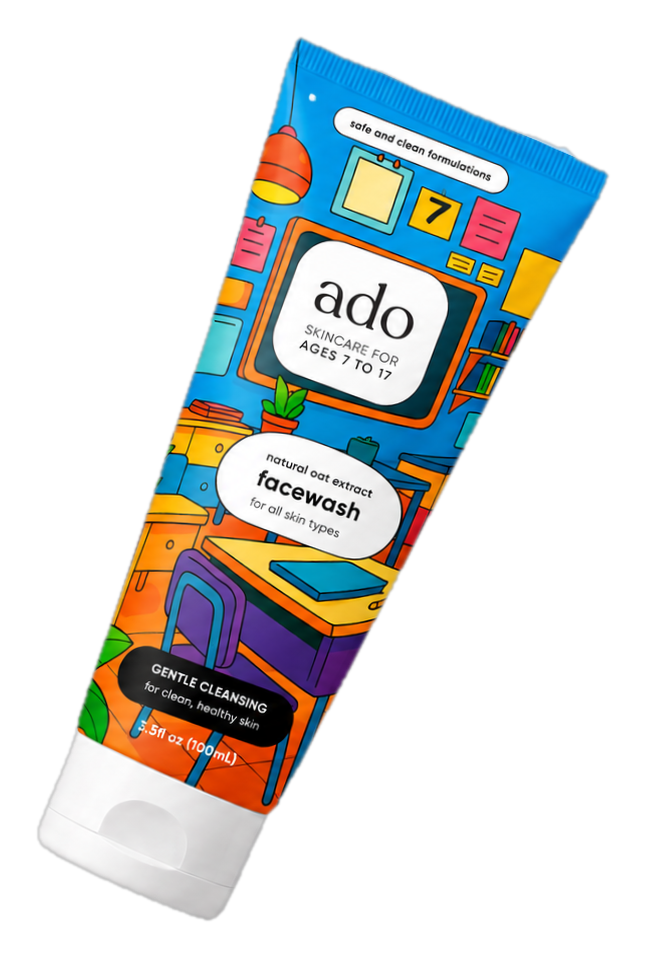
ado is an Indian skincare brand made for ages 7–17, and its Tween's Kit is a ready-made first skincare set: the gentle oat face wash, the daily moisturiser and a mineral SPF 50+ sunscreen with zinc oxide, in three 100 mL tubes for ₹2,699, which is ₹598 less than buying them separately (₹3,297). There's oat in every step and no retinoids, exfoliating acids or vitamin C serums in the range. ado's products contain fragrance (it's the last ingredient on each label); if your child has eczema, very sensitive skin or reacts to fragrance, patch-test first or choose fragrance-free. Every ingredient is listed on the product pages and explained on our ingredients page.
Made for growing skin


The complete routine
Tween's Kit
The complete ado routine in one box: cleanse, moisturise, protect.
- Cleanse Facewash
- Hydrate Moisturiser
- Protect Sunscreen
Price
₹2,699Regular price
₹3,297
Save ₹598
Sources
- A dermatologist's guide to skincare from growing up to glowing up (28 Oct 2025) · American Academy of Dermatology
- Is It OK for My Child to Use Skin Care Products? (reviewed April 2024) · Nemours KidsHealth
- Trendy Skin Care for Tweens & Teens: Is It Safe? (updated 7 Aug 2025) · American Academy of Pediatrics / HealthyChildren.org
- The digital dermatosis: social media's unintended impact on pre-adolescent skincare (viewpoint, 23 Feb 2026) · Indian Journal of Dermatology, Venereology and Leprology
- Pediatric Skin Care Regimens on TikTok (Hales et al., Pediatrics, July 2025; PubMed record) · Pediatrics / American Academy of Pediatrics
- Practical Recommendations for Indians on Sunscreen Use: A Modified Delphi Consensus by Indian Sunscreen Forum (PRISM-ISF), J Cosmet Dermatol 2025 · Journal of Cosmetic Dermatology (PMC)
- How to test skin care products · American Academy of Dermatology
- 10 skin care habits that can worsen acne · American Academy of Dermatology
- Face washing 101 · American Academy of Dermatology
- Sun Safety: Information for Parents About Sunburn & Sunscreen (updated 9 Aug 2024) · American Academy of Pediatrics / HealthyChildren.org
This guide is general information for parents, not medical advice. If you're worried about your child's skin, please see a dermatologist or paediatrician. How we write these guides.