Free tool
Kids' Skincare Ingredient Checker: Is This OK for My 7–17 Year Old?
Paste the list from any face wash, serum or cream. We flag what a growing child doesn't need, in plain words, with sources.
Quick answer
Paste a product's ingredient list into the checker below. It flags medicines such as steroid creams, adult actives such as retinol, exfoliating acids and vitamin C, and common irritants such as fragrance and drying alcohol, for ages 7–17. Each flag explains why and links a medical source. It's educational, not a diagnosis.
Check an ingredient list
Copy the ingredient list from the back of the pack or the product’s page and paste it below. We flag medicines, adult actives and common irritants, and explain each one.
Educational, not medical advice. A flag isn’t a diagnosis: many of these ingredients are right for someone, sometimes on a doctor’s advice. If your child’s skin is red, peeling, blistering or not settling, see a dermatologist or your paediatrician.
Paste any product's ingredient list into the checker above and it sorts what it finds into four groups: medicines to use only on a doctor's advice, adult actives a child doesn't need, things worth knowing, and gentle basics. Each flag says why, in plain words, and links the medical source behind it.
It's built for Indian parents of 7 to 17-year-olds, especially when a child asks for a serum from a skincare video or a relative hands over a cream "for pimples". The rules follow our guide to the skincare ingredients tweens should avoid.
How does the ingredient checker work?
It reads the list you paste, splits it into single ingredients and matches each one against a list of label names. Product labels use a standard naming system called INCI, so retinol is written "Retinol" and vitamin C often appears as "Ascorbic Acid" or "Sodium Ascorbyl Phosphate". The checker knows the common spellings.
Everything happens in your browser. Nothing you paste is sent to ado or anyone else.
- Your child's age changes some notes. Salicylic acid or benzoyl peroxide makes more sense for a 15-year-old with acne, chosen with a dermatologist, than for a 9-year-old.
- Position matters. Ingredients are listed from most to least. An acid near the end of a long list is often a small pH adjuster, and the checker says so.
- Drying alcohol is only flagged near the top. Fatty alcohols such as cetyl or cetearyl alcohol are gentle, so they are never flagged.
What do the four result groups mean?
| Group | Examples | What to do |
|---|---|---|
| Ask a doctor first | Steroids (clobetasol, betamethasone), prescription retinoids (tretinoin, adapalene), hydroquinone, antibiotic or antifungal creams, mercury | Use the medicines only as a doctor prescribes, for the stated time. Mercury should never be in any skin product. |
| Not needed at this age | Retinol, glycolic and lactic acid, salicylic acid, vitamin C, peptides, spot-fading actives, scrubs | Skip them for everyday care. For acne, a dermatologist may choose one. |
| Worth knowing | Fragrance, essential oils, niacinamide, benzoyl peroxide, drying alcohol, chemical UV filters | Usually fine. Take care with eczema or sensitive skin, and patch-test. |
| Gentle basics | Glycerin, ceramides, colloidal oatmeal, panthenol, zinc oxide | Nothing to worry about. |
The "doctor first" group matters most in India. Studies in the Indian Journal of Dermatology describe steroid-damaged faces after people used steroid and combination creams bought without a prescription. Read why dermatologists warn against steroid creams on a child's face. The World Health Organization says mercury-containing skin-lightening products are hazardous and banned in many countries.
The "not needed" group comes from the American Academy of Dermatology (AAD), which advises tweens and teens to skip retinol, vitamin C and exfoliating acids, and the American Academy of Pediatrics (AAP), which adds fragrance, alcohols, harsh sulfates and physical scrubs to its list for cleansers.
Where do you find a product's ingredient list?
On the back or side of the pack, usually after the word "Ingredients". Online, look for an "Ingredients" section on the product page or in the image gallery.
Tip: On a phone, take a photo of the label, then use your phone's "copy text from photo" feature and paste the text into the checker.
What can't the checker tell you?
It can't tell you how much of an ingredient a product contains, how your child's skin will react, or whether a product suits a skin condition. A flag isn't a diagnosis, and no flags doesn't guarantee a product is right.
See a doctor if your child's skin is red, peeling or burning and doesn't settle a few days after stopping a product, if there is swelling, blistering or oozing, or if you think a cream may contain a steroid.
Our guides go further: whether a 12-year-old can use niacinamide, and what a tween actually needs on the skincare for tweens (10–12) page.
How ado fits in
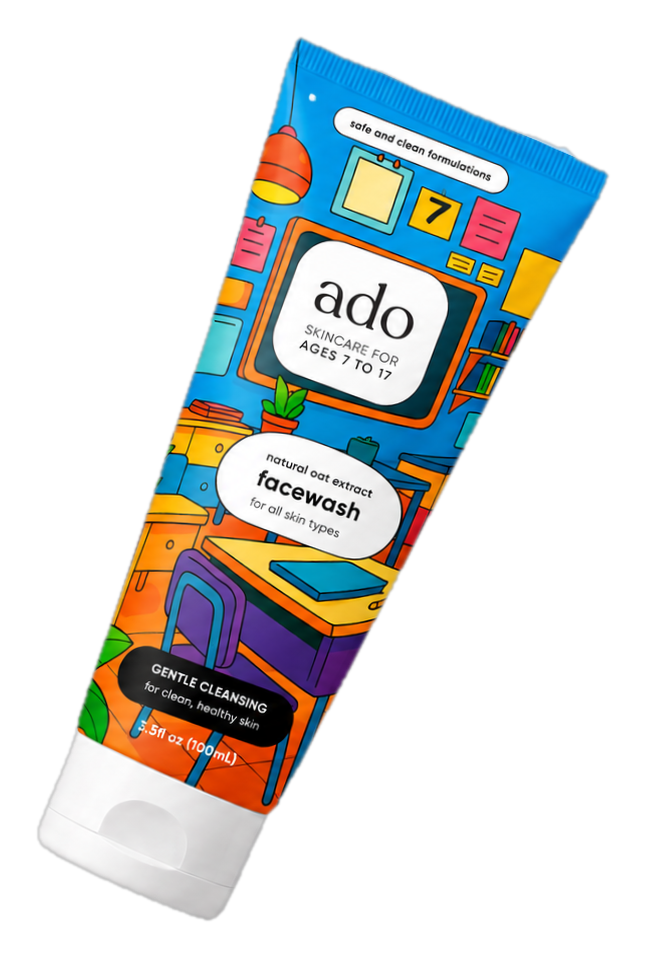
Try the checker on ado's own lists: every ingredient is on what's in ado. You'll see no adult actives, zinc oxide as the sunscreen's only UV filter, and one honest flag: all three products list fragrance, as the last ingredient. If your child has eczema or reacts to fragrance, patch-test first or choose fragrance-free. The Tween's Kit has the face wash, moisturiser and SPF 50+ sunscreen together.
Sources
- A dermatologist's guide to skincare from growing up to glowing up (28 Oct 2025) · American Academy of Dermatology
- Trendy Skin Care for Tweens & Teens: Is It Safe? (2025) · American Academy of Pediatrics / HealthyChildren.org
- Teen Acne: How to Treat & Prevent This Common Skin Condition · American Academy of Pediatrics / HealthyChildren.org
- Topical Steroid Damaged/Dependent Face (TSDF): An Entity of Cutaneous Pharmacodependence · Indian Journal of Dermatology (PMC)
- Mercury and health (fact sheet) · World Health Organization
- Fragrance allergy · DermNet
- The digital dermatosis: social media's unintended impact on pre-adolescent skincare · Indian Journal of Dermatology, Venereology and Leprology
- Practical Recommendations for Indians on Sunscreen Use: A Modified Delphi Consensus by Indian Sunscreen Forum (PRISM-ISF), J Cosmet Dermatol 2025 · Journal of Cosmetic Dermatology (PMC)